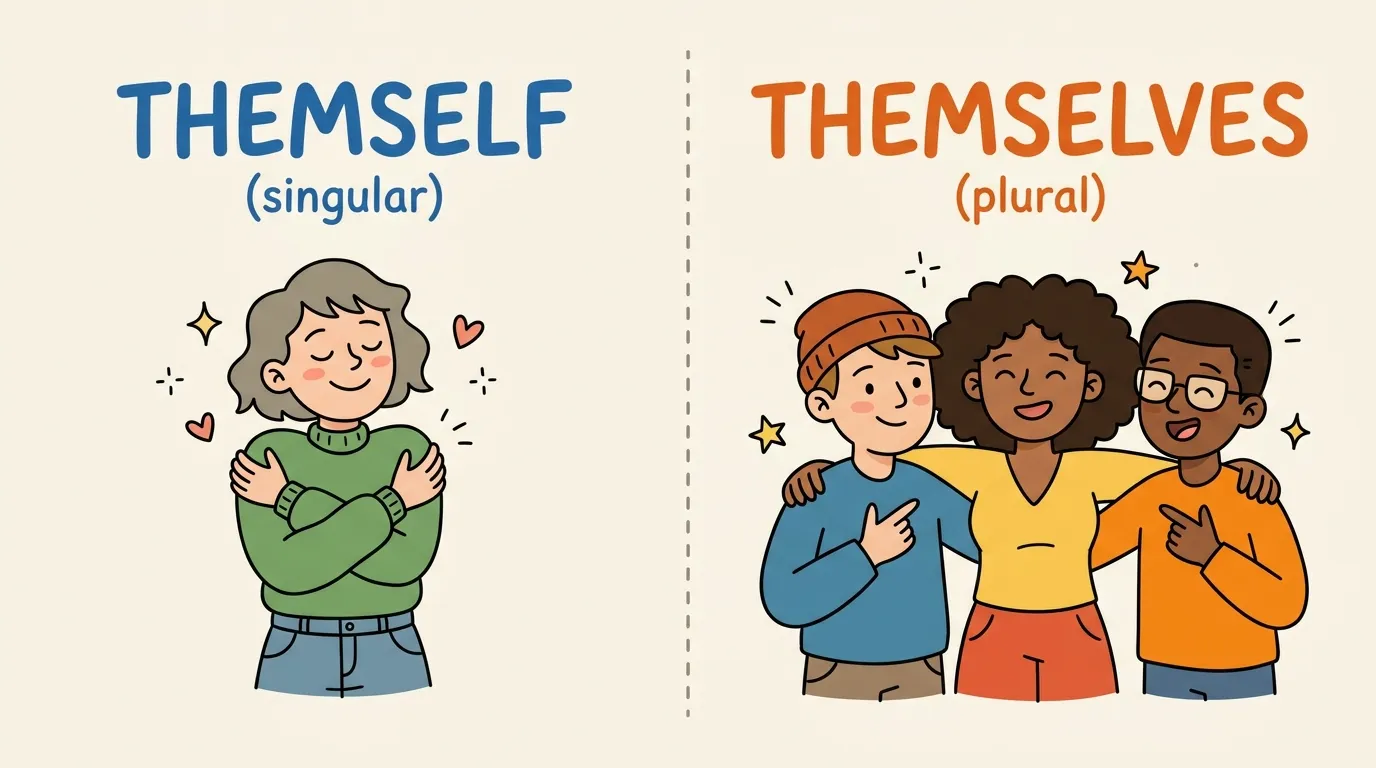
Themself or themselves? Both forms are used in English, but the best choice depends on whether you are referring to one person or multiple people and which writing style you follow.
Themselves is the traditional, widely used form for plural subjects.
Themself is a recognized form used with singular they, particularly when referring to one person whose gender is unknown or who uses they/them pronouns.
For example, you can write, “The students introduced themselves.” When referring to one person, you may write, “Alex introduced themself.”
You may also see “Alex introduced themselves,” because singular they can take themselves too.
The difference can be confusing because traditional grammar often links -self with singular pronouns and -selves with plural pronouns.
Modern English usage is more flexible. In this guide, you will learn how both forms work, which one is safer for formal writing, and how to choose the right pronoun for your sentence.
Table of Contents
- Themself or Themselves: Quick Answer
- What Does Themself Mean?
- What Does Themselves Mean?
- Themself vs Themselves: Key Differences
- When to Use Themself
- When to Use Themselves
- Can Themselves Refer to One Person?
- Common Mistakes to Avoid
- Easy Ways to Remember the Difference
- Frequently Asked Questions
- Conclusion and Key Takeaways
1. Themself or Themselves: Quick Answer
Use themselves when referring to multiple people. It is also widely used with singular they, especially in traditional or formal writing. Use themself when referring to one person with singular they, particularly when that person uses they/them pronouns or when you want to emphasize the singular meaning.
Both forms are used in modern English. If a style guide or teacher specifies a preference, follow it.
Quick Rule: Multiple people → themselves. One person using singular they → themself or themselves, depending on your style and context.
2. What Does Themself Mean?
Themself is a reflexive pronoun that refers back to a person described with singular they. A reflexive pronoun is used when the subject and object refer to the same person or thing.
For example:
- Jordan taught themself to play the guitar.
- Each student should ask themself whether the answer makes sense.
- The guest introduced themself to the host.
- Taylor wants to be themself at work.
In these examples, they refers to one person, not a group. The ending -self reflects that singular meaning.
The word is recognized in dictionaries, including Cambridge Dictionary and Oxford Advanced Learner’s Dictionary, although some dictionaries and traditional usage guides label it nonstandard or note that not everyone accepts it. Its use is particularly established in gender-inclusive writing. Cambridge Dictionary: Themself · Oxford Learner’s Dictionaries: Themself. <Cite refs={[“turn351275search3″,”turn351275search1”]}/>
Examples of themself
- Riley taught themself how to cook.
- The new employee introduced themself to the team.
- Every learner should give themself time to improve.
- Morgan wants to express themself honestly.
- The writer challenged themself to finish the project.
In each sentence, the word refers to one person.
3. What Does Themselves Mean?
Themselves is a reflexive pronoun traditionally used when referring back to two or more people. It can also be used with singular they, particularly when the subject is a general or unspecified person.
Examples:
- The children dressed themselves.
- The players congratulated themselves after the match.
- The workers organized the event themselves.
- Everyone should give themselves enough time to prepare.
- Sam said they would introduce themselves at the meeting.
The first three examples clearly refer to groups. The final two illustrate that themselves can also appear with singular they in modern English.
Examples of themselves
- The students prepared themselves for the exam.
- The guests helped themselves to refreshments.
- The children introduced themselves to the teacher.
- Each applicant should ask themselves whether they meet the requirements.
- Casey reminded themselves to take a break.
The exact choice between themself and themselves in a singular context can depend on the style guide, audience, and personal pronouns of the person being discussed.
4. Themself vs Themselves: Key Differences
| Feature | Themself | Themselves |
| Main use | Singular they | Plural they |
| Refers to one person | Yes | Yes, in established singular-they usage |
| Refers to multiple people | Generally not the preferred form | Yes |
| Traditional acceptance | Less widely accepted historically | Widely accepted |
| Inclusive writing | Useful for singular they | Also used with singular they |
| Example | Alex introduced themself. | The students introduced themselves. |
The main difference is the number of people being referred to and the preferred style. Themself makes the singular meaning explicit. Themselves is the familiar standard for plural subjects and is also common with singular they.
Neither form should be judged without looking at the sentence.
5. When to Use Themself
Use themself when they refers to one person and the singular form fits your intended meaning or style guide.
When the person’s gender is unknown
You can use singular they when you do not know someone’s gender or when gender is not relevant.
Example:
“Whoever wins should congratulate themself.”
Here, the sentence refers to one possible winner. Some editors may prefer themselves in this type of general statement, so check your style guide if consistency is important.
When referring to someone who uses they/them pronouns
If someone uses they/them pronouns, themself can be an appropriate reflexive form.
Example:
“Taylor prepared themself for the interview.”
This form clearly refers to Taylor as one person while respecting their pronouns.
When emphasizing the singular meaning
Themself can make it clear that the sentence refers to one person rather than a group.
Example:
“Each participant should ask themself what they learned.”
The phrase each participant refers to one person at a time, making themself a natural option for writers who prefer singular agreement in the reflexive pronoun.
Examples in context
- A good learner allows themself to make mistakes.
- The speaker introduced themself before beginning.
- Every person deserves time to be themself.
- Jamie reminded themself to check the details.
- A candidate should prepare themself for the interview.
Expert Tip: When writing about a specific person, respect the pronouns they use. If they use they/them pronouns, both themself and themselves may be appropriate; use the form that fits your publication’s style and the person’s preference where known.
6. When to Use Themselves
Use themselves when referring to more than one person. It is the standard choice in ordinary plural sentences and the familiar form in most formal writing.
When the subject is plural
Examples:
- The children taught themselves to swim.
- The employees introduced themselves.
- The athletes pushed themselves to improve.
- The neighbors organized themselves into teams.
- The writers gave themselves another week.
Each subject refers to multiple people, so themselves is the appropriate choice.
When referring to a general or unspecified person
Themselves is also widely used with singular words such as everyone, anyone, and someone when the writer uses singular they.
Examples:
- Everyone should prepare themselves for the meeting.
- Anyone can teach themselves a new skill.
- Someone left themselves a reminder.
- Each student should ask themselves whether the work is complete.
Some traditional grammar guides may prefer another construction, while many modern guides accept singular they and themselves. If you want to avoid disagreement over the reflexive form, you can rewrite the sentence using a plural subject.
For example:
Instead of “Every student should prepare themself,” write “All students should prepare themselves.”
7. Can Themselves Refer to One Person?
Yes. Although themselves is traditionally associated with plural subjects, modern English also uses it with singular they.
For example:
“Alex said they would introduce themselves.”
In this sentence, Alex is one person. The pronoun they is singular, but the sentence is grammatically accepted in modern English.
You may also write:
“Alex said they would introduce themself.”
Both forms are used. Themself emphasizes the singular meaning, while themselves remains familiar to many readers and is preferred by some style guides.
Which one is better for formal writing?
There is no single answer for every publication. Many formal contexts continue to prefer themselves, while some style guides accept themself for a specific person who uses singular they.
If your school, employer, or publisher has a style guide, follow it. If not, choose the form that makes the sentence clear and use it consistently.
For more on the use of singular they, see the Canadian government’s guide to gender-inclusive writing, which discusses both reflexive forms. <Cite refs={[“turn351275search11”]}/>
8. Common Mistakes to Avoid
Mistake 1: Using themself for a group
Incorrect for a plural group: “The students introduced themself.”
Correct: “The students introduced themselves.”
When the subject clearly refers to multiple students, use themselves.
Mistake 2: Calling themself a spelling error
Themself is a real English word, and dictionaries document its use with singular they. However, its acceptance varies by dictionary, style guide, and context.
Better approach: Recognize the form, then decide whether it fits your audience and writing style.
Mistake 3: Assuming themselves can only be plural
The word themselves can refer to one person when singular they is used.
Example: “Every applicant should introduce themselves.”
This usage is common in modern English.
Mistake 4: Ignoring the person’s pronouns
When writing about a specific person, do not assume you should use himself or herself. If the person uses they/them pronouns, singular they and an appropriate reflexive form can be used.
Mistake 5: Mixing forms without a reason
Avoid switching randomly between themself and themselves in the same article when the same usage context applies. Choose a consistent style, while recognizing that the right form may vary depending on whether you mean one person or a group.
9. Easy Ways to Remember the Difference
Here is a simple memory trick:
- Themself: Think of one person using singular they.
- Themselves: Think of multiple people, or use it with singular they when your style guide prefers that form.
Compare these examples:
“One person: Jordan introduced themself.”
“Multiple people: Jordan and Casey introduced themselves.”
“Singular they with the traditional reflexive form: Jordan said they would introduce themselves.”
Quick practice quiz
1. The children prepared ___ for the show.
A. themself
B. themselves
Answer: B. Themselves, because the subject refers to multiple children.
2. Alex taught ___ to play the piano.
A. themself
B. themselves
Answer: Both may be acceptable if Alex uses singular they. Choose the form that fits your style guide.
3. Which form is traditionally used for a plural subject?
A. Themself
B. Themselves
Answer: B. Themselves.
4. Is themself a real word?
A. Yes
B. No
Answer: A. Yes. It is documented in major dictionaries, especially for singular they.
10. FAQs
Is themself or themselves correct?
Both forms are used. Themselves is the traditional plural reflexive pronoun, while themself is used with singular they, especially in inclusive writing.
Is themself a real word?
Yes. Cambridge and Oxford dictionaries document themself as a reflexive form of singular they. Some dictionaries and style guides still label it nonstandard or less widely accepted.
When should I use themself?
Use themself when referring to one person with singular they, particularly if that form fits the person’s pronouns and your writing style.
When should I use themselves?
Use themselves when the subject refers to multiple people. It is also widely used with singular they, especially in general statements and many formal contexts.
Can I use themselves for one person?
Yes. Singular they can be paired with themselves. For example, “Sam said they would introduce themselves.”
Is themself grammatically correct in formal writing?
It depends on the style guide. Some publications accept themself for a specific individual who uses singular they, while others prefer themselves. Follow the rules of your publication or institution.
Is themself singular or plural?
Themself is used as a singular reflexive pronoun with singular they. It refers to one person.
What is the difference between themself and themselves?
Themself explicitly uses the singular ending -self. Themselves is the traditional plural form and is also commonly used with singular they.
Is “everyone should take care of themselves” correct?
Yes. This is a widely accepted construction in modern English. Some writers may choose themself instead, but themselves is familiar to most readers.
Can I replace themself with himself or herself?
Only if that choice fits the person’s pronouns and the intended meaning. When gender is unknown or the person uses they/them pronouns, singular they with themself or themselves can be a suitable gender-neutral option.
Conclusion
The choice between themself and themselves depends on your sentence and your writing style.
Themselves is the traditional plural reflexive pronoun and is also widely used with singular they. Themself is a recognized singular form that can make it clear you are referring to one person.
For a group, use themselves. For one person using singular they, themself or themselves may work, depending on your style guide and context.
Above all, aim for clear, respectful, and consistent writing.

Hi, I’m Ethan Brooks. I create easy-to-follow grammar guides, writing tips, and vocabulary resources to make English learning enjoyable for everyone.