You typed “put the keys over their,” hit send, and only noticed the mistake after your boss replied.
Here’s the quick fix: there refers to a place, their shows possession, and they’re is short for “they are.”
These three words sound identical when spoken, which is exactly why they get mixed up in writing so often.
Once you learn one quick test for each, you’ll never confuse them again.
Quick Answer
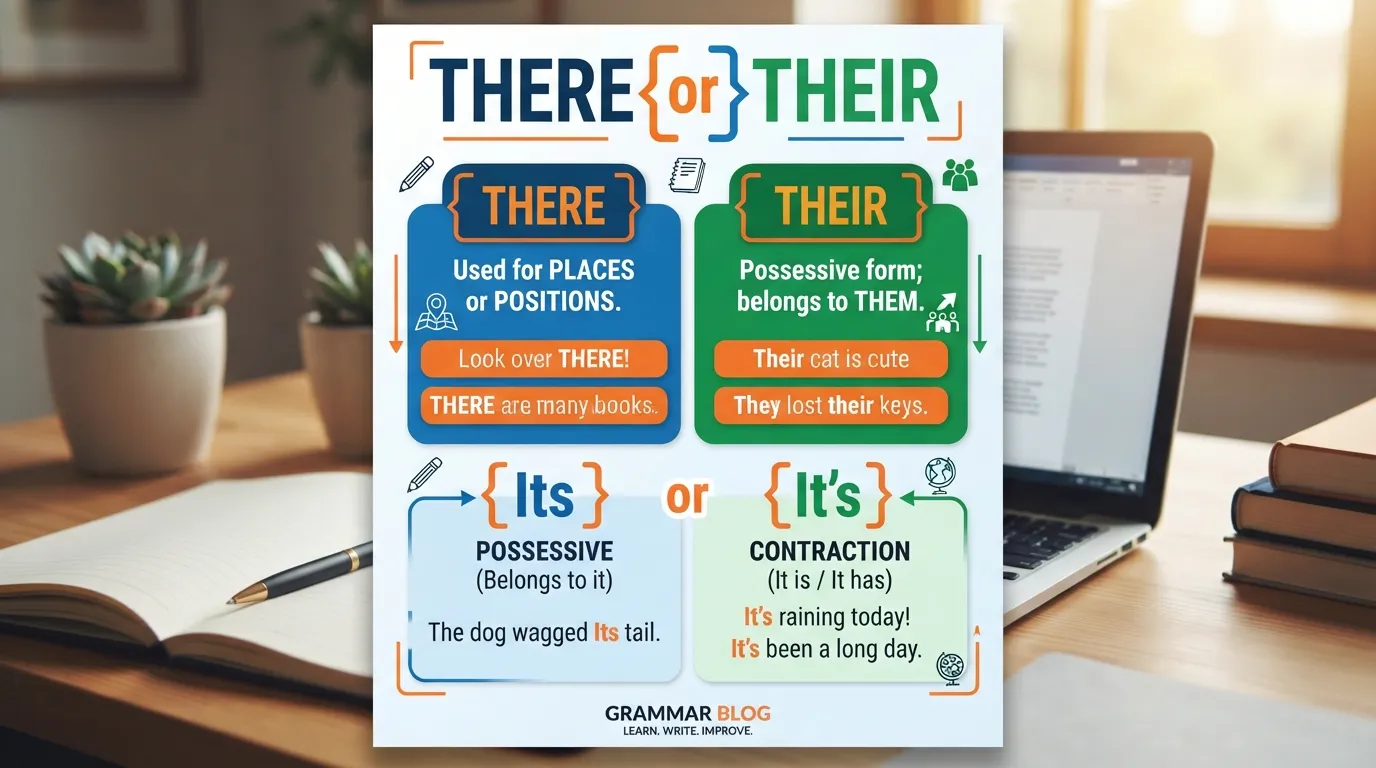
There refers to a location or place (“Put it over there”).
Their shows possession, meaning something belongs to them (“That’s their house”).
They’re is a contraction of “they are” (“They’re coming over later”).
⚡ Quick Rule
There is a place, their is possession, they’re means “they are” — three words, three jobs.
There vs Their: The Core Difference
“Their” shows that something belongs to a group of people, like “their car” or “their idea.”
“There” points to a location, whether physical or abstract, like “over there” or “there’s a problem.”
Say “Put the box there” (location), versus “That’s their box” (ownership).
This location-versus-ownership distinction is the foundation for telling these two words apart.
Grammar Rule Explained
“There” can function as an adverb of place or as part of the phrase “there is/are,” introducing something into a sentence.
“Their” is a possessive adjective, always followed by a noun it modifies, like “their house” or “their decision.”
A simple test: if you can replace the word with “here,” use “there.” If you can replace it with “his,” “her,” or “our,” use “their.”
This substitution test works in almost every sentence you’ll encounter with these words.
Don’t Forget They’re — The Third Confused Word
Most articles only cover there versus their, but “they’re” is just as commonly confused and deserves equal attention.
“They’re” is simply a contraction of “they are,” used whenever you could naturally expand it back to those two words.
Test: if you can replace “they’re” with “they are” and the sentence still makes sense, the contraction is correct.
Example: “They’re leaving soon” works as “They are leaving soon” — confirming “they’re” is correct here.
There vs Their vs They’re Comparison Table
| Word | Function | Meaning | Example |
|---|---|---|---|
| There | Adverb / location | Refers to a place | Put it over there. |
| Their | Possessive adjective | Shows ownership | That’s their car. |
| They’re | Contraction | Means “they are” | They’re on their way. |
Memory Trick
“There” contains the word “here,” both about place — think location.
“Their” contains the word “heir,” someone who inherits or owns something — think possession.
“They’re” always has an apostrophe, marking it as a squished-together version of two words: “they” and “are.”
Real Example Sentences
Using There:
- The keys are over there on the table.
- There is no reason to worry.
- We went there last summer.
- There are three options available.
- Put your bag down there, please.
Using Their:
- Their house is the blue one on the corner.
- I borrowed their car for the weekend.
- The students turned in their assignments.
- Their decision surprised everyone.
- We respect their opinion on this matter.
They’re:Using
- They’re planning a trip to Italy.
- They’re not sure what to do next.
- I heard they’re getting married next year.
- They’re always early to meetings.
- They’re bringing their own food to the party.
Over There or Their Own? Common Phrases Explained
“Over there” always uses “there,” referring to a specific location, as in “The store is over there.”
“Their own” always uses “their,” showing possession over something specific to them, as in “They built their own house.”
A sentence combining all three might read: “They’re going over there to pick up their own luggage” — each word doing its own distinct job.
Common Mistakes
1. Using “their” instead of “there” for location Incorrect: Put the boxes over their. Correct: Put the boxes over there.
2. Using “there” instead of “their” for possession Incorrect: That’s there house on the corner. Correct: That’s their house on the corner.
3. Confusing “they’re” with “their” or “there” Incorrect: There going to the store later. Correct: They’re going to the store later.
4. Forgetting the apostrophe test for “they’re” If you can’t expand it to “they are,” it isn’t “they’re” — it’s likely “there” or “their” instead.
When to Use Each Word
Use There When:
- Referring to a place or location
- Introducing something with “there is/are”
- You could replace it with “here”
Examples: over there, there’s a problem, right there
Use Their When:
- Showing possession belonging to a group
- Followed directly by a noun
- You could replace it with “his,” “her,” or “our”
Examples: their house, their idea, their choice
Use They’re When:
- You mean “they are”
- The sentence still works if expanded
- Introducing an action or state about a group
Examples: they’re leaving, they’re happy, they’re here
FAQs
What’s the difference between there, their, and they’re?
There refers to a place, their shows possession, and they’re means “they are.” All three sound identical but serve different grammatical roles.
How do I know when to use “their” instead of “there”?
If the word is followed by a noun and shows ownership, use “their.” If it refers to a location, use “there.”
How do I know when to use “they’re”?
Test it by expanding it to “they are.” If the sentence still makes sense, “they’re” is correct.
Is “there’s” the same as “theirs”?
No. “There’s” is a contraction of “there is,” while “theirs” is a possessive pronoun meaning “belonging to them,” as in “The choice is theirs.”
Can “there” ever show possession?
No, “there” never shows possession — that job always belongs to “their.”
Why do people confuse these three words so often?
Because they’re homophones, meaning they sound exactly alike when spoken, even though they’re spelled differently and serve different purposes.
Is “their” ever used without a noun following it?
No, “their” is always followed by a noun it modifies, unlike “theirs,” which stands alone.
What’s an easy way to remember all three at once?
There = place (has “here”). Their = ownership (has “heir”). They’re = “they are” (has an apostrophe).
Conclusion
There, their, and they’re may sound identical, but each one plays a completely different role in a sentence.
There points to a place, their shows possession, and they’re simply means “they are.”
Use the substitution test for each — replacing with “here,” “his/her,” or “they are” — and you’ll always choose correctlyKey Takeaways

Hi, I’m Ethan Brooks. I create easy-to-follow grammar guides, writing tips, and vocabulary resources to make English learning enjoyable for everyone.