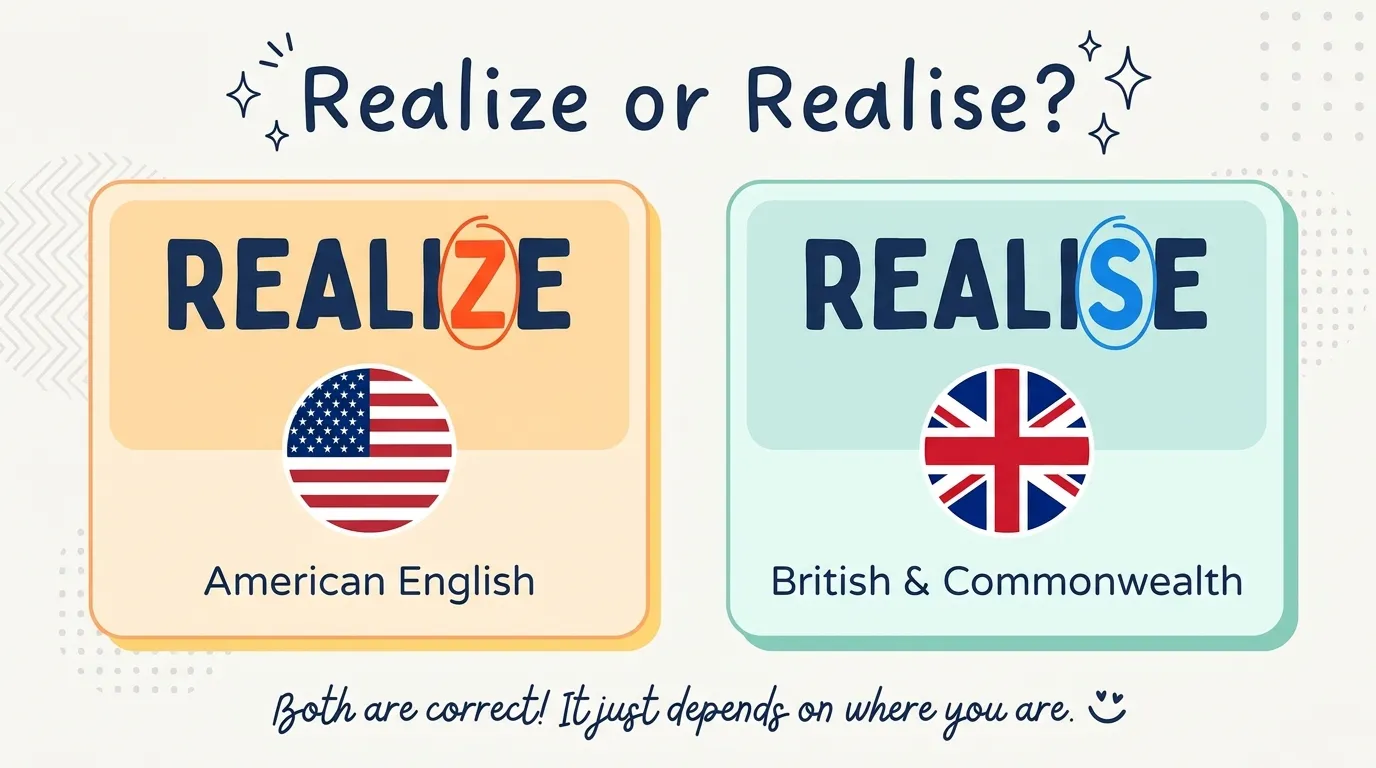
Realize or realise? Both spellings are correct. Realize is the standard spelling in American English, while realise is more common in British English.
Both words have the same meaning: to become aware of something, understand a fact, or achieve a goal.
For example, American English uses “I didn’t realize you were waiting,” while British English commonly uses “I didn’t realise you were waiting.”
The main difference is the letter z in realize and s in realise. Your choice depends on your audience and the spelling style you follow.
Quick Answer: Realize or Realise?
Use realize in American English and realise in standard British English. Both spellings are correct and have the same meaning.
| Spelling | Where It Is Common | Example |
| Realize | American English | I didn’t realize it was so late. |
| Realise | British English | I didn’t realise it was so late. |
Simple rule: Use realize for American readers and realise for British readers, unless your style guide specifies otherwise.
One important detail: some British publications follow Oxford spelling, which uses realize with a z. Therefore, it is not always incorrect to use realize in British English.
What Does Realize Mean?
Realize is a verb with several meanings. It can mean becoming aware of something, understanding a situation, achieving a goal, or making something real.
Here are its main meanings:
1. To Become Aware of Something
You realize something when you notice, discover, or understand a fact or situation.
Examples:
- I didn’t realize you were at home.
- She suddenly realized that she had forgotten her keys.
- He realized his mistake after reading the instructions.
- We didn’t realize how late it had become.
- Do you realize how important this decision is?
2. To Understand Something Clearly
Realize can also describe the moment when something becomes clear to you.
Examples:
- I realize why you were upset.
- She finally realized what the teacher meant.
- He realized that he needed to change his approach.
- They realized the problem was more serious than expected.
- Once I read the message again, I realized what she meant.
3. To Achieve a Goal or Dream
The word can also mean achieving something you hoped or planned to accomplish.
Examples:
- She worked hard to realize her dream of becoming a doctor.
- He finally realized his ambition.
- The team hopes to realize its goals this year.
- They realized their dream of owning a home.
- With patience and effort, you can realize your potential.
4. To Make Something Real or Tangible
In formal contexts, realize may refer to making an idea, plan, or design real.
Examples:
- The architect realized the client’s vision.
- The project helped realize an ambitious plan.
- The artist realized her ideas through sculpture.
The spelling realise carries these same meanings. Only the regional spelling preference changes.
What Does Realise Mean?
Realise is the British English spelling of the same verb. It can mean becoming aware of a fact, understanding something, or achieving a goal.
Examples:
- I didn’t realise you were waiting.
- She realised that she had taken the wrong train.
- He began to realise the importance of practice.
- They hope to realise their plans soon.
- I suddenly realised where I had seen him before.
You do not need to learn a separate definition for realise. If you understand realize, you understand realise too.
Realize vs Realise: Key Differences
The two spellings differ mainly by region and writing convention.
| Feature | Realize | Realise |
| American English | Standard spelling | Not the usual choice |
| British English | Used in Oxford-style spelling and some other styles | Common spelling |
| Australian English | Less common in general usage | Common spelling |
| Meaning | To become aware of or achieve something | Same meaning |
| Pronunciation | Generally the same | Generally the same |
| Past tense | Realized | Realised |
| -ing form | Realizing | Realising |
| Noun form | Realization | Realisation |
The table shows common patterns, not an absolute rule for every publication. Always follow the spelling convention required by your school, employer, publisher, or style guide.
Is Realize American or British English?
Realize is the standard American English spelling. It is the form you should normally use in US school assignments, business documents, websites, and other writing intended for American readers.
Examples:
- I didn’t realize the meeting had been moved.
- She wants to realize her full potential.
- We realized that the information was incorrect.
- He is beginning to realize his dream.
American English generally uses -ize in words such as organize, recognize, and realize.
If your website targets an American audience, choose realize and use related forms such as realized, realizing, and realization consistently.
Is Realise British English?
Yes. Realise is common in British English and is also widely used in Australian and New Zealand English.
Examples:
- I didn’t realise the shop was closed.
- She realised that she had made a mistake.
- We hope to realise our plans next year.
- He is beginning to realise his potential.
British English often uses -ise in words such as organise, recognise, and realise.
However, British English does not always require the -ise ending. Oxford spelling uses -ize in words such as realize and organize. This is why you may see both spellings in British publications.
Realize or Realise in Different Countries
The preferred spelling can depend on the country and the style guide being followed.
| Country or Writing Style | Common Choice |
| United States | Realize |
| United Kingdom | Realise is common; realize is also used in Oxford spelling |
| Australia | Realise |
| New Zealand | Realise |
| Canada | Realize is common, though usage can vary by style |
| International academic writing | Follow the required style guide |
For readers in countries where British spelling is common, realise is usually a natural choice. For American readers, realize is the safer standard.
If you are writing for a worldwide audience, choose one consistent spelling style rather than switching between the two.
Realized or Realised: Which Is Correct?
Both realized and realised are correct past-tense forms.
- Realized: Standard American spelling and used in Oxford-style spelling.
- Realised: Common British, Australian, and New Zealand spelling.
Examples:
- American: I realized I had left my phone at home.
- British: I realised I had left my phone at home.
- American: She realized her dream.
- British: She realised her dream.
The meaning does not change. The same regional spelling pattern applies to the other forms of the word.
Realizing or Realising: Which Should You Use?
Both spellings are correct.
Use realizing in American English and realising in common British English.
Examples:
- American: I am realizing how much work this requires.
- British: I am realising how much work this requires.
- American: She is realizing her full potential.
- British: She is realising her full potential.
Remember that the spelling of the related forms should match your chosen style. If you write realize, use realized and realizing. If you write realise, use realised and realising.
Realization or Realisation: Which Is Correct?
Both realization and realisation are correct noun forms.
- Realization: American English and Oxford-style spelling.
- Realisation: Common British English spelling.
Examples:
- The realization changed his perspective.
- Her realisation came after a long conversation.
- It was a sudden realization that she had misunderstood the question.
- The realisation of their plans took several years.
The noun follows the same spelling pattern as the verb. Choose the form that matches the English variety used throughout your writing.
15 Examples of Realize and Realise in Sentences
These examples show how the two spellings work in everyday writing. Each pair has the same meaning.
| American English | British English |
| I didn’t realize you were here. | I didn’t realise you were here. |
| She realized her mistake. | She realised her mistake. |
| He suddenly realized the truth. | He suddenly realised the truth. |
| We realized the train was late. | We realised the train was late. |
| They realized their dream. | They realised their dream. |
| Did you realize what happened? | Did you realise what happened? |
| I realize how difficult this is. | I realise how difficult this is. |
| She realized she was lost. | She realised she was lost. |
| He didn’t realize the time. | He didn’t realise the time. |
| We realized the plan needed changes. | We realised the plan needed changes. |
| I am realizing my potential. | I am realising my potential. |
| She hopes to realize her ambition. | She hopes to realise her ambition. |
| The mistake was realized later. | The mistake was realised later. |
| It was an important realization. | It was an important realisation. |
| He finally realized what she meant. | He finally realised what she meant. |
Notice that only the spelling changes. The sentence structure and meaning remain the same.
Common Mistakes to Avoid
Even though both forms are correct, writers can make mistakes when they mix spelling conventions.
1. Switching Between American and British Spelling
Incorrect for consistent American English:
- I realized the truth, but later I realised my mistake.
Better:
- I realized the truth, but later I realized my mistake.
For consistent British spelling:
- I realised the truth, but later I realised my mistake.
Mixing styles is not always a grammatical error, but it can make your writing look inconsistent.
2. Assuming Realise Is Always Wrong
Realise is not a misspelling. It is a recognized spelling used in British English and other varieties that follow British conventions.
3. Assuming Realize Is Always Wrong in British English
This is also incorrect. Some British writers and publishers follow Oxford spelling, which uses realize.
4. Changing Only the Main Word
If you choose American spelling, remember the related forms:
- Realize
- Realized
- Realizing
- Realization
For common British spelling, use:
- Realise
- Realised
- Realising
- Realisation
5. Treating the Two Spellings as Different in Meaning
There is no general difference in meaning between realize and realise. The choice is mainly a matter of spelling convention.
Easy Trick to Remember the Difference
Use this simple memory trick:
US = Z = Realize
Common UK spelling = S = Realise
You can also compare familiar spelling pairs:
- American: color; British: colour
- American: organize; common British: organise
- American: realize; common British: realise
This trick works for general spelling choices, but remember that Oxford-style British English often uses -ize.
Quick Practice Quiz
Choose the best spelling for each situation.
- American English: I didn’t ___ the door was open.
- Common British English: She didn’t ___ her mistake.
- American English: He finally ___ his dream.
- Common British English: We are ___ how important this is.
- American English noun: Her ___ came too late.
Answers
- Realize
- Realise
- Realized
- Realising
- Realization
The correct choice depends on the English variety specified in each question.
FAQs
1. Is realize or realise correct?
Both are correct. Realize is standard in American English, while realise is more common in British English.
2. Is realise wrong in American English?
It is a recognized variant, but realize is the standard choice for American writing. Use the standard US form when writing for an American audience.
3. Is realize wrong in British English?
No. Realise is common in British English, but realize is also accepted in Oxford-style spelling and other writing conventions.
4. Do realize and realise mean the same thing?
Yes. Both can mean to become aware of something, understand a fact, achieve a goal, or make an idea real.
5. Is it realized or realised?
Both are correct. Use realized in American English and realised in common British English.
6. Is it realizing or realising?
Both are correct. American English normally uses realizing, while common British spelling uses realising.
7. Is it realization or realisation?
Both are correct noun forms. Realization is standard in American English, while realisation is common in British English.
8. Does Oxford English use realize or realise?
Oxford spelling uses realize, with a z, even in British English. Other British spelling conventions commonly prefer realise.
9. Which spelling should I use on my website?
Choose the spelling that matches your target audience. Use realize for a US-focused website and realise for a website following common British spelling. Keep related forms consistent.
10. Are realize and realise pronounced differently?
Generally, no. They are spelling variants of the same word and are usually pronounced the same way within a given English accent.
Conclusion
The choice between realize or realise comes down to regional spelling preferences. Both words are correct and share the same meaning.
Use realize for American English. Use realise for common British, Australian, and New Zealand English. If you follow Oxford spelling, realize may also be appropriate in British English.
The most important rule is consistency. Choose the spelling that suits your readers, then use the same style for realized/realised, realizing/realising, and realization/realisation throughout your writing.

Hi, I’m Sophia Bennett. My goal is to make grammar easy, clear, and useful through simple explanations and real-life examples.