You’re wrapping up a business email: “I’ll follow-up next week,” and something about that hyphen looks slightly off, even though you can’t quite say why.
Use “follow up” (two words, no hyphen) as a verb, meaning to check on or pursue something. Use “follow-up” (hyphenated) as a noun or adjective, meaning a continuation or a related check-in.
Table of Contents
Quick Answer Box
Quick Rule in One Line
The Difference Explained
Grammar Rule: Verb vs Noun/Adjective
Follow-Ups: The Plural Noun Form
Followed Up or Followed-Up? (Past Tense)
Following Up or Following-Up? (Gerund Form)
Follow-Up vs Follow-On
Follow-Up vs Follow-Through
Follow Up On or Follow Up With?
Comparison Table
Memory Trick
Example Sentences
Common Mistakes
When to Use Each Form
Expert Tip
FAQs
Conclusion
Key Takeaways
Quick Answer Box
“Follow up” (no hyphen) is a verb phrase: “I’ll follow up with you tomorrow.” “Follow-up” (hyphenated) is a noun or adjective: “Let’s schedule a follow-up” or “This is a follow-up email.”
The single word “followup” is not standard in formal writing, though it appears informally.
⚡ Quick Rule in 1 Line
“No hyphen for the action (follow up), hyphen for the thing (follow-up).”
The Difference Explained
“Follow up” is a phrasal verb, made of two separate words working together as an action: to check on, revisit, or pursue something further.
“Follow-up” is the same idea turned into a noun or adjective, describing a thing rather than an action, like a meeting, email, or appointment that continues something earlier.
The hyphen is the visual signal that the phrase has shifted from describing an action to describing a thing.
Grammar Rule: Verb vs Noun/Adjective
This follows a common English pattern: when a phrasal verb (two words that function as a verb, like “follow up,” “check out,” or “log in”) gets turned into a noun or adjective, it typically gets hyphenated or closed into one word.
As a verb, keep it open: “follow up,” “check out,” “log in.” As a noun or adjective describing something, add the hyphen: “follow-up,” “checkout,” “log-in.”
Major style guides, including AP and Chicago, agree on this pattern for “follow up/follow-up” specifically.
Follow-Ups: The Plural Noun Form
When “follow-up” is used as a plural noun, the hyphen stays in place: ‘follow-ups,’ never ‘follow ups’ with a space. This follows the same logic as the singular noun form; since the hyphen signals a thing rather than an action, that signal doesn’t disappear just because there’s more than one.
❌ ‘We have three follow ups scheduled today.’ ✅ ‘We have three follow-ups scheduled today.’
If you’re using it as a verb instead, with multiple people each doing the checking-in, it stays as two separate words with no hyphen and takes an ‘s’ on ‘follow’: ‘she follows up with every client,’ not ‘she follow-ups with every client.’
Followed Up or Followed-Up? (Past Tense)
The correct past tense is ‘followed up,’ written as two separate words with no hyphen, the same way the base verb ‘follow up’ has no hyphen. ‘Followed-up,’ with a hyphen, is not standard in any context, since the hyphenation rule only applies when the phrase becomes a noun or adjective, never to its verb forms.
❌ ‘I followed-up with the client yesterday.’ ✅ ‘I followed up with the client yesterday.’
Following Up or Following-Up? (Gerund Form)
The same rule applies to the ‘-ing’ form: ‘following up’ stays as two separate words with no hyphen when it’s functioning as a verb, such as in ‘I’m following up on your request’ or ‘following up is important.’ ‘Following-up,’ hyphenated, is not standard English in any context.
The only time you’d see a hyphenated, adjective-style version is if ‘follow-up’ itself is modifying another word directly, such as ‘a follow-up call,’ but this uses the noun/adjective form of ‘follow-up,’ not a hyphenated version of ‘following up.’
Follow-Up vs Follow-On
These are related but genuinely different phrases, not just variant spellings of the same idea. ‘Follow-up’ refers to a continuation or check-in related to something already discussed, like a follow-up email or follow-up appointment. ‘Follow-on’ refers to something that comes directly after and builds on a prior event, more common in British English, cricket terminology (a ‘follow-on’ in a cricket match), and business contexts like a ‘follow-on funding round.’
If you mean a check-in or continuation of communication, use ‘follow-up.’ If you mean a subsequent event that directly builds on the one before it, especially in British, financial, or sports contexts, ‘follow-on’ may be the more precise term.
Follow-Up vs Follow-Through
‘Follow-up’ and ‘follow-through’ are also distinct phrases with different meanings, despite both involving the idea of continuing something. ‘Follow-through’ means completing or fully carrying out a plan, promise, or commitment you already started, as in ‘she showed great follow-through on the project.’
A simple way to separate them: ‘follow-up’ is about checking in again; ‘follow-through’ is about finishing what you started.
Follow Up On or Follow Up With?
Both prepositions are correct, but they pair with different objects. Use ‘follow up with’ when the object is a person: ‘I’ll follow up with the client.’ Use ‘follow up on’ when the object is a task, request, or topic: ‘I’ll follow up on your request.’
Mixing them up, such as ‘follow up on the client’ or ‘follow up with your request,’ isn’t grammatically wrong in every case, but ‘follow up with’ plus a person and ‘follow up on’ plus a topic is the clearer, more natural pairing in professional writing.
Comparison Table: Follow Up vs Follow-Up
| Feature | Follow Up | Follow-Up |
|---|---|---|
| Part of speech | Verb | Noun or adjective |
| Hyphen | No | Yes |
| Example | I’ll follow up with you tomorrow. | Let’s schedule a follow-up. |
| As adjective | N/A | This is a follow-up email. |
| Style guide support | AP, Chicago | AP, Chicago |
Memory Trick
Think: “up” stays loose when it’s an action, and gets locked down with a hyphen when it becomes a thing. If you can replace the phrase with “check” or “pursue,” you need the two-word verb, “follow up.” If you can replace it with “meeting” or “email,” you need the hyphenated “follow-up.”
Example Sentences
Using “follow up” (verb):
I’ll follow up with the client on Monday.
Please follow up on this request by Friday.
She always follows up after every interview.
We need to follow up on the missing shipment.
He forgot to follow up with the new hire.
Using “follow-up” (noun/adjective):
I scheduled a follow-up for next Tuesday.
This is a follow-up email regarding your application.
The doctor recommended a follow-up in two weeks.
Her follow-up questions were sharp and specific.
We’re still waiting on the follow-up report.
Common Mistakes
❌ I will follow-up with you tomorrow. ✅ I will follow up with you tomorrow.
❌ Let’s schedule a follow up meeting. ✅ Let’s schedule a follow-up meeting.
Can you send a followup email? ✅ Can you send a follow-up email.
I followed-up with them last week. ✅ I followed up with them last week.
❌ We have two follow ups this afternoon. ✅ We have two follow-ups this afternoon.
When to Use Each Form
Use “follow up” whenever the phrase is doing something, functioning as the main verb in your sentence. Use “follow-up” whenever the phrase is naming a thing, or describing one, sitting in front of a noun like “email,” “call,” “meeting,” or “appointment.”
Expert Tip 💡
Before sending a professional email or resume, search your document for “follow-up” and “follow up” separately. Check each instance: is it acting as a verb (no hyphen) or naming a thing (hyphen)? This quick pass catches the most common version of this mistake in business writing.
FAQs
Is “followup” (one word) ever correct?
It’s not standard in formal or edited writing, though it appears informally and in some casual or internal contexts. Stick with the hyphenated “follow-up” for noun and adjective use.
Is “follow up” always two separate words?
Only when it’s functioning as a verb. As a noun or adjective, it takes a hyphen: “follow-up.”
Do AP Style and Chicago Manual of Style agree on this rule?
Yes. Both recommend “follow up” as a verb and “follow-up” as a noun or adjective.
How do I know which form my sentence needs?
Check if the phrase is the main action (verb, no hyphen) or if it’s naming or describing a thing (noun/adjective, hyphen).
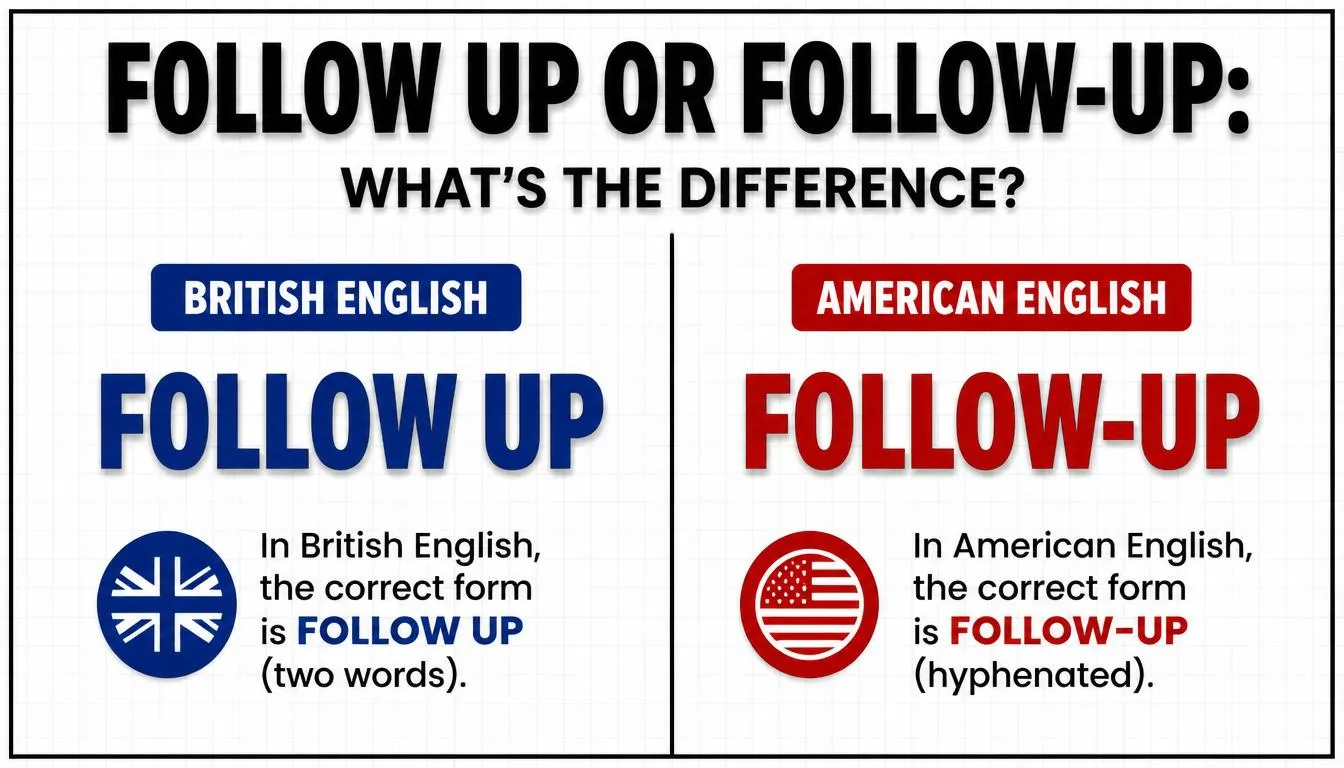
Is this the same in British and American English?
Yes, the verb/noun-adjective distinction applies in both, though British style guides sometimes allow slightly more flexibility informally.
What’s a quick substitution test?
Try swapping in “check” or “pursue.” If that works, use “follow up.” Try swapping in “meeting” or “email.” If that works, use “follow-up.”
Is “follow-up” capitalized differently in titles?
Yes. In most title-case styles, only “Follow” gets capitalized in the hyphenated form; “up” stays lowercase since the hyphen treats the phrase as one unit.
Can “follow-up” be plural?
Yes: “follow-ups,” as in “We have three follow-ups scheduled this week.”
What’s the past tense of “follow up”?
“Followed up,” written as two separate words with no hyphen, the same as the base verb form.
Is “following up” hyphenated?
No. As a verb form, “following up” stays as two separate words with no hyphen, such as in “I’m following up on this today.”
What’s the difference between “follow-up” and “follow-on”?
“Follow-up” means a check-in or continuation of communication. “Follow-on” refers to a subsequent event that directly builds on something earlier, more common in British English, cricket, and finance contexts.
What’s the difference between “follow-up” and “follow-through”?
“Follow-up” means checking back in on something later. “Follow-through” means completing or fully carrying out something you already committed to.
Should I say “follow up with” or “follow up on”?
Use “follow up with” before a person, like “follow up with the client,” and “follow up on” before a task or topic, like “follow up on the request.”
Conclusion
“Follow up,” without a hyphen, is the verb, the action of checking on or pursuing something.
“Follow-up,” with a hyphen, is the noun or adjective, naming or describing a thing like a meeting or email.
Once you identify whether your sentence needs an action or a thing, the hyphen decision becomes automatic.
READ MORE:
Canceled or Cancelled? The Simple Spelling Rule You Need to Know
Color or Colour: Which Spelling Is Correct? (US vs UK Guide)
Canceling or Cancelling? Which Spelling Is Correct? (US vs UK)

Hi, I’m Sophia Bennett. My goal is to make grammar easy, clear, and useful through simple explanations and real-life examples.