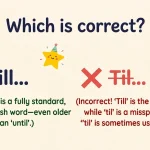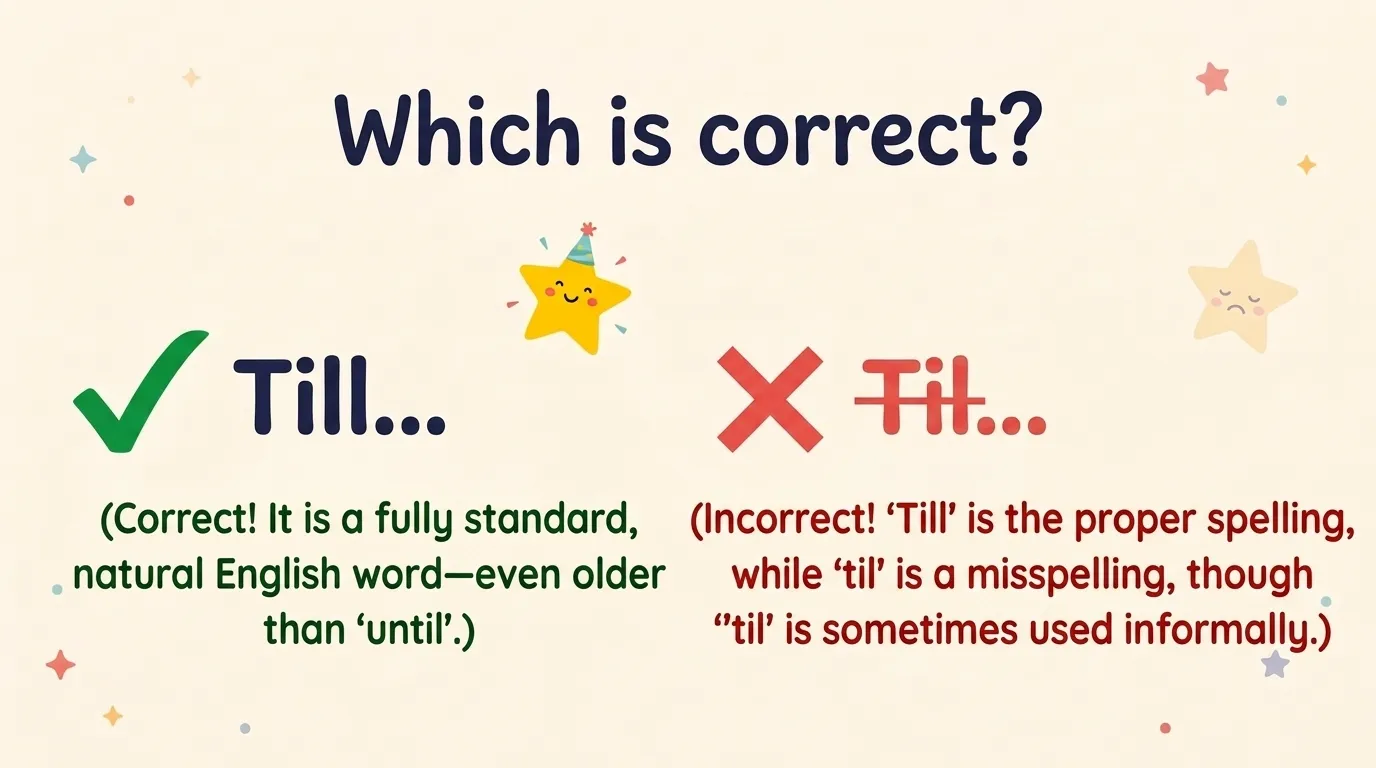
Til or till? If you mean “up to a particular time,” till is the established standard spelling. The word til is often used informally as a shortened form of until, especially in casual messages, song titles, and advertising. You may also see it written as ’til.
For example, you can write, “I will wait till Friday” or “I will wait until Friday.” Both are correct and have the same basic meaning.
The important point is that till is not a misspelling of until. It is a legitimate English word with a long history. In fact, till is older than until. For formal writing, until is often the safest choice, while till is also correct. The spelling til is less suitable for formal documents.
In this guide, you’ll learn the difference between til, till, and until, how to use each form, and which spelling is best for your writing.
Quick Answer: Til or Till?
Till is the established spelling when you mean “until” or “up to a particular time.” Til is an informal variant, usually written as ’til when it represents a shortened form of until. For formal writing, choose until or till.
| Word | Correct? | Best Use |
| Till | Yes | Standard English; means “until” |
| Until | Yes | Formal and everyday writing |
| Til | Informal variant | Casual messages and informal contexts |
| ’Til | Common informal variant | Songs, signs, captions, and casual writing |
| ’Till | Generally nonstandard | Avoid in edited writing |
Simple rule: Use until or till in regular writing. Save til and ’til for informal contexts where the shortened style fits.
What Does Till Mean?
Till is a preposition or conjunction that means “until” or “up to a particular time.” It connects an action or situation to the time when it stops or changes.
Examples:
- I will stay here till noon.
- She worked till midnight.
- Wait till the rain stops.
- We cannot leave till the meeting ends.
- He stayed at the office till Friday.
In each sentence, till refers to the endpoint of an action or situation.
The word is correct in both American and British English. Although some writers consider it less formal than until, it is not inherently incorrect or merely slang.
Till as a Preposition
A preposition can show the time up to which something continues.
Examples:
- The shop is open till 9 p.m.
- I worked till late in the evening.
- We stayed at the beach till sunset.
- The library will remain closed till Monday.
- She waited till the last bus arrived.
Till as a Conjunction
A conjunction can connect a main clause with another clause.
Examples:
- Wait till I come back.
- I will not leave till you arrive.
- Keep reading till you reach the final chapter.
- We stayed inside till the storm passed.
- You can play outside till dinner is ready.
In these examples, till connects the action to the event or time that marks its endpoint.
What Does Til Mean?
Til is commonly used informally as a shortened form of until. However, when discussing the established standard spelling, til without an apostrophe is less conventional than till or until.
You may encounter til in casual messages, online captions, song lyrics, and informal advertising.
Examples:
- See you til tomorrow!
- I will be here til five.
- Just one more day til vacation.
- Counting down til the weekend.
- Stay here til I get back.
These examples illustrate informal usage, not the preferred spelling for edited formal writing. In standard writing, you would generally use until or till instead.
For example:
- Informal: Just one more day til vacation.
- Standard: Just one more day till vacation.
- Standard: Just one more day until vacation.
The meaning stays the same, but the spelling changes the level of formality.
Is It Til or ’Til?
You may see both til and ’til in everyday English. The apostrophe in ’til signals that the form is being treated as a shortened version of until.
Examples:
- See you ’til next time!
- Open ’til midnight.
- I will love you ’til the end.
- Waiting ’til the morning.
- Counting down ’til Friday.
The form ’til is common in informal writing, but many editors prefer till or until because till is already a complete, established word.
For example:
- Informal: Open ’til midnight.
- Standard: Open till midnight.
- Standard: Open until midnight.
If you are writing a school assignment, a professional email, or an article for a grammar website, until is the safest option. If you choose till, you do not need an apostrophe.
Til vs. Till vs. Until: Key Differences
These three forms can express the same basic idea, but they differ in spelling convention and formality.
| Feature | Til | Till | Until |
| Meaning “up to a time” | Used informally | Yes | Yes |
| Standard spelling | Less conventional | Yes | Yes |
| Formal writing | Usually avoid | Acceptable | Often preferred |
| Casual messages | Common | Common | Common |
| Needs an apostrophe | Sometimes written as ’til | No | No |
| American English | Informal use | Correct | Correct |
| British English | Informal use | Correct | Correct |
The key distinction is not a difference in meaning between till and until. Both are established words and are generally interchangeable when referring to time.
The main caution concerns til, which is usually an informal spelling choice.
Is Till a Short Form of Until?
No. Although till and until have related meanings, till is not simply a shortened form of until. The word till existed in English before until.
This history explains why till does not need an apostrophe. It is a complete word on its own.
Compare:
- Correct: I will wait till six.
- Correct: I will wait until six.
- Informal: I will wait ’til six.
- Less conventional: I will wait til six.
You do not need to add an apostrophe to till. Writing ’till is generally unnecessary and is best avoided in edited writing.
Til or Till in American English
In American English, till and until are both correct. Til and ’til also appear in informal writing, but they are less suitable for formal documents.
Examples:
- I will be home till six.
- The store stays open until midnight.
- We waited till the movie started.
- She will remain here until Friday.
- See you ’til next time!
For professional emails, essays, and website articles intended for American readers, use until or till. You do not need to avoid till just because until may sound more formal to some readers.
Til or Till in British English
British English also accepts till and until when referring to time. Both forms are used in everyday speech and writing.
Examples:
- The train does not arrive till noon.
- Please wait until your name is called.
- I worked till seven o’clock.
- We stayed until the rain stopped.
- The road will remain closed till Monday.
As in American English, til is more informal and less conventional in edited prose.
There is no general American-versus-British spelling difference for till and until. The main choice is between standard writing and an informal shortened form.
15 Examples of Til, Till, and Until in Sentences
The following examples show how these forms appear in different contexts. Remember that til is included mainly to illustrate informal usage.
| Informal or Standard Sentence | Alternative Standard Form |
| I’ll wait till Friday. | I’ll wait until Friday. |
| Stay here till I return. | Stay here until I return. |
| The shop is open till nine. | The shop is open until nine. |
| We worked till midnight. | We worked until midnight. |
| Don’t leave till the show ends. | Don’t leave until the show ends. |
| I’ll be here til five. | I’ll be here till five. |
| Just one day til vacation. | Just one day till vacation. |
| See you ’til next time! | See you till next time! |
| Wait till the rain stops. | Wait until the rain stops. |
| She stayed till Monday. | She stayed until Monday. |
| I won’t decide till tomorrow. | I won’t decide until tomorrow. |
| Keep walking till you see the bridge. | Keep walking until you see the bridge. |
| The office is closed till Tuesday. | The office is closed until Tuesday. |
| He read till he fell asleep. | He read until he fell asleep. |
| We cannot begin till everyone arrives. | We cannot begin until everyone arrives. |
The standard forms till and until work naturally in all these sentences. Choose between them based on tone and preference.
Common Mistakes to Avoid
1. Thinking Till Is Incorrect
Incorrect claim: “Till is a misspelling of until.”
Better explanation: Till is an established English word and can mean “up to a particular time.” It is not merely a shortened spelling of until.
2. Using Til in Formal Writing
Informal: I will be there til Monday.
Better: I will be there till Monday.
Also correct: I will be there until Monday.
The standard forms are more suitable for professional and academic writing.
3. Writing ’Till Instead of Till
Avoid writing ’till when you mean “until.” The apostrophe is unnecessary because till is already a complete word.
Preferred: Wait till tomorrow.
Also correct: Wait until tomorrow.
4. Assuming Till and Until Have Different Meanings
When referring to time, till and until are generally interchangeable.
- I worked till noon.
- I worked until noon.
Both refer to the time up to noon.
5. Confusing Till With the Cash Register
The word till has another meaning: a cash drawer or register used in a shop.
Examples:
- The cashier opened the till.
- She put the money in the till.
- The shop has three checkout tills.
In these sentences, till does not mean until. The meaning depends on the context.
6. Using Until When You Mean By
Until and by do not always mean the same thing.
- “I will work until Friday” means the work continues up to Friday.
- “I will finish the work by Friday” means the work will be completed no later than Friday.
Choose the word that expresses your intended meaning.
An Easy Trick to Remember the Difference
Use this simple memory trick:
TILL = standard word.
UNTIL = standard word.
TIL = informal spelling.
Remember that till is already a complete word. It does not need an apostrophe to make it correct.
If you are writing something formal, choose until or till. If you are writing a casual caption or message, til or ’til may fit the tone, but standard spelling is still the safer choice for edited content.
Quick Practice Quiz
Test your understanding of til and till.
1. Which is an established standard spelling meaning “up to a time”?
A. Till
B. Tyl
C. Tille
2. Which word is often preferred in formal writing?
A. Til
B. Until
C. ’Till
3. Complete the sentence: “I will wait ___ you arrive.”
A. till
B. til
C. Both A and B are equally standard
4. Which form is generally best avoided in formal writing?
A. Until
B. Till
C. Til
5. Is till simply a misspelling of until?
A. Yes
B. No
Answers:
- A — Till
- B — Until
- A — Till (or until; til is informal)
- C — Til
- B — No
FAQs
1. Is it til or till?
T ill is the established standard spelling when you mean “until” or “up to a particular time.” Til is used informally, often as a shortened form of until.
2. Is till a correct English word?
Yes. Till is a complete English word that can mean “up to a particular time.” It is not simply a misspelling or shortened version of until.
3. Is til wrong?
Til is used informally, but it is less conventional in standard edited writing. Use till or until when you want the safest standard spelling.
4. Should I write ’til or till?
Use till for the established standard word. ’Til is a common informal variant. For formal writing, till or until is usually preferable.
5. Is ’till correct?
’Till is generally considered nonstandard when used to mean until. The apostrophe is unnecessary because till is already a complete word.
6. Is till more informal than until?
Some readers may perceive till as less formal, but it is a standard word. Until is often preferred in formal writing, especially at the beginning of a sentence.
7. Is till correct in American English?
Yes. Till and until are both correct in American English. The same applies to British English.
8. Is till older than until?
Yes. Historical evidence shows that till existed in English before until. This is another reason till should not be treated as an incorrect shortening.
9. Can I use til in a text message?
Yes. People often use til or ’til in informal messages, captions, and online posts. For formal or edited writing, choose till or until.
10. What is the difference between till and until?
When referring to time, the words generally have the same meaning. The main difference is that until may sound more formal to some readers, while till is a standard alternative.
Conclusion
When choosing between til or till, remember that till is the established standard word, while til is generally an informal spelling. Both till and until can mean “up to a particular time,” and they are usually interchangeable in that sense.
For formal writing, use until or till. For casual messages and creative writing, til or ’til may be suitable if the informal tone fits. Avoid ’till, since the apostrophe is unnecessary.
The simplest rule is to use till or until in standard writing and reserve til for informal contexts.

Hi, I’m Sophia Bennett. My goal is to make grammar easy, clear, and useful through simple explanations and real-life examples.