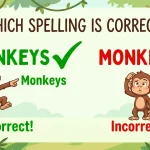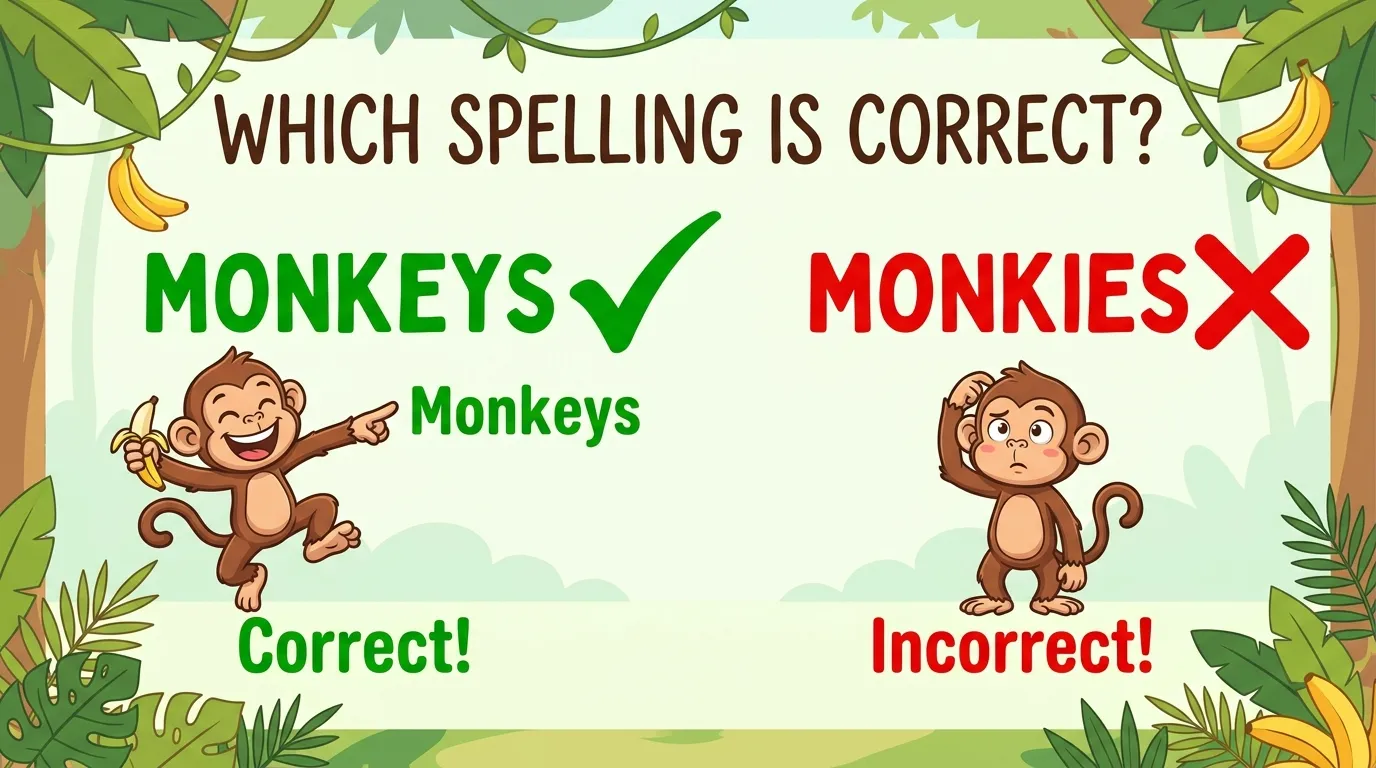
Monkeys or monkies? The correct spelling in modern English is monkeys. The word monkey becomes plural by adding -s, not by changing the final y to i and adding -es.
Although monkies appeared in older English, it is now considered an obsolete or nonstandard spelling.
For example, you should write, “We saw three monkeys at the zoo,” not “We saw three monkies at the zoo.”
The confusion comes from a common English spelling rule. Words such as baby and city change their final y to ies in the plural.
However, monkey follows a different pattern because the letter before the final y is a vowel.
In this guide, you’ll learn why monkeys is correct, how to remember the rule, and how to use the word in everyday sentences.
Quick Answer: Monkeys or Monkies?
Monkeys is the correct standard plural of monkey. Monkies is an obsolete spelling that you should avoid in modern writing.
| Word | Correct? | Explanation |
| Monkey | Yes | Singular form |
| Monkeys | Yes | Standard plural form |
| Monkies | No, not in modern standard usage | Obsolete or nonstandard plural spelling |
| Monkey’s | Yes | Singular possessive |
| Monkeys’ | Yes | Plural possessive |
Simple rule: Since monkey ends in a vowel followed by y, keep the y and add -s.
- One monkey
- Two monkeys
- Several monkeys
This spelling is the same in American and British English. There is no regional spelling difference between the two forms.
Why Is Monkeys Correct and Monkies Incorrect?
The answer comes from how English forms plurals for nouns ending in y.
Some nouns change their final y to i and add -es. This usually happens when a consonant comes immediately before the final y.
For example:
- Baby → babies
- City → cities
- Puppy → puppies
- Story → stories
- Country → countries
However, when a vowel comes before the final y, the usual pattern is to keep the y and add -s.
For example:
- Monkey → monkeys
- Donkey → donkeys
- Key → keys
- Boy → boys
- Toy → toys
- Journey → journeys
Look at the word monkey. The letter immediately before the final y is e, which is a vowel. Therefore, you simply add s to make the plural.
The correct spelling is monkeys, not monkies.
What Is the Plural of Monkey?
The plural of monkey is monkeys.
A singular noun refers to one person, animal, place, or thing. A plural noun usually refers to more than one.
Here are some examples:
| Singular | Plural | Example |
| Monkey | Monkeys | The monkeys are climbing. |
| Donkey | Donkeys | Two donkeys are standing nearby. |
| Key | Keys | I found three keys. |
| Toy | Toys | The children put away their toys. |
| Boy | Boys | The boys played outside. |
| Baby | Babies | The babies are sleeping. |
| City | Cities | Several cities hosted the event. |
Notice that monkey, donkey, and key keep their final y. Words such as baby and city change y to ies because a consonant comes before the final y.
Learning this difference will help you spell many other English plurals correctly.
Monkeys or Monkies in American and British English
Both American English and British English use monkeys as the standard plural of monkey.
| English variety | Correct plural | Incorrect in modern standard usage |
| American English | Monkeys | Monkies |
| British English | Monkeys | Monkies |
| Australian English | Monkeys | Monkies |
| Canadian English | Monkeys | Monkies |
| New Zealand English | Monkeys | Monkies |
Unlike spelling pairs such as color/colour and organize/organise, monkeys does not have a standard American-versus-British spelling difference.
For example:
American English: We saw several monkeys at the zoo.
British English: We saw several monkeys at the zoo.
The spelling remains the same in both sentences.
You should use monkeys whether you’re writing a school assignment, a business email, a blog post, or an article for an international audience.
15 Examples of Monkeys in Sentences
Reading examples is a helpful way to remember the correct spelling. Notice how monkeys is used whenever the sentence refers to more than one monkey.
- The monkeys climbed high into the trees.
- We watched the monkeys playing at the zoo.
- Several monkeys were looking for food.
- The children enjoyed watching the monkeys.
- Monkeys often use their hands to handle objects.
- A group of monkeys crossed the path.
- The monkeys rested in the shade during the afternoon.
- Researchers observed the monkeys in their natural habitat.
- Two monkeys were sitting on a branch.
- The photographer took pictures of the monkeys.
- The monkeys moved quickly through the forest.
- Many monkeys live in tropical and subtropical regions.
- The zookeeper prepared food for the monkeys.
- We could hear the monkeys making sounds nearby.
- The monkeys returned to the trees before sunset.
Each sentence uses the standard plural spelling, monkeys. Writing monkies instead would be incorrect in ordinary modern English.
Monkey’s or Monkeys’: What Is the Difference?
The words monkey’s, monkeys, and monkeys’ may look similar, but they serve different purposes.
1. Monkey’s: Possession by One Monkey
Use monkey’s when something belongs to one monkey.
Examples:
- The monkey’s tail was long.
- The monkey’s food was placed in a bowl.
- We watched the monkey’s movements.
- The monkey’s habitat was carefully maintained.
The apostrophe and s indicate possession by one monkey.
2. Monkeys: More Than One Monkey
Use monkeys when you are talking about two or more monkeys.
Examples:
- The monkeys climbed the trees.
- Several monkeys were eating fruit.
- The monkeys played together.
- We saw five monkeys at the wildlife park.
No apostrophe is needed to form the ordinary plural.
3. Monkeys’: Possession by Multiple Monkeys
Use monkeys’ when something belongs to more than one monkey.
Examples:
- The monkeys’ habitat was cleaned.
- We observed the monkeys’ behavior.
- The monkeys’ food was prepared early.
- The monkeys’ enclosure was spacious.
The apostrophe comes after the s because the noun is already plural.
Here’s a simple comparison:
| Form | Meaning | Example |
| Monkey | One monkey | The monkey is eating. |
| Monkeys | More than one | The monkeys are eating. |
| Monkey’s | Something belongs to one monkey | The monkey’s tail is long. |
| Monkeys’ | Something belongs to multiple monkeys | The monkeys’ tails are long. |
Understanding these differences helps you avoid both spelling and punctuation mistakes.
Why Do People Spell It as Monkies?
The spelling monkies usually results from applying the wrong plural rule.
Many English learners know that words ending in a consonant followed by y often change to ies. For instance, baby becomes babies and puppy becomes puppies.
Because monkey also ends in y, it may seem logical to write monkies. However, English spelling rules depend on the letter immediately before the final y, not simply on whether a word ends in y.
Compare these examples:
Consonant + y:
- Baby → Babies
- Lady → Ladies
- Party → Parties
- Family → Families
Vowel + y:
- Monkey → Monkeys
- Donkey → Donkeys
- Boy → Boys
- Key → Keys
The difference is the letter before the y. In baby, the letter is b, a consonant. In monkey, the letter is e, a vowel.
That is why the correct plural is monkeys.
Is Monkies Ever Correct?
In modern standard English, monkeys is the normal plural form. However, monkies is not entirely unknown in historical texts.
Older English sources sometimes used monkies as a plural spelling. Historical dictionaries record it as an obsolete form. You might therefore encounter it in an old book, quotation, or historical document.
That does not make it the appropriate spelling for contemporary writing.
Use monkeys in modern contexts, including:
- School assignments
- Academic writing
- Professional documents
- Website articles
- Emails and messages
- Social media posts
- Captions and educational materials
If you are quoting an old text, preserve the original spelling when accuracy requires it. Otherwise, use the standard modern form, monkeys.
An Easy Trick to Remember the Correct Spelling
Here’s a simple memory trick:
Vowel + y = usually add s.
In monkey, the letter before the final y is e. Because e is a vowel, you keep the y and add s.
Remember:
Monkey → Monkeys
Not:
Monkey → Monkies
You can also remember the word donkey, which follows the same pattern.
- One donkey → Two donkeys
- One monkey → Two monkeys
If you remember donkeys, remembering monkeys becomes easier.
Common Mistakes to Avoid
Mistake 1: Writing Monkies as the Plural
Incorrect: We saw three monkies at the zoo.
Correct: We saw three monkeys at the zoo.
The standard plural is formed by adding s.
Mistake 2: Applying the -ies Rule to Every Word Ending in Y
Incorrect: The key changed to kies.
Correct: The key changed to keys.
Not every noun ending in y follows the same plural pattern. Check the letter before the final y.
Mistake 3: Adding an Apostrophe to an Ordinary Plural
Incorrect: The monkey’s are climbing.
Correct: The monkeys are climbing.
An apostrophe is not needed to form a regular plural. Use monkey’s only when showing possession by one monkey or when using it as a contraction in a suitable context.
Mistake 4: Assuming British English Uses Monkies
Incorrect: British English uses monkies, while American English uses monkeys.
Correct: Both varieties use monkeys as the standard modern plural.
Mistake 5: Confusing Monkeys’ With Monkey’s
Use monkey’s for possession by one monkey and monkeys’ for possession by multiple monkeys.
Examples:
- The monkey’s banana was ripe.
- The monkeys’ bananas were ripe.
Quick Practice Quiz
Test your understanding of the correct spelling.
1. Which spelling is correct?
A. Monkies
B. Monkeys
2. What is the plural of monkey?
A. Monkeyes
B. Monkeys
C. Monkys
3. Complete the sentence: “We saw five ___ at the zoo.”
A. monkey’s
B. monkeys
C. monkies
4. Which word follows the same plural pattern as monkey?
A. Baby
B. City
C. Donkey
5. Which form shows possession by multiple monkeys?
A. Monkey’s
B. Monkeys
C. Monkeys’
Answers:
1. B —Monkeys;
2. B The Monkeys;
3. B Monkeys;
4. C — Donkey;
5. C — Monkeys’.
FAQs
1. Is it monkeys or monkies?
Monkeys is the correct standard spelling in modern English. Monkies is an obsolete or nonstandard form.
2. What is the plural of monkey?
The plural of monkey is monkeys. You simply add s to the singular word.
3. Why is it monkeys and not monkies?
The letter before the final y in monkey is e, a vowel. Words ending in a vowel followed by y generally form their plurals by adding s.
4. Is monkies a real word?
The spelling monkies appears in older English as an obsolete plural form. However, it is not the standard spelling for modern writing. Use monkeys.
5. Is monkeys correct in British English?
Yes. Monkeys is the standard plural in British English, just as it is in American English.
6. Is it monkey’s or monkeys?
Use monkey’s to show possession by one monkey. Use monkeys when referring to more than one monkey.
7. What is the plural possessive of monkey?
The plural possessive is monkeys’. For example: “The monkeys’ habitat was clean.”
8. Do words ending in y always change to ies in the plural?
No. Nouns ending in a consonant followed by y usually change y to ies, as in baby → babies. Nouns ending in a vowel followed by y usually add s, as in monkey → monkeys.
9. Is there a difference between American and British spelling?
No. Both American and British English use monkeys as the standard plural. There is no regional spelling difference for this word.
10. How can I remember the spelling of monkeys?
Remember the rule vowel + y = usually add s. Since e comes before the final y in monkey, the correct plural is monkeys.
Conclusion
When choosing between monkeys or monkies, use monkeys. It is the standard modern plural of monkey in both American and British English.
The confusion comes from the English plural rule for words ending in y. Words such as baby and city change y to ies, but monkey follows a different pattern because a vowel comes before its final y.
Remember the simple rule: monkey → monkeys. Avoid monkies in modern writing unless you are reproducing a historical source that uses the older spelling.

Hi, I’m Sophia Bennett. My goal is to make grammar easy, clear, and useful through simple explanations and real-life examples.