You type “I’ll be there in awhile” and something feels slightly off.
Quick answer: it should be “in a while,” two words. “Awhile” is one word and works only in specific spots.
Here’s the simple rule that clears it up for good.
Table of Contents
- Did You Know?
- Quick Answer Box
- Quick Rule in One Line
- The Difference Explained
- Grammar Rule: The Preposition Test
- Comparison Table
- Memory Trick
- Example Sentences
- Common Mistakes
- When to Use Each Form
- Expert Tip
- Quick Quiz
- FAQs
- Conclusion
- Key Takeaways
Did You Know? 🔍
“Awhile” already means “for a short time.” That means “for awhile” is technically redundant, since you’d be saying “for for a short time.”
Quick Answer Box
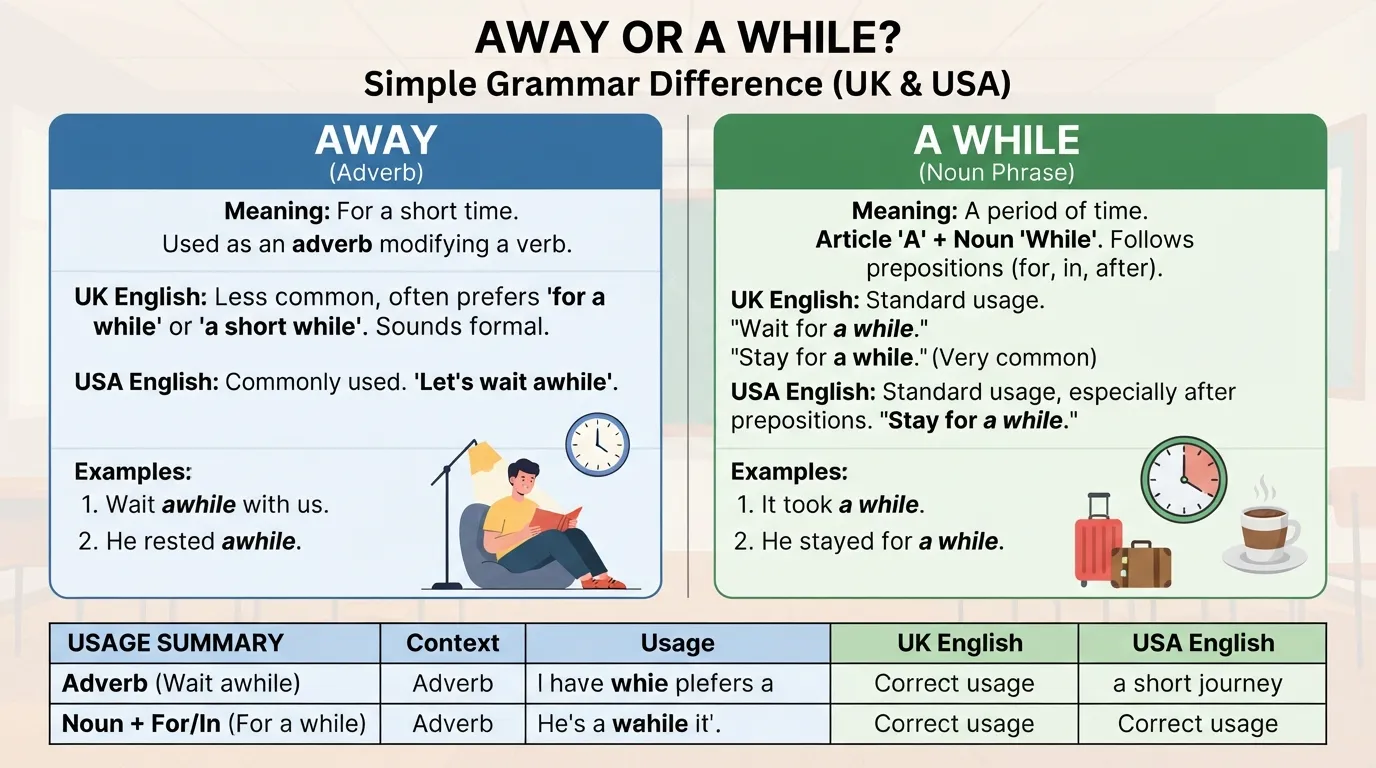
“Awhile” is one word, an adverb, meaning “for a short time.” It follows a verb directly, like “stay awhile.”
“A while” is two words, a noun phrase, meaning “a period of time.” It follows a preposition, like “for a while” or “in a while.”
⚡ Quick Rule in 1 Line
“After a preposition, use two words: a while. Otherwise, one word works: awhile.”
The Difference Explained
“Awhile” and “a while” both relate to time, but they work differently in a sentence.
“Awhile” is an adverb. It directly modifies a verb, describing how long an action lasts: “Let’s stay awhile.”
“A while” is a noun phrase, made of the article “a” and the noun “while.” It often follows a preposition like “for,” “in,” or “after”: “Let’s stay for a while.”
Grammar Rule: The Preposition Test
Prepositions need a noun or noun phrase as their object, not an adverb. That’s the entire rule in one sentence.
Since “a while” is a noun phrase, it can follow prepositions: “for a while,” “in a while,” “after a while.”
Since “awhile” is an adverb, it cannot follow a preposition. “For awhile” is grammatically incorrect, even though it’s a very common mistake.
Without a preposition, both often work: “Stay awhile” and “stay a while” are both acceptable, though “awhile” is more traditional in that spot.
Comparison Table
| Feature | Awhile | A While |
|---|---|---|
| Part of speech | Adverb | Noun phrase |
| Word count | One word | Two words |
| Follows a preposition? | No | Yes |
| Example | Let’s rest awhile. | Let’s rest for a while. |
| Common mistake | “For awhile” (incorrect) | — |
Memory Trick
If you can swap in another time word, like “an hour” or “a moment,” and the sentence still works, use “a while”: “I’ll see you in a while” becomes “I’ll see you in an hour.”
If the word directly follows a verb with no preposition in between, “awhile” usually fits: “Stay awhile.”
Example Sentences
Using “awhile” (adverb, no preposition)
- Let’s stay awhile and talk.
- She paused awhile before answering.
- Wait awhile before calling back.
- He rested awhile after the hike.
- Stay awhile, dinner isn’t ready yet.
Using “a while” (noun phrase, after a preposition)
- I’ll be there in a while.
- We haven’t spoken in a while.
- She left for a while and came back later.
- It’s been quite a while since we last met.
- He returned after a while.
Common Mistakes
❌ “I’ll wait for awhile.” ✅ “I’ll wait for a while.” (or simply “I’ll wait awhile”)
❌ “See you in awhile.” ✅ “See you in a while.”
❌ Assuming “awhile” and “a while” are always interchangeable. ✅ Checking whether a preposition comes right before the word.
When to Use Each Form
Use “awhile” when it directly follows a verb, with no preposition in between: “stay awhile,” “wait awhile,” “rest awhile.”
Use “a while” whenever it follows a preposition like “for,” “in,” “after,” or “since,” or whenever you could swap in another time noun, like “an hour.”
Expert Tip 💡
If you’re ever unsure, “a while” is the safer default. It works correctly in nearly every context, including the ones where “awhile” also works.
Quick Quiz
- “I haven’t seen her ___.” (awhile / for a while)
- “Let’s ___ before deciding.” (wait awhile / wait for awhile)
Answers: 1. for a while · 2. wait awhile
FAQs
Is “awhile” one word or two?
“Awhile” is always one word when used as an adverb. “A while,” the noun phrase, is always two words.
Is “for awhile” ever correct?
No. “For awhile” is a common but incorrect phrase. Use “for a while” instead.
Can “awhile” and “a while” be used interchangeably?
Sometimes, but only when there’s no preposition involved, such as “stay awhile” versus “stay a while.” After a preposition, only “a while” works.
What part of speech is “awhile”?
It’s an adverb, meaning “for a short time,” and it modifies a verb directly.
What part of speech is “a while”?
It’s a noun phrase, made of the article “a” and the noun “while,” meaning “a period of time.”
Is “a while ago” correct?
Yes. “A while ago” is correct, since “while” functions as a noun here, not following a true preposition in the same way.
How can I test which one to use?
Check if a preposition comes right before the word. If it does, use “a while.” If not, “awhile” often works.
Is this rule the same in British and American English?
Yes, the grammatical rule is the same in both varieties of English.
Conclusion
“Awhile” and “a while” both relate to time, but they follow different grammatical rules.
“Awhile” is a single-word adverb that follows a verb directly. “A while” is a two-word noun phrase that follows a preposition.
Check whether a preposition comes right before the word, and you’ll always pick the right form.

Hi, I’m Ethan Brooks. I create easy-to-follow grammar guides, writing tips, and vocabulary resources to make English learning enjoyable for everyone.