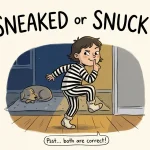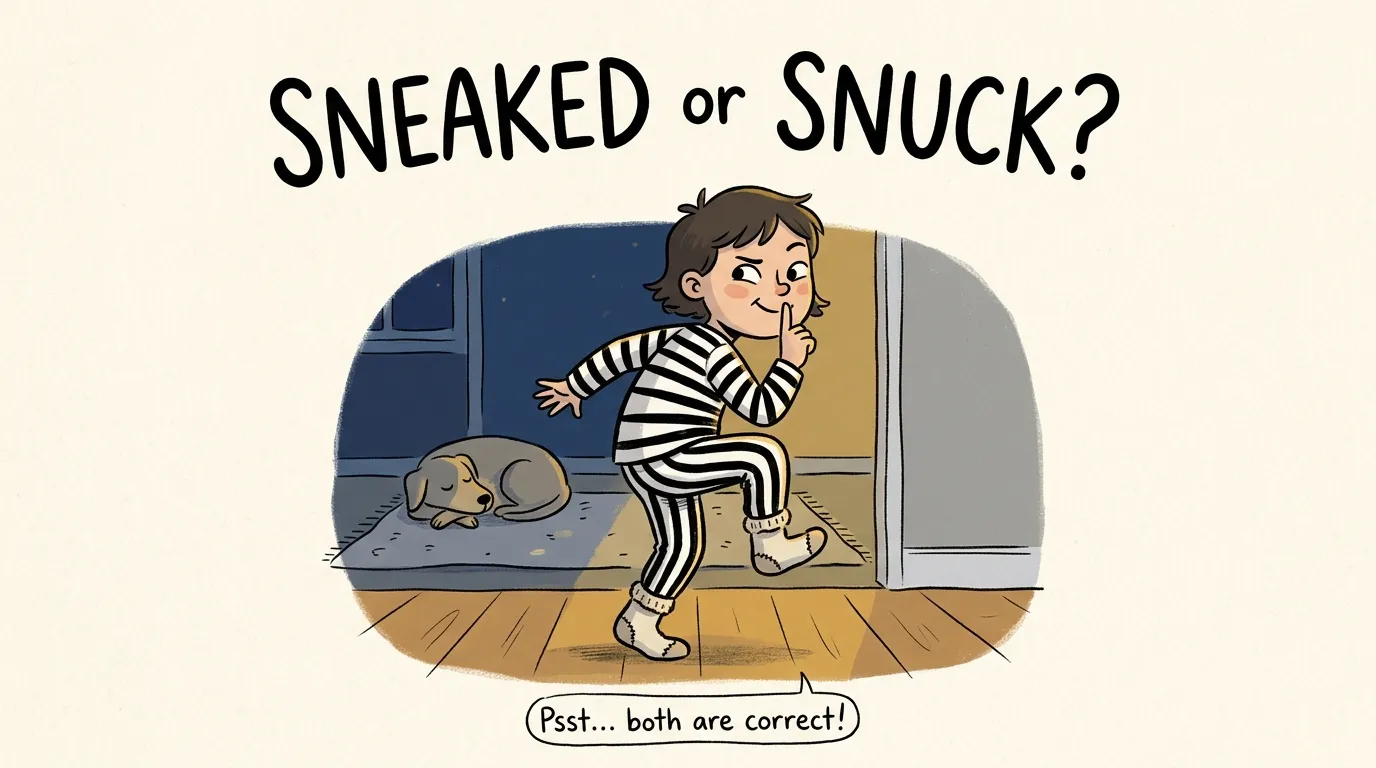
Sneaked or snuck? Both spellings are correct past-tense forms of the verb sneak.
The word sneaked is the regular past tense, while snuck is an established alternative that is especially common in American English.
For example, you can write, “She sneaked out of the house” or “She snuck out of the house.” Both sentences mean that she left secretly or quietly, trying not to be noticed.
The main difference is usage. Sneaked is often preferred in British English and formal writing, while snuck is widely used in everyday American English.
However, neither form is automatically wrong in every situation.
In this guide, you’ll learn when to use sneaked or snuck, how they differ across English varieties, and how to choose the right form for your writing.
Quick Answer: Sneaked or Snuck?
Both sneaked and snuck are correct. Use sneaked as the regular past-tense form of sneak. Use snuck when it suits your audience and writing style, especially in informal American English.
| Word | Correct? | Common Usage |
| Sneaked | Yes | Regular form; common in British English and formal writing |
| Snuck | Yes | Especially common in American English and informal speech |
| Sneak | Yes | Present-tense and base form |
| Sneaking | Yes | The -ing form of the verb |
Simple rule: If you’re unsure, sneaked is a safe choice in formal writing. For natural, conversational American English, snuck is also perfectly acceptable.
What Does Sneaked Mean?
Sneaked is the regular past tense and past participle of sneak. The verb means to move, enter, leave, look, or do something secretly or quietly, usually to avoid being noticed.
For example:
- She sneaked out of the room.
- He sneaked into the kitchen for a snack.
- They sneaked past the sleeping dog.
- I sneaked a quick look at the answer.
- We sneaked into the garden without making a sound.
In each sentence, the action happens secretly or discreetly.
Sneaked as the Simple Past Tense
Use sneaked to describe an action that happened in the past.
Examples:
- The children sneaked downstairs after bedtime.
- He sneaked into the office before everyone arrived.
- I sneaked a glance at my phone during the meeting.
- She sneaked an extra cookie from the kitchen.
- They sneaked away before the guests noticed.
Sneaked as a Past Participle
You can also use sneaked after helping verbs such as has, have, and had.
Examples:
- She has sneaked out before.
- They have sneaked into the building several times.
- He had sneaked away before the discussion ended.
- I had sneaked a look at the letter before returning it.
The word remains sneaked in these examples because it is the regular past participle.
What Does Snuck Mean?
Snuck is an alternative past-tense and past-participle form of sneak. It has the same meaning as sneaked: to move or act secretly, often to avoid being seen or heard.
Examples:
- She snuck out after everyone went to bed.
- He snuck into the kitchen for a snack.
- They snuck past the guard.
- I snuck a quick look at the message.
- We snuck away before the meeting finished.
The meaning does not change when you use snuck instead of sneaked. The difference lies mainly in style and regional preference.
Snuck in Everyday Conversation
Snuck is particularly natural in informal American English.
Examples:
- I snuck an extra cookie before dinner.
- He snuck out to meet his friends.
- She snuck a peek at the birthday present.
- We snuck into the movie just before it started.
- They snuck away while everyone was distracted.
These sentences sound natural in casual conversation, personal stories, and informal writing.
Snuck as a Past Participle
Snuck can also follow has, have, and had.
Examples:
- She has snuck out before.
- He had snuck into the room unnoticed.
- They have snuck snacks into the cinema.
- I had snuck a quick look before putting the letter away.
These constructions are especially familiar in American English.
Sneaked vs Snuck: Key Differences
The two words communicate the same action, but their use can vary by region and context.
| Feature | Sneaked | Snuck |
| Meaning | Moved or acted secretly | Same meaning |
| Grammar | Regular past tense and past participle | Alternative past tense and past participle |
| American English | Correct and widely understood | Especially common in everyday usage |
| British English | Traditional and generally safe | Used by some speakers; may sound more American or informal |
| Formal writing | Often a safe choice | Acceptability depends on the style guide and audience |
| Informal conversation | Natural | Very natural, especially in American English |
| Present tense | Sneak | Sneak |
| -ing form | Sneaking | Sneaking |
Neither form changes the basic meaning of the sentence. Choose according to your audience, tone, and preferred spelling convention.
Is Sneaked or Snuck More Common in American English?
Both forms are used in American English, but snuck is especially common in everyday conversation.
For example:
- I sneaked out of the office early.
- I snuck out of the office early.
Both sentences are correct. The second may sound more conversational to many American speakers.
You might hear snuck in stories, casual emails, social media posts, and everyday discussions. Meanwhile, sneaked remains a valid option in American writing and speech.
If you’re writing a formal report, academic assignment, or professional document, check whether your style guide recommends one form. If no specific rule applies, either can work when used consistently.
Is Sneaked or Snuck More Common in British English?
Sneaked is generally the safer traditional choice in British English.
For example:
- She sneaked out before the teacher returned.
- He sneaked into the room without making a noise.
- They sneaked a look at the results.
British speakers also use snuck, but some readers may associate it more strongly with American English or informal speech.
If you’re writing for a British audience and want a conventional choice, use sneaked. However, don’t assume that snuck is universally incorrect in British English. Usage varies among speakers and contexts.
Sneaked or Snuck in Other English-Speaking Countries
English spelling and grammar preferences can vary by region, but the choice between these forms is not as straightforward as some American-versus-British spelling pairs.
| Audience | Practical Recommendation |
| United States | Both are correct; snuck is especially common in informal usage |
| United Kingdom | Sneaked is a safe traditional choice |
| Australia | Sneaked is a safe choice for formal writing; snuck may also occur |
| Canada | Both forms are understood; follow your preferred style |
| New Zealand | Sneaked is a safe choice in formal writing |
| International audience | Choose one form and use it consistently |
These are practical writing recommendations, not absolute rules for every speaker or publication. A publisher’s house style should take priority when one is provided.
15 Examples of Sneaked and Snuck in Sentences
The following pairs show how both forms can be used to describe the same action.
| Sneaked | Snuck |
| She sneaked out of the house at midnight. | She snuck out of the house at midnight. |
| He sneaked into the kitchen for food. | He snuck into the kitchen for food. |
| They sneaked past the sleeping dog. | They snuck past the sleeping dog. |
| I sneaked a look at the answer. | I snuck a look at the answer. |
| We sneaked away before the guests arrived. | We snuck away before the guests arrived. |
| The children sneaked downstairs after bedtime. | The children snuck downstairs after bedtime. |
| He sneaked into the office early. | He snuck into the office early. |
| She sneaked an extra cookie from the jar. | She snuck an extra cookie from the jar. |
| They sneaked into the cinema quietly. | They snuck into the cinema quietly. |
| I sneaked a peek at the gift. | I snuck a peek at the gift. |
| The cat sneaked into the bedroom. | The cat snuck into the bedroom. |
| He sneaked out during the break. | He snuck out during the break. |
| We sneaked through the back door. | We snuck through the back door. |
| She sneaked a message to her friend. | She snuck a message to her friend. |
| They sneaked away without saying goodbye. | They snuck away without saying goodbye. |
Each pair has essentially the same meaning. The choice depends on the style and variety of English you want to use.
Sneaked or Snuck in Different Situations
1. In Academic Writing
If you’re writing an essay for school or university, sneaked is a safe option, especially when following a traditional or British English style.
Example:
“The suspect sneaked into the building after closing time.”
However, if your instructor or style guide accepts snuck, you can use it where appropriate.
2. In Everyday Conversation
In casual American conversation, snuck often sounds natural.
Example:
“I snuck downstairs to get a glass of water.”
You could also say, “I sneaked downstairs to get a glass of water.” Both are correct.
3. In Professional Writing
For business reports, formal documents, and official communications, choose the form that fits your organization’s style guide.
Example:
“The employee sneaked out of the meeting before it ended.”
In most professional contexts, clarity and consistency matter more than choosing one universally preferred form.
4. In Fiction and Storytelling
Writers can choose either form to suit a character’s voice and the tone of a story.
Examples:
- “He sneaked through the garden and disappeared into the night.”
- “She snuck downstairs, hoping nobody would hear her.”
Both sentences work. Snuck may feel more conversational in some contexts, while sneaked can suit a more traditional narrative style.
Common Mistakes to Avoid
Mistake 1: Assuming Snuck Is Always Wrong
Incorrect claim: “Snuck is not a real word.”
Better explanation: Snuck is an established alternative past-tense and past-participle form of sneak, particularly common in American English.
Mistake 2: Assuming Sneaked Is Outdated
Incorrect claim: “Nobody uses sneaked anymore.”
Better explanation: Sneaked remains correct and widely understood. It is also a safe choice in traditional and formal writing.
Mistake 3: Mixing Forms Without a Reason
If you are writing a story or article, avoid switching between the forms randomly when one consistent style would work better.
For example, you might write:
“He snuck outside, then sneaked back into the house.”
This is grammatically possible, but using the same form throughout may improve consistency:
“He sneaked outside, then sneaked back into the house.”
Or:
“He snuck outside, then snuck back into the house.”
Mistake 4: Confusing Sneak With Sneaking
Sneak is the base form, while sneaking is the -ing form.
Examples:
- Present: I sneak out early.
- Past: I sneaked out early.
- Alternative past: I snuck out early.
- Continuous: I am sneaking out early.
The correct form depends on the tense and sentence structure.
Mistake 5: Forgetting the Past Participle
Both sneaked and snuck can follow has, have, or had.
Examples:
- She has sneaked out.
- She has snuck out.
Both are acceptable, although regional and stylistic preferences may differ.
An Easy Way to Remember the Difference
Use this simple memory trick:
Sneaked = regular form.
Snuck = alternative form, especially common in American English.
Think of sneaked as the straightforward past tense formed by adding -ed. Remember snuck as the shorter alternative you often hear in casual American speech.
Both forms share the same base verb:
- Present: Sneak
- Past: Sneaked or snuck
- Past participle: Sneaked or snuck
- -ing form: Sneaking
If you’re unsure which form to choose for formal writing, sneaked is a practical default.
Quick Practice Quiz
Test your understanding with these five questions.
1. Which two words are correct past-tense forms of sneak?
A. Sneaked and snuck
B. Sneak and sneaking
C. Snooked and sneaked
2. Which form is especially common in informal American English?
A. Sneaking
B. Snuck
C. Sneak
3. Complete the sentence: “She ___ out before anyone noticed.”
A. Sneaked
B. Sneaking
C. Sneak
4. Which form is a safe traditional choice for British English?
A. Snooked
B. Sneaked
C. Sneaking
5. Complete the sentence: “He has ___ into the kitchen.”
A. Sneak
B. Sneaking
C. Sneaked or snuck
Answers:
- A — Sneaked and snuck
- B — Snuck
- A — Sneaked
- B — Sneaked
- C — Sneaked or snuck
Remember that the best choice can depend on the variety of English and the writing style you follow.
FAQs
1. Is it sneaked or snuck?
Both are correct. Sneaked is the regular past-tense form, while snuck is an established alternative that is especially common in American English.
2. Is snuck grammatically correct?
Yes. Snuck is an accepted past-tense and past-participle form of sneak. It is widely used in American English.
3. Is sneaked more correct than snuck?
Not universally. Sneaked is the regular form and is often preferred in traditional British English or formal contexts. Snuck is also correct, particularly in American English.
4. Is snuck American or British English?
Snuck is especially common in American English. Some British speakers also use it, although sneaked is generally the safer traditional choice in British writing.
5. What is the past tense of sneak?
The past tense of sneak can be either sneaked or snuck. Both describe an action that happened secretly in the past.
6. Is it has sneaked or has snuck?
Both forms are possible: “She has sneaked out” and “She has snuck out.” The preferred choice depends on regional usage and style.
7. Can I use snuck in a formal essay?
You can, provided it fits the required style guide. If you are unsure or writing in a traditional British English style, sneaked is a safer choice.
8. Do sneaked and snuck mean the same thing?
Yes. Both mean that someone moved or acted secretly or quietly, often to avoid being noticed.
9. What is the present tense of sneaked and snuck?
The base form is sneak. For example, “I sneak out quietly.” The -ing form is sneaking.
10. Which word should English learners remember?
Learn both forms. Use sneaked as the regular past tense and recognize snuck as a common alternative, especially in American English.
Conclusion
The choice between sneaked or snuck depends mainly on your audience and writing style. Both forms are correct and describe the same action: moving or doing something secretly.
Sneaked is the regular past tense and a safe choice for traditional British English and many formal contexts.
Snuck is especially common in informal American English, although it is also used elsewhere.
If you are unsure, choose sneaked and keep your writing consistent. When a more conversational American tone suits your sentence, snuck is a perfectly reasonable choice.

Hi, I’m Sophia Bennett. My goal is to make grammar easy, clear, and useful through simple explanations and real-life examples.