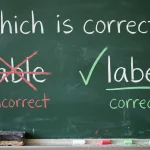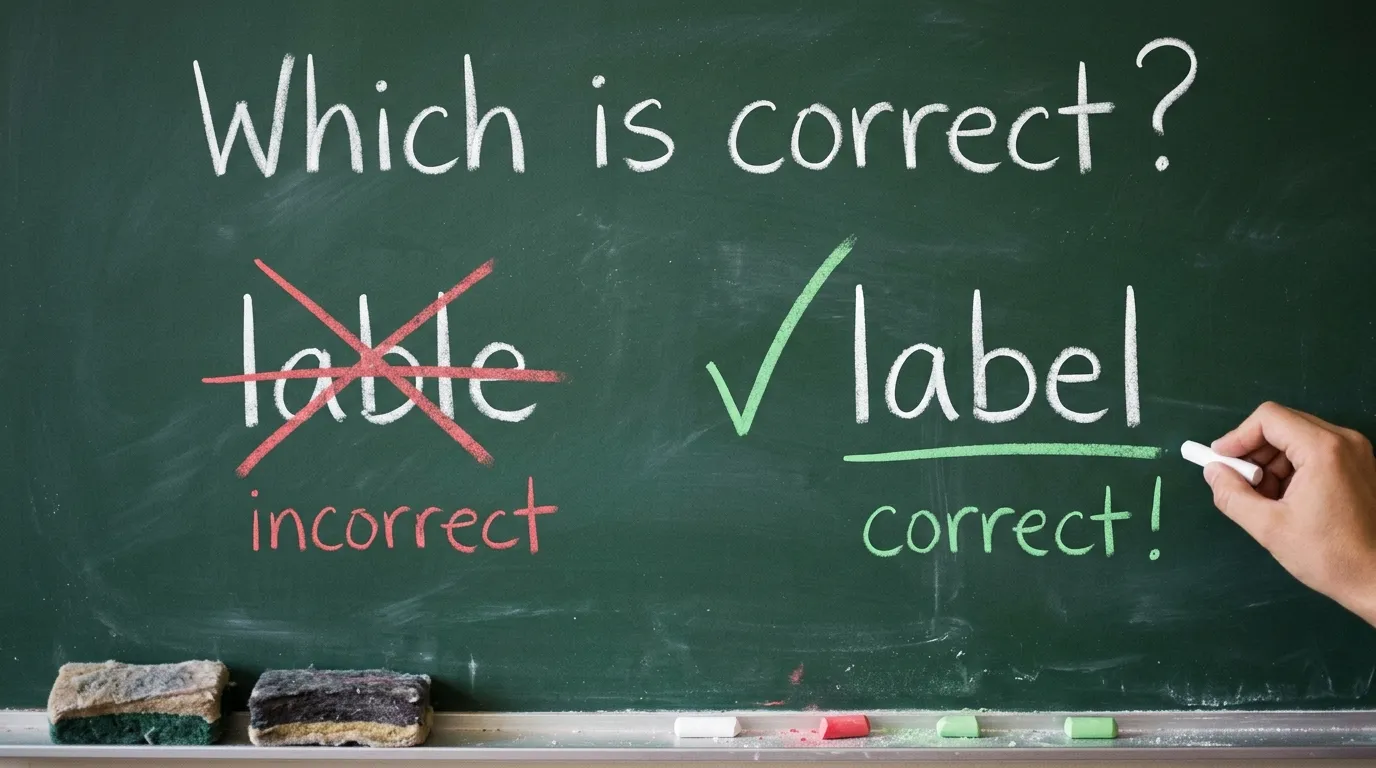
Lable or label: Which spelling is correct? The correct spelling in standard English is label.
The spelling lable is a common misspelling and should generally be avoided in schoolwork, professional writing, emails, and website content.
A label is a piece of paper, a sticker, or another mark that gives information about an item. It can also mean a word used to describe a person, thing, or category.
For example, you might put a label on a box, read a label on a food package, or label a folder to keep your files organized.
The confusion happens because label is pronounced with two syllables, and some writers accidentally switch the final letters.
Fortunately, the correct spelling is easy to remember. In this guide, you’ll learn what label means, how to use it as a noun and verb, common mistakes to avoid, and the difference between American and British spelling.
Table of Contents
- Lable or Label: Quick Answer
- What Does Label Mean?
- Is Lable a Correct Word?
- Label as a Noun
- Label as a Verb
- Label in a Sentence
- Label, Labeled, and Labelled
- Common Spelling Mistakes
- Easy Ways to Remember the Spelling
- Frequently Asked Questions
- Conclusion
Lable or Label: Quick Answer
Label is the correct spelling in standard English. It can refer to a sticker or tag that identifies an object, or it can mean to attach identifying information to something. It can also mean to describe or classify a person or thing.
Lable is generally a spelling error, not an accepted alternative spelling of label.
Examples:
- Correct: Please put a label on the package.
- Incorrect: Please put a lable on the package.
According to the Cambridge Dictionary, label is used as both a noun and a verb.
Quick Rule
Always spell the word label: L-A-B-E-L, not lable.
What Does Label Mean?
The word label has several meanings, depending on how you use it. It commonly refers to information attached to an object, but it can also describe the act of identifying or classifying something.
1. Label as a Name or Tag
A label can be a sticker, tag, or piece of material that provides information about an object.
Examples:
- The bottle has a clear label.
- Write your name on the label.
- The shipping label includes the delivery address.
- Read the product label before using the item.
In these examples, the label helps people identify an item or understand important information about it.
2. Label as a Description
A label can also be a word or phrase used to describe a person, group, object, or idea.
Examples:
- She dislikes the label of being careless.
- The teacher used a simple label to organize the categories.
- That label does not accurately describe his work.
In this sense, a label can sometimes oversimplify a person or situation.
3. Label as a Verb
As a verb, label means to attach a label, write identifying information, or describe something in a particular way.
Examples:
- Please label each folder.
- We need to label the boxes before moving.
- Don’t label someone without understanding their situation.
The meaning depends on the context, but the spelling remains the same: label.
Is Lable a Correct Word?
In standard English, lable is a misspelling of label. It is not the normal spelling used by major English dictionaries.
People may type lable because they remember the sound of the word but forget the order of the letters. The correct sequence is L-A-B-E-L.
Compare these examples:
| Incorrect | Correct |
| lable | label |
| adress | address |
| recieve | receive |
| seperate | separate |
| untill | until |
These words illustrate how a small spelling error can make a familiar word incorrect.
Why Do People Write Lable?
There are a few common reasons:
- Letter order confusion: Writers may accidentally switch the final letters.
- Typing too quickly: The mistake can happen when writing without checking.
- Visual familiarity: The incorrect form may look familiar after repeated exposure.
- Limited proofreading: Spell-checking or rereading can catch the error before publication.
The solution is simple: learn the correct spelling and check the word when proofreading.
Label as a Noun
A noun names a person, place, thing, or idea. When used as a noun, label usually means an identifying tag, sticker, name, or descriptive category.
Examples of Label as a Noun
- The label on the bottle lists its ingredients.
- I printed a new address label for the parcel.
- The shirt’s care label says to wash it in cold water.
- The company changed the design of its product label.
- The box had no label, so we didn’t know where it belonged.
- She removed the price label before giving the gift.
- The warning label explains how to handle the product safely.
- He felt that the label was unfair.
- Each folder needs a label for easy identification.
- The record label released a new album.
Common Types of Labels
| Type of label | Purpose | Example |
| Address label | Shows delivery details | Put the address label on the parcel. |
| Product label | Identifies a product | Check the product label for details. |
| Food label | Provides food information | Read the food label before buying. |
| Warning label | Communicates a risk | The warning label explains the danger. |
| Name label | Identifies a person or owner | Add a name label to the school bag. |
| Clothing label | Provides brand or care information | Check the clothing label before washing. |
A label can be printed, written, attached, or displayed digitally. Its main purpose is to identify something or communicate information.
Label as a Verb
A verb describes an action or state. As a verb, label means to mark something with information or classify someone or something.
Examples of Label as a Verb
- Please label all the boxes.
- The teacher asked us to label the diagram.
- We should label the files by date.
- The workers label every package before shipping.
- Don’t label people based on one mistake.
- She decided to label each container clearly.
- The company will label its new products.
- They label the folders according to subject.
In each example, label describes an action.
Different Forms of the Verb Label
The spelling changes slightly when certain endings are added.
| Verb form | American English | British English |
| Base form | label | label |
| Third-person singular | labels | labels |
| Past tense | labeled | labelled |
| Past participle | labeled | labelled |
| -ing form | labeling | labelling |
The main word is always label. The regional spelling difference appears in forms such as labeled/labelled and labeling/labelling.
Label, Labeled, and Labelled: What’s the Difference?
Although label is the standard base form in both American and British English, some of its forms follow different regional spelling conventions.
Label
Use label for the base form of the word.
Example: Please label the containers.
Labeled
Labeled is the usual American English spelling of the past tense and past participle.
Example: The boxes were labeled before delivery.
Labelled
Labelled is the usual British English spelling of the past tense and past participle.
Example: The boxes were labelled before delivery.
Both labeled and labelled are correct. The difference is regional, not a difference in meaning.
The Cambridge Dictionary’s label entry records the spelling distinction between US and UK English.
For a more detailed comparison, read Grammarlify’s existing article: Labelled or Labeled.
Label in a Sentence: More Examples
Here are additional examples showing how to use label correctly in everyday English.
Everyday Examples
- Put a label on your lunchbox.
- I need to label my school supplies.
- The label on the jar is difficult to read.
- Please label your notebook with your name.
- The package arrived with the wrong label.
School and Office Examples
- The students had to label the parts of the plant.
- Each file needs a clear label.
- She labeled the folders by department. (American English)
- He labelled the folders by department. (British English)
- The teacher checked whether every diagram was correctly labeled.
Business Examples
- The manufacturer printed a new product label.
- Workers must label each shipment correctly.
- The company uses a different label for each product line.
- The packages were labeled with tracking information.
- The store checked every item for a missing label.
These sentences demonstrate that label can function as either a noun or a verb. The sentence structure tells you which meaning applies.
Common Spelling Mistakes to Avoid
Mistake 1: Writing Lable Instead of Label
Incorrect: Please write your name on the lable.
Correct: Please write your name on the label.
Why? The correct spelling places the letters in this order: L-A-B-E-L.
Mistake 2: Assuming Labelled Is Incorrect
Incorrect assumption: Labelled is always a spelling mistake.
Correct understanding: Labelled is standard in British English, while labeled is standard in American English.
Why? These are recognized regional spelling forms. They are different from lable, which is generally a misspelling.
Mistake 3: Mixing American and British Spellings
If you use American English, write labeled and labeling. If you use British English, write labelled and labelling.
Mixing the two systems within the same article can make the writing look inconsistent. Choose one style and use it throughout.
Mistake 4: Using Label When You Need Labeled
Incorrect: The package was label yesterday.
Correct: The package was labeled yesterday. (American English)
Correct: The package was labelled yesterday. (British English)
Why? The sentence describes a completed action, so it needs the past participle.
Easy Ways to Remember the Correct Spelling
Use these simple tricks to remember label.
1. Break It Into Letters
Remember the spelling as:
L-A-B-E-L
Say each letter slowly when you are unsure. Pay special attention to the order of the final three letters: B-E-L.
2. Connect It With a Familiar Object
Think of a sticker on a bottle or a name tag on a school bag. That sticker is a label.
Visualizing the object can help you connect the word with its correct spelling.
3. Remember the Base Word
The word stays label in both American and British English. The extra l appears in certain British forms, such as labelled and labelling.
It does not turn the base word into lable.
4. Use a Short Practice Sentence
Write this sentence a few times:
“Please put a label on the box.”
Then try another:
“Every folder needs a label.”
Repeated practice can help you recognize the correct letter order more quickly.
Quick Practice Quiz
Choose the correct spelling in each sentence.
- Please put a (lable / label) on the bottle.
- The package was (labeled / labled) before shipping.
- We need to (label / lable) every folder.
- The product (label / lable) lists the ingredients.
- The boxes were (labelled / lableled) before delivery.
Answers:
- Label
- Labeled
- Label
- Label
- Labelled
Remember that labeled and labelled are both correct regional forms. The incorrect spelling in the first and third questions is lable.
FAQs
1. Is it lable or label?
Label is correct in standard English. Lable is generally a misspelling. Use label when referring to a tag, sticker, description, or the act of identifying something.
2. Is lable a real English word?
Lable is not the standard spelling of the word discussed in this article. In normal English writing, use label instead.
3. What does label mean?
A label is a tag or mark that gives information about something. As a verb, label means to attach identifying information or describe something in a particular way.
4. How do you spell label correctly?
Spell it L-A-B-E-L. Remember that the final letters are E-L, not L-E.
5. Is label a noun or a verb?
It can be both. As a noun, it refers to a tag or description. As a verb, it means to mark, identify, or classify something.
6. Is labelled correct in British English?
Yes. Labelled is the usual British English spelling of the past tense and past participle. American English generally uses labeled.
7. Is labeling or labelling correct?
Both are correct, depending on the variety of English. Labeling is standard in American English, while labelling is standard in British English.
8. What is the plural of label?
The plural is labels.
Example: The labels on these bottles are easy to read.
9. What is the past tense of label?
The past tense is labeled in American English and labelled in British English.
Examples:
- American: She labeled the folders.
- British: She labelled the folders.
10. How can I avoid spelling label incorrectly?
Remember the letter order L-A-B-E-L, use the word in practice sentences, and proofread your writing. A spell-checking tool can also help identify the mistake.
Conclusion
When choosing between lable or label, always use label in standard English. The word can refer to a sticker or tag, a descriptive name, or the action of marking something with information.
For example, you might read a label on a food package, label your school supplies, or add an address label to a parcel. The meaning changes with the sentence, but the base spelling remains the same.
Remember that labeled and labelled are both correct past-tense forms, depending on whether you’re following American or British English. However, lable is generally a spelling error.
Once you remember the correct letter order, you’ll find it much easier to use label confidently in everyday writing.

Hi, I’m Sophia Bennett. My goal is to make grammar easy, clear, and useful through simple explanations and real-life examples.