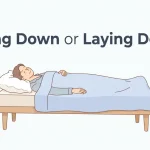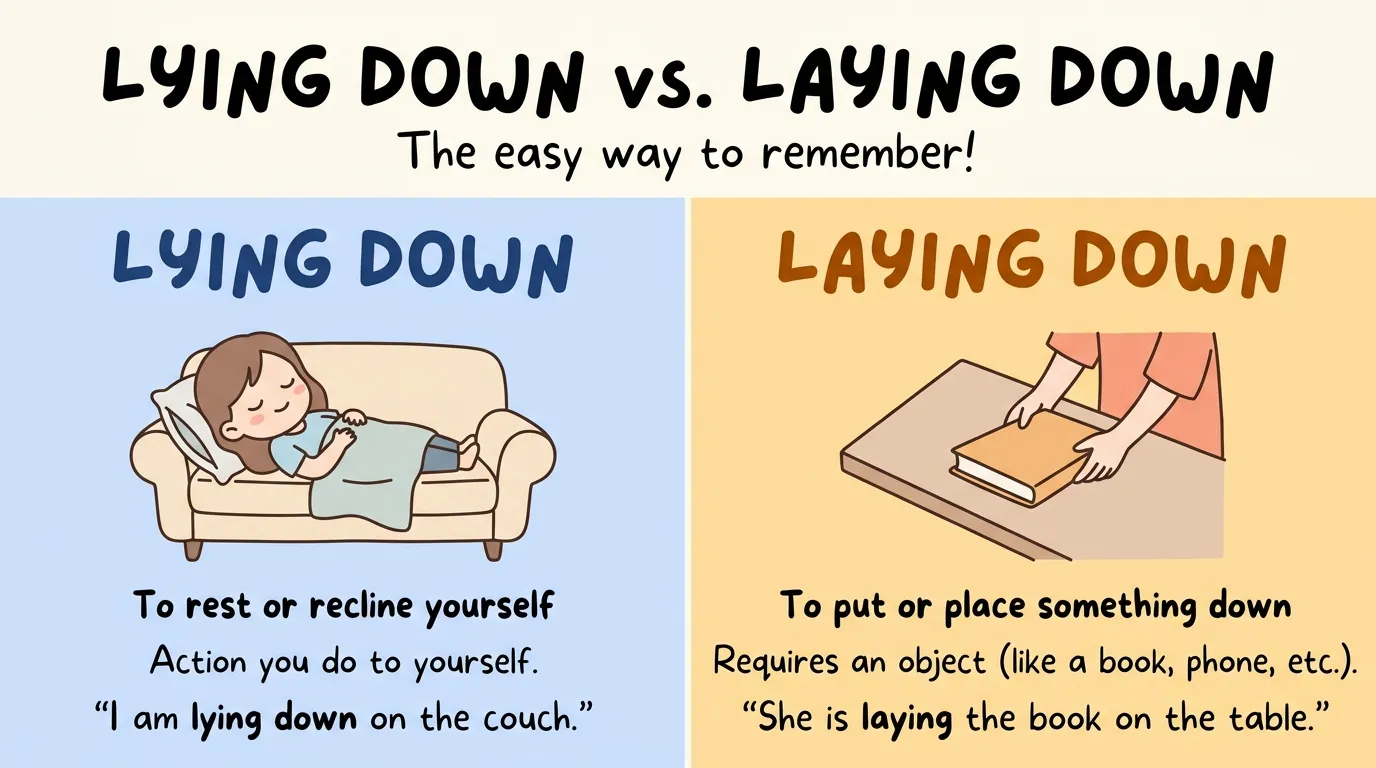
Have you ever wondered whether to write “I am laying down” or “I am lying down”? Both phrases are common in everyday English, but they do not mean exactly the same thing.
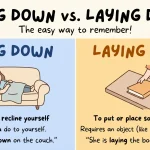
The correct choice depends on what you are doing. If you are resting your body on a bed, couch, or floor, use lying down. If you are putting something on a surface, use laying down.
For example, “I am lying down because I am tired” is correct. However, “I am laying down my phone” is also correct because you are placing an object somewhere.
The confusion comes from the unusual relationship between the verbs lie and lay. Their forms overlap in the past tense, which makes the difference harder to remember.
In this guide, you will learn when to use each phrase, see practical examples, understand their verb forms, and discover a simple trick for choosing the right one.
Laying Down vs Lying Down: Quick Answer
Lying down is the correct phrase when you mean that you are resting your body in a horizontal position. Laying down is correct when you are putting something or someone down and the sentence has an object.
Examples:
- Correct: I am lying down on the sofa.
- Correct: I am laying down my jacket.
- Correct: She is lying down because she feels tired.
- Correct: She is laying down the rules for the team.
Quick Rule
Lie down to rest your body; lay something down to place it somewhere.
What Does Lying Down Mean?
Lying down means resting or moving into a horizontal position. You use it when a person or animal reclines on a bed, couch, floor, or another surface.
The phrase comes from the verb lie, which does not need a direct object when it describes a resting position.
Examples of Lying Down
- I am lying down because I have a headache.
- She is lying down on her bed and reading a book.
- The dog is lying down beside the fireplace.
- We are lying down on the grass and looking at the clouds.
- He was lying down when the phone rang.
- The baby is lying down in the crib.
In each example, the subject is resting. Nobody is placing a separate object somewhere.
When Should You Use Lying Down?
Use lying down in situations such as these:
- Resting: “I am lying down after a long day at work.”
- Sleeping: “The child is lying down for a nap.”
- Feeling unwell: “She is lying down because she feels dizzy.”
- Relaxing: “We are lying down on the beach.”
- Describing an animal: “The cat is lying down in the sun.”
Remember that lying can have other meanings in English, including telling something untrue. However, in the phrase lying down, it describes resting or reclining.
What Does Laying Down Mean?
Laying down means placing something or someone in a particular position. It comes from the verb lay, which generally takes a direct object.
A direct object is the person or thing that receives the action.
For example, in “I am laying down the book,” the book is the object being placed down.
Examples of Laying Down
- I am laying down my phone on the table.
- She is laying down a blanket for the baby.
- He is laying down the tools before dinner.
- They are laying down new rules for the game.
- The worker is laying down tiles on the floor.
- We are laying down the cards before starting the game.
Notice that each sentence identifies something being placed or established.
When Should You Use Laying Down?
Use laying down in these situations:
1. Placing an object
“I am laying down my keys.”
You are putting the keys on a surface.
2. Placing a person or animal somewhere
“She is laying the baby down in the crib.”
The baby is the object of the action. In this example, the correct form is laying the baby down, not laying down the baby in every context; both orders can be grammatical, but the first is often more natural.
3. Establishing rules or expectations
“The manager is laying down clear rules.”
Here, laying down means establishing or setting out rules.
4. Placing material on a surface
“They are laying down new flooring.”
The verb describes putting material into position.
Lying Down vs Laying Down: Key Differences
Both expressions are grammatically correct, but you must use them in the right context.
| Feature | Lying down | Laying down |
| Main verb | Lie | Lay |
| Basic meaning | Resting or reclining | Placing something down |
| Needs a direct object? | No, when describing reclining | Usually yes |
| Correct example | I am lying down. | I am laying down the book. |
| Another example | The dog is lying down. | She is laying down a blanket. |
| Common mistake | — | Using it for reclining without an object |
Compare These Sentences
Example 1
- Correct: “I am lying down on the bed.”
- Incorrect in standard edited English: “I am laying down on the bed.”
The first sentence describes your own position. You are not placing a separate object anywhere.
Example 2
- Correct: “I am laying down my bag.”
- Incorrect for this meaning: “I am lying down my bag.”
The bag is receiving the action, so laying is the right choice.
Example 3
- Correct: “The dog is lying down.”
- Correct: “The owner is laying the dog down.”
In the first sentence, the dog is resting. In the second, the owner is moving the dog into a resting position.
The easiest way to choose is to identify what receives the action. If the subject is simply resting, use lying. If the subject is putting something or someone down, use laying.
The Difference Between Lie and Lay
To understand these phrases fully, you need to know the basic forms of both verbs.
The main difficulty is that lay is the present tense of one verb and the past tense of another.
Verb Forms of Lie and Lay
| Tense or form | Lie (recline) | Lay (put something down) |
| Base form | Lie | Lay |
| Present participle | Lying | Laying |
| Simple past | Lay | Laid |
| Past participle | Lain | Laid |
Examples:
- Present: “I lie down when I feel tired.”
- Present continuous: “I am lying down now.”
- Simple past: “I lay down yesterday.”
- Present perfect: “I have lain here for an hour.”
- Present continuous with an object: “I am laying the book on the desk.”
- Simple past with an object: “I laid the book on the desk.”
The form lain is correct in standard English, although it is less common in everyday conversation than forms such as have been lying.
Why Is “I Lay Down Yesterday” Correct?
This is one of the most confusing parts of English grammar.
The present-tense verb is lie when you mean to recline. However, its simple past form is lay.
That means these sentences are correct:
- Today, I lie down after lunch.
- Right now, I am lying down.
- Yesterday, I lay down after lunch.
Do not confuse this past-tense lay with lay meaning “to place something.”
Compare:
- “Yesterday, I lay down for a nap.” — I rested.
- “Yesterday, I laid down my phone.” — I placed my phone somewhere.
Cambridge Dictionary explains this distinction in its guide to lay or lie.
Is “I Am Laying Down” Ever Correct?
Yes, the phrase can be correct when an object is understood from the context, but it is not the standard choice when you simply mean that you are reclining.
For example:
- “I am laying down the book.” — Correct.
- “I am laying down the law.” — Correct; this means asserting authority or stating rules firmly.
- “I am lying down because I am exhausted.” — Correct for resting your body.
In casual conversation, some speakers use laying down to mean resting. However, standard edited English generally distinguishes the two verbs.
If you are writing an article, school assignment, business email, or other formal text, choose “I am lying down” when you mean that your body is resting.
What About “I Am Laying in Bed”?
If you mean that you are resting in bed, standard English uses:
- “I am lying in bed.”
- “She is lying in bed and reading.”
- “They were lying in bed when the storm began.”
If you mean placing something in bed, use laying with an object:
- “I am laying the clothes on the bed.”
- “She is laying the baby on the bed.”
The object helps establish the meaning.
Common Mistakes to Avoid
Even experienced English speakers sometimes confuse these verbs. Here are several mistakes and their standard corrections.
| Incorrect or unsuitable for the intended meaning | Correct form | Why? |
| I am laying down because I am tired. | I am lying down because I am tired. | You are resting, not placing an object. |
| The dog is laying on the floor. | The dog is lying on the floor. | The dog is resting. |
| I was laying in bed all morning. | I was lying in bed all morning. | The sentence describes a resting position. |
| I am lying down the book. | I am laying down the book. | The book receives the action. |
| Yesterday, I lied down for a nap. | Yesterday, I lay down for a nap. | Lay is the past tense of lie when reclining. |
| She has laid down all afternoon. | She has been lying down all afternoon. | The intended meaning is resting. |
Mistake 1: Using “Laying” Without an Object
If you write, “I am laying down,” ask yourself what you are laying down.
If the answer is nothing because you mean that you are resting, use lying down in standard edited English.
Mistake 2: Using “Lied” as the Past Tense of Reclining
The verb lie has two different meanings and two different sets of forms.
- Lie, lay, lain = recline or be in a position.
- Lie, lied, lied = tell something untrue.
Therefore, “I lied down yesterday” is incorrect for the meaning of resting. The correct sentence is “I lay down yesterday.”
Mistake 3: Confusing “Laid” and “Lain”
Use laid as the past tense and past participle of lay when it means placing something.
Use lain as the past participle of lie when it means reclining.
- “She has laid the book on the desk.”
- “She has lain on the couch for an hour.”
The second sentence is grammatically correct, although “She has been lying on the couch for an hour” often sounds more natural in everyday English.
Examples in Everyday English
Here are more examples to help you recognize the correct phrase in different situations.
At Home
- “I am lying down on the couch while watching television.”
- “Dad is laying down the newspaper.”
- “The cat is lying down near the window.”
- “She is laying down a towel on the bathroom floor.”
At Work or School
- “I was lying down when my colleague called.”
- “The teacher is laying down the rules for the classroom.”
- “He lay down on the grass during the break.”
- “The workers are laying down the new carpet.”
In Casual Text Messages
People often use these phrases in texts and chats.
- “I’m lying down for a bit.”
- “I’m going to lie down. I’m exhausted.”
- “I’m laying down the blanket for the picnic.”
- “I lay down early last night.”
If you are texting a friend to say that you are resting, “I’m lying down” is the standard grammatical choice.
Short Practice Quiz
Choose the correct word in each sentence.
- I am (laying / lying) down because I feel sleepy.
- She is (laying / lying) the book on the table.
- Yesterday, we (lay / laid) down after lunch.
- He is (laying / lying) down a blanket for the picnic.
- The dog is (laying / lying) beside the door.
Answers:
- Lying
- Laying
- Lay
- Laying
- Lying
Remember that sentence 3 uses lay as the past tense of lie. It does not mean that the people placed an object down.
Easy Ways to Remember the Rule
You do not need to memorize every grammar rule at once. Start with these simple tips.
1. Ask Yourself: Am I Resting?
If you are moving your body into a horizontal position or describing yourself resting, use lie down or lying down, depending on the tense.
Example: “I am lying down.”
2. Look for an Object
If someone is putting a book, phone, blanket, or another object down, use lay or laying, depending on the tense.
Example: “I am laying down my phone.”
3. Remember the Past Tense
This small table is useful:
- Today: I lie down.
- Right now: I am lying down.
- Yesterday: I lay down.
- Today, with an object: I lay the book down.
- Right now, with an object: I am laying the book down.
- Yesterday, with an object: I laid the book down.
4. Learn the Two Patterns
Lie → lying → lay → lain
Use this pattern for reclining.
Lay → laying → laid → laid
Use this pattern for placing something down.
These patterns cover the most common situations in everyday English.
FAQs
1. Is it laying down or lying down?
Both phrases can be correct, but their meanings differ. Use lying down when you are resting your body. Use laying down when you are putting something or someone down.
2. Is “I am laying down” grammatically correct?
In standard edited English, use “I am lying down” when you mean that you are resting. “I am laying down” is appropriate when an object is supplied or understood, such as “I am laying down the book.”
3. Is “lying down” always correct?
No. Use lying down for reclining or resting. If you are describing the act of placing an object down, laying down is the correct form.
4. What is the past tense of “lie down”?
The simple past tense is lay down. For example, “I lay down for an hour yesterday.” The past participle is lain, as in “I have lain here for an hour.”
5. Is “I laid down” correct?
It depends on what you mean. If you mean that you placed something down, “I laid down the book” is correct. If you mean that you reclined, the standard past-tense form is “I lay down.”
6. Should I write “laying in bed” or “lying in bed”?
Use “lying in bed” when describing yourself or someone else resting in bed. Use laying when placing something or someone there, as in “She is laying the baby in bed.”
7. Why do people confuse laying and lying?
The verbs have similar meanings, and the past tense of lie is lay. This overlap makes the forms confusing, even for fluent speakers. Learning the verb patterns makes the distinction easier.
8. Is “laying down the law” correct?
Yes. “Laying down the law” is an established expression meaning to state rules firmly or assert authority. In this expression, laying down does not mean resting.
9. Is “lying down” American or British English?
Both American and British English use lying down for reclining and laying down for placing something down. The standard grammatical distinction is the same in both varieties.
10. What is an easy way to remember laying vs lying?
Remember this rule: You lie down, but you lay something down. The first describes your position; the second describes an action performed on an object.
Conclusion
Choosing between laying down and lying down becomes easier when you focus on the meaning of the sentence.
Use lying down when a person or animal is resting in a horizontal position. Use laying down when someone is placing something or someone down, or establishing rules.
The past tense can be confusing because lay is the past tense of lie. For example, “I lay down yesterday” is correct when you mean that you rested.
Keep the basic rule in mind: lie down to rest; lay something down to place it. With a little practice, you can use both phrases confidently in everyday writing and conversation.

Hi, I’m Sophia Bennett. My goal is to make grammar easy, clear, and useful through simple explanations and real-life examples.