Is it in effect or in affect? These phrases look and sound similar, so it is easy to mix them up. However, they do not mean the same thing.
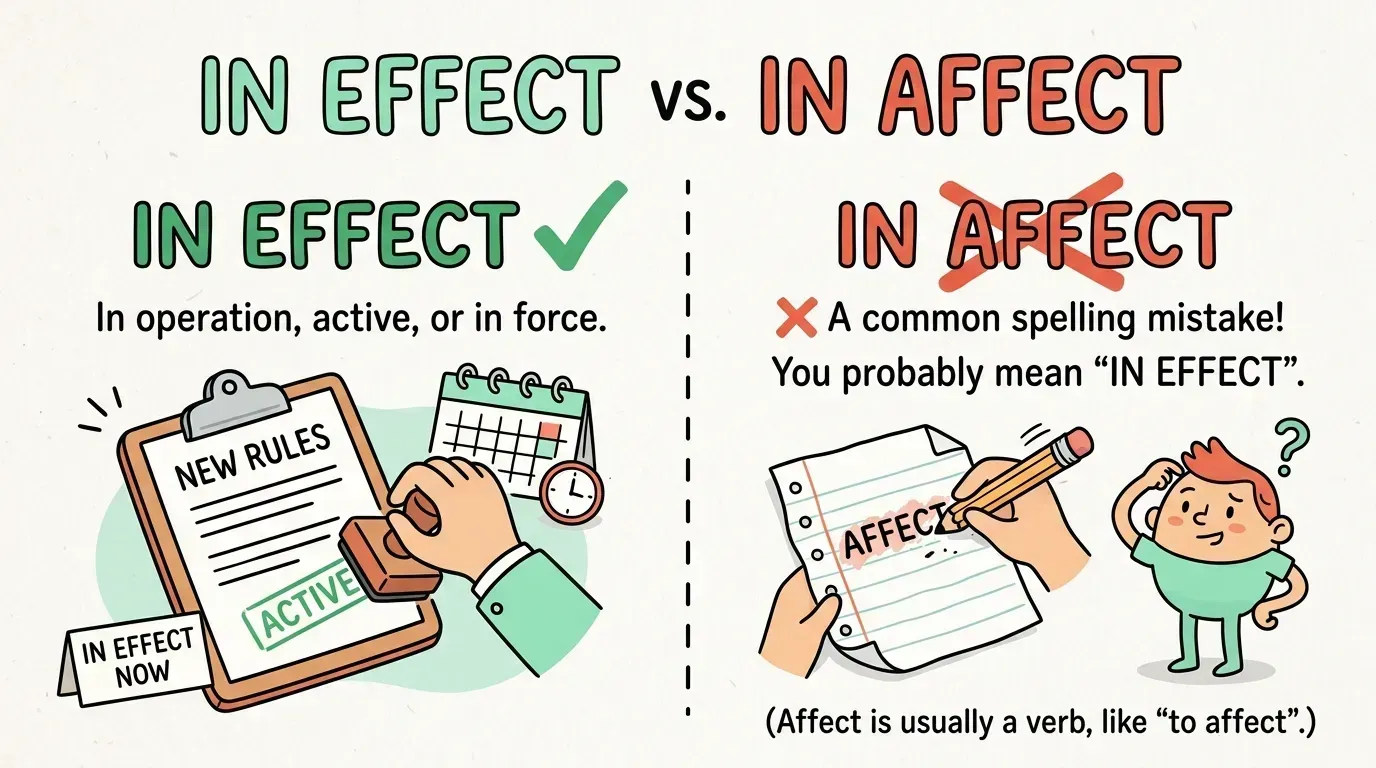
In everyday English, in effect is the correct phrase when you mean that a rule, law, policy, or agreement is active. It can also mean “in practice” or “essentially.”
For example, you would write, “The new policy is in effect today,” not “The new policy is in affect today.”
The word affect usually works as a verb meaning “to influence.” However, it can also be a noun in specialized psychology and medical writing. That is why the phrase in affect may appear in certain technical contexts.
In this guide, you will learn when to use each expression, see practical examples, and discover an easy way to remember the difference.
Quick Answer: In Effect or In Affect?
In effect is the correct choice in standard everyday English when you mean active, operating, or in force. In affect is not a standard expression with that meaning.
| Phrase | Meaning | Example |
| In effect | Active or in force | The new rules are in effect. |
| In effect | In practice or essentially | The change was, in effect, a price increase. |
| In affect | Not a standard phrase meaning “in force” | Do not write “The law is in affect.” |
| Affect (noun) | Emotional expression or state in psychology | The clinician observed changes in affect. |
Cambridge Dictionary recognizes in effect as a phrase meaning that something is active or being used, or that something is true in practice. Read the Cambridge definition of effect.
What Does “In Effect” Mean?
The phrase in effect has two main meanings. Understanding the context will help you use it correctly.
1. In Effect Means Active or in Force
Use in effect when a rule, law, policy, agreement, or restriction is currently active.
Examples:
- The new school policy is in effect today.
- The parking restrictions remain in effect until Monday.
- The agreement is still in effect.
- The new tax rules will be in effect next month.
- The warning remains in effect until further notice.
- The company introduced a policy that is now in effect.
In each example, in effect tells readers that something is active or applies at that time.
2. In Effect Means “In Practice” or “Essentially”
The phrase can also describe what something means in practical terms, even if it is not stated directly.
Examples:
- The decision was, in effect, a rejection of the proposal.
- His actions were, in effect, an apology.
- The change was, in effect, a new company policy.
- By removing the service, the company was, in effect, ending the agreement.
In these sentences, in effect means something similar to “essentially” or “in practical terms.”
What Does “In Affect” Mean?
In affect is not the standard phrase for saying that a rule is active or that something is true in practice.
The confusion comes from the words affect and effect. Although they look similar, they usually have different grammatical roles.
- Affect is usually a verb meaning to influence or change something.
- Effect is usually a noun meaning a result or consequence.
For example:
- Correct: The weather can affect your mood.
- Correct: The weather can have an effect on your mood.
- Correct: The new rules are in effect.
- Incorrect for the intended meaning: The new rules are in affect.
There is one important exception. In psychology, affect can be a noun referring to a person’s emotional state or observable emotional expression. A sentence such as “The clinician observed changes in affect” can be correct.
In that case, affect is being used as a technical noun. It does not mean that a law or policy is active. See Cambridge Dictionary’s definition of affect.
In Effect vs. In Affect: Key Differences
| Feature | In Effect | In Affect |
| Standard everyday usage | Yes | No, not with the meaning “in force” |
| Means active or operating | Yes | No |
| Means essentially or in practice | Yes | No |
| Uses effect as a noun | Yes | No |
| Can appear in specialized psychology writing | Not specifically | Yes, when affect is a noun |
| Example | The new rule is in effect. | The report noted changes in affect. |
The easiest rule is to use in effect whenever you are talking about something being active, operating, or true in practical terms.
Common Phrases With “Effect”
Several everyday expressions use effect. Learning them can help you avoid spelling mistakes.
Go Into Effect
Use go into effect when a rule, law, or policy starts to apply.
- The new law will go into effect on January 1.
- The revised school rules go into effect tomorrow.
Come Into Effect
This phrase also means that something begins to operate or apply.
- The new regulations come into effect next week.
- The changes came into effect last month.
Take Effect
Use take effect when a change, treatment, or process begins to produce its intended result or starts operating.
- The medicine may take effect within an hour.
- The new policy will take effect immediately.
Remain in Effect
Use remain in effect when something continues to be active.
- The warning will remain in effect overnight.
- The agreement remains in effect until June.
Put Into Effect
This phrase means to put a plan, decision, or policy into operation.
- The school will put the new safety measures into effect.
- The company plans to put the revised policy into effect soon.
Remember: these standard expressions use effect, not affect.
In Effect or In Affect: Example Sentences
Here are more examples to show how the expressions work in context.
Correct Examples With “In Effect”
- The new traffic law is in effect starting today.
- The temporary restrictions remain in effect until further notice.
- The agreement is still in effect.
- The new prices will be in effect next week.
- The rule was, in effect, a complete ban.
- The emergency order went into effect at midnight.
- The new policy is now in effect across all departments.
- The decision was, in effect, a rejection of the original plan.
Examples With “Affect”
These sentences are also correct, but they use affect as a verb rather than as part of the phrase in effect.
- The weather may affect our travel plans.
- Lack of sleep can affect your concentration.
- The new policy could affect every employee.
- The price increase may affect customer demand.
Example With “Affect” as a Noun
The following sentence uses the specialized psychological meaning:
- The clinician documented changes in the patient’s affect.
This use is different from the expression in effect. In ordinary writing, you will rarely need the noun affect.
Common Mistakes to Avoid
Mistake 1: Using “In Affect” for a Law or Rule
Incorrect: The new law is in affect.
Correct: The new law is in effect.
Why? The phrase in effect means that the law is active or in force.
Mistake 2: Writing “Go Into Affect”
Incorrect: The new policy will go into affect tomorrow.
Correct: The new policy will go into effect tomorrow.
Why? The established expression is go into effect, which means that a policy or rule starts to apply.
Mistake 3: Confusing “Affect” and “Effect”
Incorrect: The weather had a negative affect on our plans.
Correct: The weather had a negative effect on our plans.
Why? In this sentence, you need the noun effect, meaning a result.
Mistake 4: Assuming “Effect” Is Always a Noun
Although effect is usually a noun, it can also be a verb meaning to bring about or accomplish something.
Example: The organization hopes to effect meaningful change.
This is a more formal use of the word. It is different from the common phrase in effect.
Easy Ways to Remember the Difference
Try these simple memory tips.
1. Think “effect = active.”
When you are discussing a rule or policy that is active, remember the phrase in effect.
Example: The new rules are in effect.
2. Remember the common grammar pattern.
Affect is usually a verb, while effect is usually a noun. This is a helpful general rule, although both words have less common uses in other grammatical roles.
3. Replace “in effect” with “in force.”
If the sentence still makes sense with in force, you probably need in effect.
Example:
The new regulations are in force.
The new regulations are in effect.
Both sentences communicate the same basic idea.
Practice Quiz: In Effect or In Affect?
Choose the correct word or phrase to complete each sentence.
1. The new parking rules are now ___.
a) in effect
b) in affect
2. The changes will go into ___ next week.
a) affect
b) effect
3. The storm may ___ our travel plans.
a) affect
b) effect
4. The agreement remains ___ until December.
a) in affect
b) in effect
5. The report described changes in the patient’s emotional ___.
a) effect
b) affect
Answers
- a) in effect — The rules are active.
- b) effect — The standard expression is go into effect.
- a) affect — Here, affect is a verb meaning to influence.
- b) in effect — The agreement remains active.
- b) affect — This is the specialized psychological noun referring to emotional expression or state.
Frequently Asked Questions
1. Is it “in effect” or “in affect”?
Use in effect when you mean active, operating, or in force. In affect is not the standard phrase for these meanings.
2. What does “in effect” mean in simple English?
It means that something is active or applies in practice. For example, “The new rules are in effect” means people must follow the new rules.
3. Is “in affect” ever correct?
The words can appear together in a sentence when affect is a noun in a specialized psychological context. However, in affect is not the usual expression for an active law, rule, or policy.
4. Is it “go into effect” or “go into affect”?
The correct expression is go into effect. It means that a law, rule, or policy starts to apply.
5. Is it “take effect” or “take affect”?
Use take effect. It means that something starts operating or begins to produce a result.
6. What is the difference between affect and effect?
Affect is usually a verb meaning to influence something. Effect is usually a noun meaning a result. For example, “The weather affects my mood” and “The weather has an effect on my mood.”
7. Does “in effect” mean “in fact”?
Sometimes. When in effect means “essentially” or “in practice,” it can be similar to in fact. However, when it describes an active rule or policy, in force is a closer alternative.
8. Is “still in effect” correct?
Yes. Still in effect means that something continues to be active or valid.
Example: The contract is still in effect.
9. Should “in effect” be written as one word?
No. Write it as two separate words: in effect.
10. How can I remember “in effect or in affect”?
Remember that rules and policies are in effect when they are active. If you can replace the phrase with in force, use in effect.
Conclusion
When deciding between in effect or in affect, choose in effect for standard everyday writing. It means that something is active, operating, or true in practice.
For example, “The new policy is in effect” is correct, while “The new policy is in affect” is incorrect for the intended meaning.
Remember that affect usually means “to influence,” although it can also be a noun in specialized psychology writing. Once you understand this difference, you can use both words more confidently.

Hi, I’m Sophia Bennett. My goal is to make grammar easy, clear, and useful through simple explanations and real-life examples.