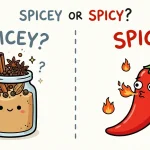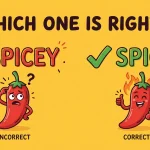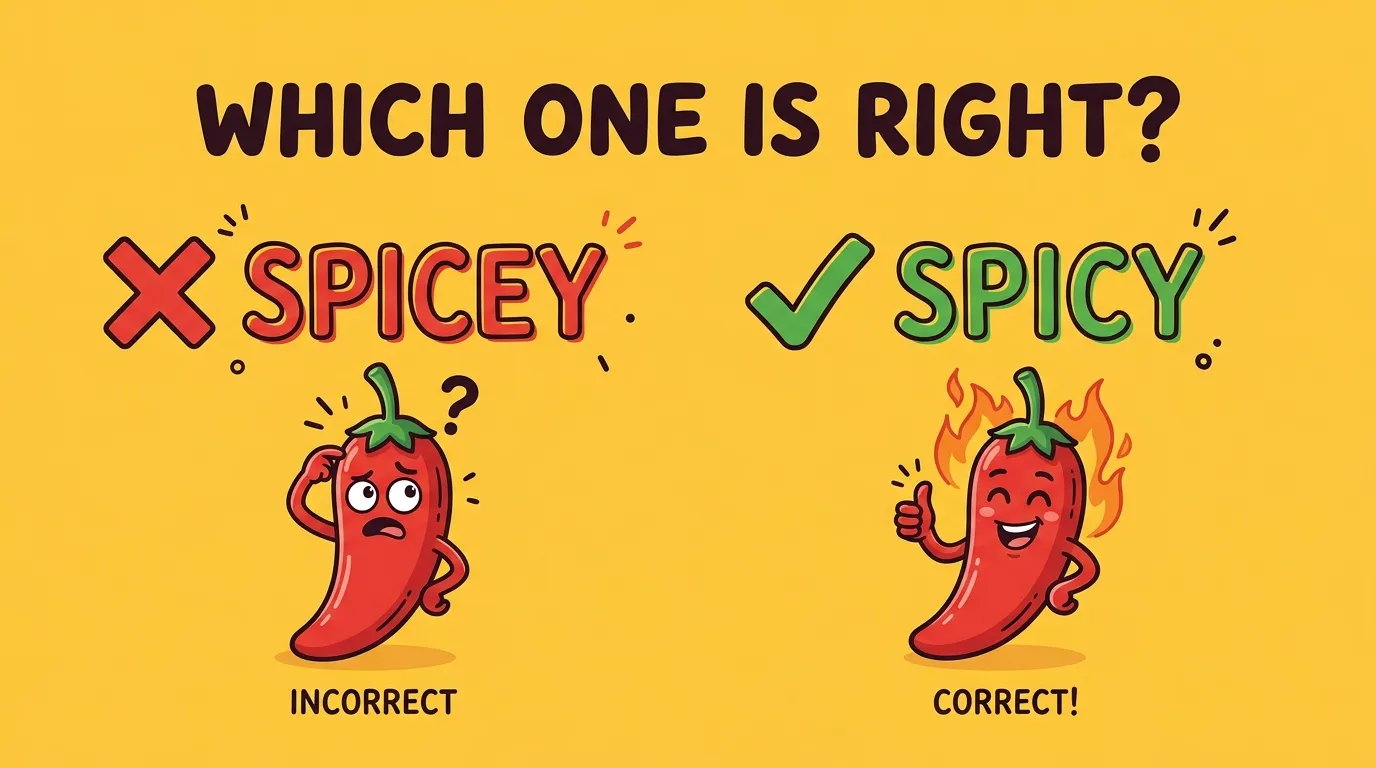
Are you unsure whether to write spicey or spicy? The standard spelling in modern English is spicy. It describes food with a strong flavor, especially food seasoned with chili peppers or other spices.
Although spicey appears in some older texts and is recorded as a variant spelling by some dictionaries, spicy is the form you should normally use in everyday and professional writing.
For example, write “This curry is too spicy for me,” not “This curry is too spicey for me.”
The confusion is understandable because the noun spice ends in an e. However, the established adjective is spelled spicy, without that final e. The same spelling is used in American and British English.
In this guide, you will learn the difference between spicey and spicy, explore their meanings, review sentence examples, and discover an easy way to remember the correct spelling.
Spicey or Spicy: Quick Answer
Spicy is the standard spelling in modern English. Use it when describing food with a strong, pungent, or hot flavor. Spicey is a less common variant spelling recorded in some references, but it is not the preferred form for ordinary modern writing.
| Spelling | Status | Example |
| Spicy | Standard spelling | This soup is spicy. |
| Spicey | Uncommon variant | Use spicy in normal writing. |
| Spicier | Correct comparative form | This sauce is spicier than that one. |
| Spiciest | Correct superlative form | This is the spiciest dish on the menu. |
Quick rule: Write spicy, not spicey, in recipes, schoolwork, articles, emails, and everyday messages unless you are reproducing an official name or a specific source exactly.
What Does Spicy Mean?
Spicy is an adjective that describes something with a strong, sharp, pungent, or sometimes hot flavor. It often refers to food containing ingredients such as chili peppers, black pepper, ginger, or other seasonings.
However, spicy does not always mean extremely hot. Depending on the context, it can describe a warm flavor, a strong aroma, or even an exciting or provocative situation.
1. Spicy Means Having a Hot Flavor
The most common use of spicy is to describe food that creates a noticeable heat or burning sensation in the mouth.
Examples:
- This spicy curry is too hot for me.
- She ordered a spicy chicken sandwich.
- I enjoy spicy noodles with chili sauce.
- The restaurant serves spicy Mexican food.
- He added extra pepper to make the soup spicier.
In these sentences, spicy describes the taste or heat of the food.
2. Spicy Means Strongly Seasoned
Food can also be described as spicy when it has a strong flavor from seasonings, even if it is not especially hot.
Examples:
- The spicy rice smelled wonderful.
- Ginger gives the tea a spicy flavor.
- The sauce has a warm, spicy aroma.
- I enjoy the spicy taste of cinnamon and cloves.
- The dish was richly seasoned with aromatic spices.
The exact meaning depends on the ingredients and the context. A dish with cinnamon, cardamom, or ginger can have a spicy flavor without containing hot chili peppers.
3. Spicy Can Describe an Exciting or Provocative Situation
In informal English, spicy can describe something bold, dramatic, controversial, or likely to attract attention.
Examples:
- That was a spicy opinion.
- The debate became spicy after the announcement.
- She shared a spicy comment on social media.
- The movie includes a few spicy scenes.
- His spicy remarks started an argument.
This figurative meaning is common in casual conversation and online discussions. It does not necessarily refer to food.
Is Spicey a Real Word?
Spicey is an uncommon spelling variant that appears in some dictionary references and historical writing. For example, Wiktionary identifies it as an uncommon spelling of spicy, and Merriam-Webster has recorded it as a variant spelling.
That means it is too broad to say that spicey has never existed in English. However, the standard form you should choose for normal modern writing is spicy.
Consider these examples:
Preferred: The spicy chicken was delicious.
Not recommended in ordinary writing: The spicey chicken was delicious.
Preferred: I prefer spicy food.
Not recommended in ordinary writing: I prefer spicey food.
The meaning is generally the same, but the first spelling in each pair is the conventional modern choice.
There is also an important exception: if Spicey is part of an official brand name, business name, username, or title, keep the spelling used by that name’s owner. Proper names do not always follow ordinary spelling conventions.
Why Is Spicy the Standard Spelling?
The noun spice is the base word, but the established adjective is spelled spicy. English spelling does not always preserve every letter of a base word when a related form is created.
The correct form is:
Spice → Spicy
The final e is removed before the y is added.
You can remember this spelling through a few similar word pairs:
| Base word | Correct related word |
| Ice | Icy |
| Juice | Juicy |
| Grease | Greasy |
| Spice | Spicy |
These examples can help you remember the spelling pattern, but English has exceptions. For example, price becomes pricey, and dicey is also a standard word.
Therefore, do not assume that every word ending in e must lose that letter before y is added. For this particular word, simply remember the established spelling: spicy.
Spicey vs Spicy: Comparison Table
The main difference between spicey and spicy is their spelling status, not their usual meaning.
| Feature | Spicy | Spicey |
| Standard modern spelling | Yes | No; uncommon variant |
| Meaning | Strong, pungent, or hot in flavor | Generally the same when used as a variant |
| Common in ordinary writing | Yes | Less common |
| Suitable for recipes | Yes | Prefer spicy |
| Suitable for professional writing | Yes | Prefer spicy |
| Used in American English | Yes | Not the preferred form |
| Used in British English | Yes | Not the preferred form |
| Comparative | Spicier | Avoid inventing spiceyer |
| Superlative | Spiciest | Avoid inventing spiceyest |
For standard writing, choose spicy regardless of whether you are describing food, a strong flavor, or a bold opinion.
How to Use Spicy in a Sentence
The best way to learn a word is to see how it works in different situations. Here are examples of spicy in everyday English.
Spicy in Food Descriptions
- This curry is too spicy for my children.
- I ordered a spicy chicken burger for lunch.
- The chef prepared a spicy sauce with fresh chilies.
- These noodles are spicier than the ones we had yesterday.
- My father enjoys spicy food, but I prefer mild dishes.
- The restaurant is famous for its spicy chicken wings.
- Add a little chili if you want the soup to be spicier.
- This recipe combines spicy peppers with fresh vegetables.
- The spicy flavor of the ginger made the tea more interesting.
- We ordered the spiciest dish on the menu.
Each sentence uses spicy in its standard form.
Spicy in Casual Conversation
The word can also describe strong opinions or lively situations.
- That was a spicy take on the latest news.
- Their conversation became spicy when they discussed politics.
- He posted a spicy comment that started a debate.
- The show is known for its spicy humor.
- Her spicy response surprised everyone.
In these examples, spicy is figurative. It suggests boldness, controversy, or excitement rather than a taste.
Spicy in Questions
You can also use the word when asking about food or preferences.
- Is this curry spicy?
- How spicy is the sauce?
- Do you prefer spicy or mild food?
- Can you make the noodles less spicy?
- Which dish is the spiciest?
These are natural ways to use the adjective in everyday conversation.
Spicy vs Hot vs Spiced
Although these words are related, they do not always mean the same thing.
Spicy
Spicy describes a strong or pungent flavor, often associated with spices or chili heat.
Example: The spicy salsa made my mouth tingle.
Hot
Hot can refer to a high temperature or to a strong burning sensation caused by chili peppers.
Examples:
- The soup is hot because it has just been cooked.
- The chili sauce is so hot that I need some water.
Context tells you which meaning applies.
Spiced
Spiced means that something has been flavored or seasoned with spices. It does not necessarily mean the food is hot.
Examples:
- We drank spiced apple cider.
- She baked a spiced cake with cinnamon and nutmeg.
- The recipe calls for spiced rice with cardamom.
A dish can be spiced without being particularly spicy. Likewise, food can be spicy because of hot peppers even when its other seasonings are simple.
Is Spicy American or British English?
Spicy is the standard spelling in both American and British English. This is not a regional spelling difference like color and colour.
| English variety | Standard spelling |
| American English | Spicy |
| British English | Spicy |
| Canadian English | Spicy |
| Australian English | Spicy |
For example:
- American English: I love spicy chicken.
- British English: I love spicy chicken.
- Australian English: I love spicy chicken.
The spelling remains the same across these varieties.
You may encounter spicey online or in a name, but it is not the standard regional alternative to spicy. If you are writing for a US audience, UK audience, or international readers, choose spicy.
Common Spelling Mistakes to Avoid
Here are a few errors to watch for when using spicy.
Mistake 1: Writing Spicey in a Recipe
Incorrect: Add the spicey sauce to the noodles.
Correct: Add the spicy sauce to the noodles.
Why? Spicy is the standard spelling of the adjective.
Mistake 2: Writing Spicey Food in a Restaurant Review
Incorrect: This restaurant serves the best spicey wings in town.
Correct: This restaurant serves the best spicy wings in town.
Why? Use the standard spelling in reviews, menus, blogs, and food descriptions.
Mistake 3: Using Spiceyer Instead of Spicier
Incorrect: This curry is spiceyer than the other one.
Correct: This curry is spicier than the other one.
Why? The standard comparative form is spicier.
Mistake 4: Using Spiceyest Instead of Spiciest
Incorrect: This is the spiceyest dish I have ever eaten.
Correct: This is the spiciest dish I have ever eaten.
Why? The standard superlative form is spiciest.
Mistake 5: Assuming Spicy Always Means Extremely Hot
Incorrect assumption: Every spicy dish must contain a lot of chili.
Better understanding: Spicy can describe a warm, pungent, or strongly seasoned flavor. The word does not always mean that food is extremely hot.
Mistake 6: Treating Spicey as a British Spelling
Incorrect assumption: Americans write spicy, but British people write spicey.
Correct understanding: Both American and British English use spicy as the standard spelling.
Easy Ways to Remember Spicy
If you often hesitate between spicey and spicy, try these simple tips.
1. Memorize the Correct Word
Remember this form:
SPICE → SPICY
The adjective has no e before the final y.
2. Think of Icy and Juicy
The pairs ice/icy and juice/juicy can help you remember how spicy is spelled.
For example:
- Icy road
- Juicy fruit
- Spicy curry
The pattern is a memory aid, not a universal rule for every English word.
3. Read Your Sentence Aloud
Reading your writing aloud can help you catch awkward sentences, but pronunciation alone may not reveal a spelling mistake. Both spicy and the variant spicey may be pronounced similarly.
That is why it helps to check the written form as well.
4. Check Before Publishing
If you are writing a recipe, school assignment, website article, or restaurant menu, use a spell-checking tool and proofread the final text.
For standard writing, replace spicey with spicy unless you have a specific reason to preserve the alternative spelling.
FAQs
1. Is it spicey or spicy?
Spicy is the standard spelling in modern English. Spicey is an uncommon variant recorded in some references, but spicy is the preferred form for everyday and professional writing.
2. Why is spicy spelled without an e?
The established adjective is formed as spicy, dropping the final e from spice. Although English spelling has exceptions, the standard form to memorize is spicy.
3. Is spicey ever correct?
Spicey appears as an uncommon spelling variant in some references and historical texts. It may also appear in proper names. For normal modern writing, however, use spicy.
4. Is spicy the same in American and British English?
Yes. Both American and British English use spicy. There is no standard US-versus-UK spelling difference for this word.
5. What does spicy mean?
Spicy describes a strong, pungent, or hot flavor. It can also describe a bold opinion, lively debate, or provocative comment in informal English.
6. What is the comparative form of spicy?
The comparative form is spicier. Use it when comparing two things.
Example: “This sauce is spicier than the other one.”
7. What is the superlative form of spicy?
The superlative form is spiciest. Use it when identifying the highest degree among three or more things.
Example: “This is the spiciest curry on the menu.”
8. Is spicy the same as hot?
Not always. Hot can describe temperature or a burning sensation from chili peppers. Spicy can describe hotness, pungency, or a strong flavor from seasonings.
9. Can spicy describe something other than food?
Yes. In informal English, spicy can describe a bold opinion, a provocative comment, a dramatic conversation, or suggestive content.
Example: “That was a spicy take on the issue.”
10. Can food be spicy without chili peppers?
Yes. Ingredients such as ginger, black pepper, mustard, or other pungent seasonings can create a spicy flavor without chili peppers. The exact description depends on the ingredients and the dish.
Conclusion
When choosing between spicey or spicy, use spicy in standard modern English.
It is the conventional spelling for describing food with a strong, pungent, or hot flavor. It can also describe bold opinions and lively situations in informal writing.
Although spicey is recorded as an uncommon variant in some references, it is not the preferred form for ordinary writing. Use spicy in recipes, school assignments, restaurant reviews, website articles, and professional messages.
Remember that the spelling is the same in American and British English. Also, learn the related forms spicier and spiciest so you can compare flavors correctly.
The simplest rule is easy to remember: Spice becomes spicy, not spicey, in standard modern writing.

Hi, I’m Sophia Bennett. My goal is to make grammar easy, clear, and useful through simple explanations and real-life examples.