You’re writing a short story and typing “she dreamt of the ocean,” then wonder if “dreamed” would sound more natural instead.
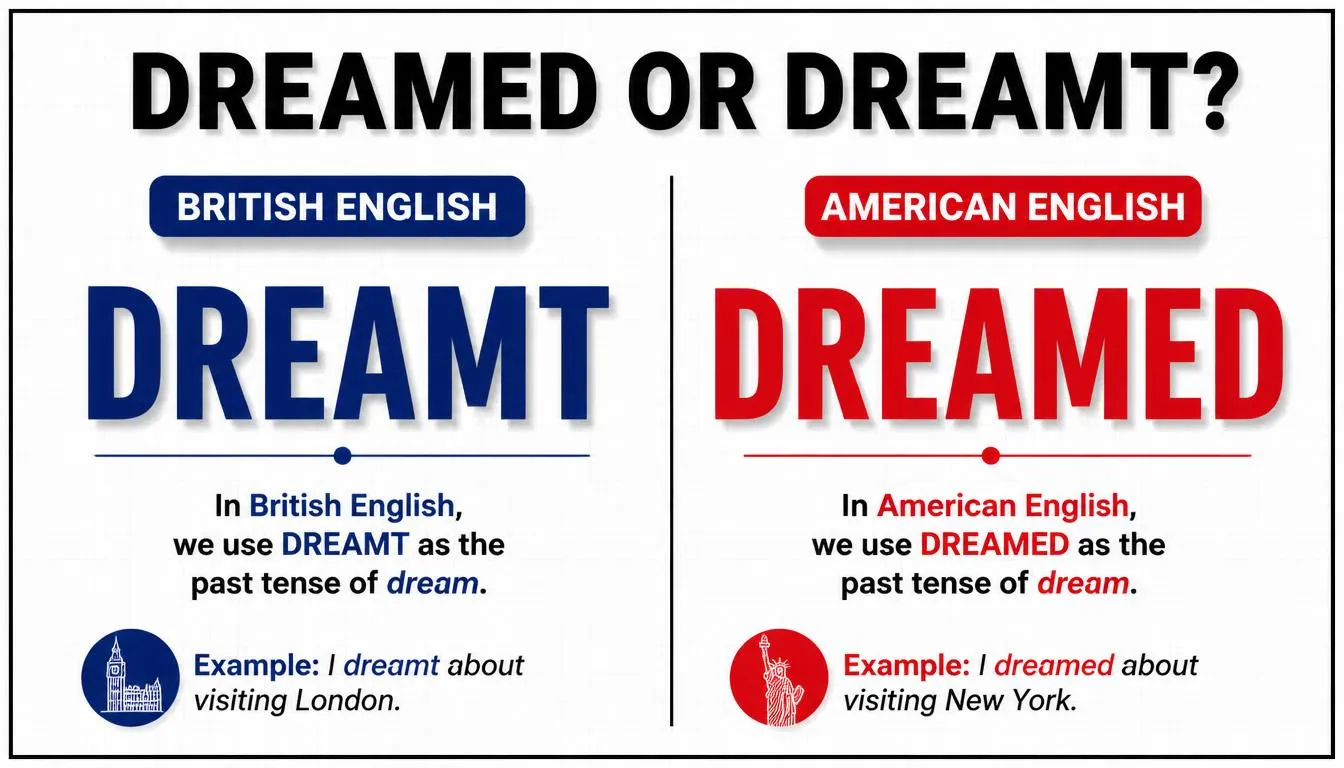
Quick answer: In American English, “dreamed” is standard, though “dreamt” is understood. In British English, both are common, with “dreamed” actually appearing slightly more often than “dreamt” overall.
Table of Contents
- Quick Answer Box
- Quick Rule in One Line
- The Difference Explained
- Grammar Rule: Regular vs Irregular Verb Forms
- Comparison Table
- Memory Trick
- Example Sentences
- Common Mistakes
- When to Use Each Form
- Expert Tip
- Common Misconception Callout
- FAQs
- Conclusion
- Key Takeaways
Quick Answer Box
“Dreamed” and “dreamt” are both correct past tense forms of “dream.” American English strongly favors “dreamed.”
British English accepts both, and despite “dreamt” feeling more British, “dreamed” is actually the more frequently used form there too, according to language data.
⚡ Quick Rule in 1 Line
“Dreamed is the safer default everywhere; dreamt just adds a literary, British flavor.”
The Difference Explained
Both words mean exactly the same thing: the past tense and past participle of “to dream.” The difference is stylistic and regional, not a difference in meaning.
“Dreamed” follows the regular “-ed” pattern, the same way “walked” and “talked” work. “Dreamt” follows an older, irregular “-t” pattern, shared with words like “learnt” and “burnt.”
Here’s the twist: even though “dreamt” reads as the classic British choice, actual usage data shows “dreamed” wins out in both countries, just by a wider margin in the US.
Grammar Rule: Regular vs Irregular Verb Forms
Regular verbs form their past tense by adding “-ed”: walk becomes walked, talk becomes talked. “Dream” can follow this pattern too, becoming “dreamed.”
Irregular verbs change form in another way. “Dream” also has this option, becoming “dreamt,” following the same “-t” ending seen in “learnt,” “burnt,” and “spelt.”
Unlike many of those other “-t” pairs, “dream” doesn’t split neatly by country. Both forms genuinely compete for use on both sides of the Atlantic, which makes this pair a little different from a strict US/UK rule.
Comparison Table
| Feature | Dreamed | Dreamt |
|---|---|---|
| Verb type | Regular (-ed ending) | Irregular (-t ending) |
| American English | Standard, dominant | Understood, but uncommon |
| British English | Common, actually more frequent overall | Common, feels more traditional |
| Tone | Neutral, everyday | Slightly literary or old-fashioned |
| Example | She dreamed of traveling the world. | She dreamt of traveling the world. |
Memory Trick
Picture “dreamed” as the practical, everyday choice, plain and regular, like “walked” or “talked.” Picture “dreamt” as the choice that shows up more in poetry, song lyrics, and older novels, since it carries a slightly literary weight, regardless of which country the writer is from.
Example Sentences
Using “dreamed”:
- She dreamed of becoming a doctor since childhood.
- I dreamed about flying over the mountains last night.
- They dreamed up a new plan for the fundraiser.
- He dreamed of opening his own restaurant one day.
- We dreamed about traveling the world together.
- She dreamed she was back in her old classroom.
- I never dreamed this opportunity would come so soon.
- They dreamed of a quiet life by the coast.
- He dreamed vividly about his childhood home.
- She dreamed up the idea during a long drive.
Using “dreamt”:
- She dreamt of becoming a doctor since childhood.
- I dreamt about flying over the mountains last night.
- They dreamt up a new plan for the fundraiser.
- He dreamt of opening his own restaurant one day.
- We dreamt about traveling the world together.
- She dreamt she was back in her old classroom.
- I never dreamt this opportunity would come so soon.
- They dreamt of a quiet life by the coast.
- He dreamt vividly about his childhood home.
- She dreamt up the idea during a long drive.
Common Mistakes
❌ Assuming “dreamt” is wrong in the US and never used there. ✅ Recognizing “dreamt” is understood in American English, just less common than “dreamed.”
❌ Assuming “dreamt” is always the British default. ✅ Understanding “dreamed” is actually the more frequent choice in Britain too, per usage data.
Mixing “dreamed” and “dreamt” inconsistently in the same document. ✅ Picking one form and staying consistent throughout a single piece of writing.
When to Use Each Form
For American audiences, in business writing, school assignments, or general content, use “dreamed”; it’s the clear standard. For British audiences, either form works naturally, though “dreamed” remains statistically more common even there.
Reach for “dreamt” specifically when you want a softer, more literary or nostalgic tone, in fiction, poetry, or reflective personal writing.
Expert Tip 💡
If you’re writing for a global or mixed audience, “dreamed” is the safer, more universally expected choice. Save “dreamt” for creative writing where its slightly old-fashioned, wistful tone actually adds something to the sentence.
Common Misconception Callout
Many writers assume this pair splits cleanly along US/UK lines, the same way “color” and “colour” do. It doesn’t. Usage data shows “dreamed” is actually more common in both countries, even though “dreamt” still feels more British to most readers.
FAQs
Is “dreamt” only used in British English?
No. It’s understood everywhere and used in the US occasionally, though “dreamed” is far more common there.
Is “dreamed” wrong in British English?
No, and it’s actually the more frequently used form in British English overall, despite “dreamt” feeling more traditionally British.
What’s the past participle of “dream”?
Both “dreamed” and “dreamt” work as the past participle, following the same pattern as the simple past tense.
Why does “dreamt” feel more British if it isn’t actually more common there?
Because “dreamt” appears often in classic British literature and poetry, which shapes the impression even though everyday usage now favors “dreamed.”
Are “dreamed up” and “dreamt up” both correct?
Yes, both work for the phrasal verb meaning “to invent” or “to imagine,” following the same regional pattern.
Does “dream” have other similar verb pairs?
Yes, including “learn/learnt/learned,” “burn/burnt/burned,” and “spell/spelt/spelled.”
Which form should I use for a global audience?
“Dreamed” is the safer, more universally recognized choice for mixed or international audiences.
Is “dream” a regular or irregular verb?
Both, depending on the form chosen: regular as “dreamed,” irregular as “dreamt.”
How do I remember which one to use?
Default to “dreamed” for clear, modern writing. Reach for “dreamt” only when you want a literary, reflective tone.
Conclusion
“Dreamed” and “dreamt” mean exactly the same thing, but this isn’t quite the clean US/UK split it first appears to be.
American English clearly favors “dreamed,” and, somewhat surprisingly, so does British English overall, even though “dreamt” still carries that classic British, literary feel.
For everyday writing, “dreamed” is the safest choice; save “dreamt” for when you want a touch of old-fashioned atmosphere.

Hi, I’m Ethan Brooks. I create easy-to-follow grammar guides, writing tips, and vocabulary resources to make English learning enjoyable for everyone.