Quiet or quite is one of the most common word pairs that English learners confuse
You typed “please be quite in the library,” and the message got a laughing reaction before anyone addressed your actual request.
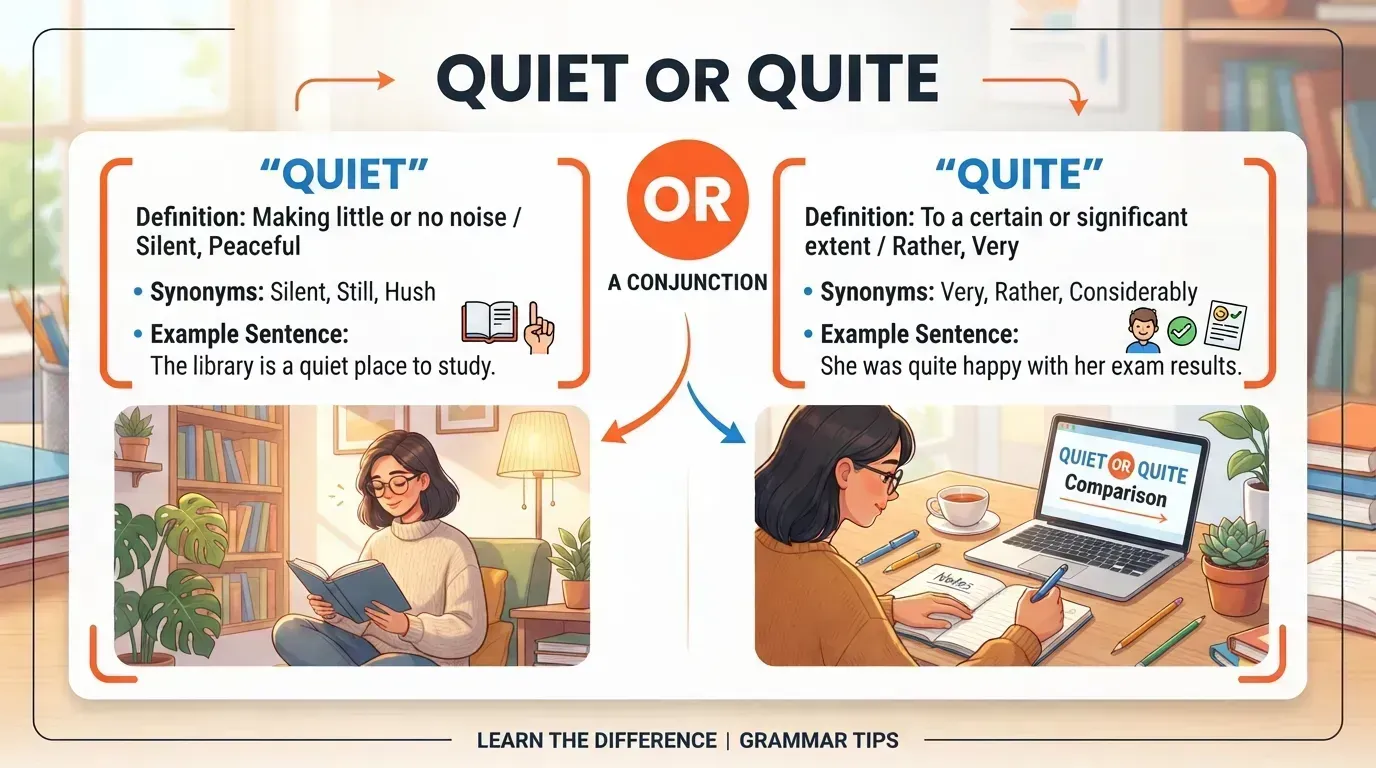
Here’s the quick fix: quiet means making little or no noise, while quite means “to a certain degree” or “completely.”
These words differ only by two swapped letters, but they mean completely different things.
Once you notice this small swap, you’ll catch the mistake before hitting send every time.
Quick Answer
Quiet describes low noise or calmness (“Please keep the room quiet”).
Quite describes degree or extent, meaning “very” or “completely” (“That’s quite impressive”).
The letters “e” and “t” simply swap positions between these two words, which is exactly why they’re so easy to mistype.
⚡ Quick Rule
Quiet means silent or calm; quite means “very” or “completely” — swap the last two letters, swap the meaning.
Quiet vs Quite: The Core Difference
“Quite” is an adverb describing the degree or extent of something, often meaning “very” or “fairly.”
Say “The library was quiet” (no noise), versus “The library was quite busy” (very busy, to a notable degree).
This noise-versus-degree distinction is the entire difference between these two words.
Grammar Rule Explained
“Quiet” typically modifies a noun directly or describes a state, functioning as an adjective.
“Quite” typically modifies an adjective or another adverb, functioning as an intensifier.
A simple test: if the sentence is about sound or calmness, use “quiet.” If it’s intensifying another word’s meaning, use “quite.”
This sound-versus-intensity test resolves nearly every mix-up between these two words.
Quiet vs Quite Comparison Table
| Feature | Quiet | Quite |
|---|---|---|
| Part of speech | Adjective | Adverb |
| Meaning | Silent, calm, low noise | Very, fairly, completely |
| Example | The house was quiet at night. | The movie was quite good. |
| Function | Describes a noun | Modifies an adjective or adverb |
Memory Trick
Remember: “Quiet” ends in “-et,” just like the word “silen-t” — both describe silence.
“Quite” ends in “-te,” just like “grea-t,” often pairing with adjectives to boost their meaning.
If you can replace the word with “very” or “fairly,” use “quite.” If it’s about noise or calm, use “quiet.”
Real Example Sentences
Using Quiet:
- Please keep your voice quiet in the library.
- The neighborhood is very quiet at night.
- She stayed quiet during the entire meeting.
- The baby finally fell into a quiet sleep.
- It’s quiet enough here to concentrate.
Using Quite:
- The exam was quite difficult this year.
- I’m quite tired after the long trip.
- That’s quite an impressive achievement.
- She’s quite certain about her decision.
- The weather has been quite unpredictable lately.
Quite a Bit or Quiet a Bit? Common Mistakes in Phrases
“Quite a bit” always uses “quite,” meaning “a considerable amount,” as in “We saved quite a bit of money.”
“Quiet a bit” is never correct — this phrase describes quantity or degree, not silence, so “quite” is the only correct option.
A helpful check: “quite a bit” means “somewhat a lot,” while “quiet” never pairs naturally with the word “bit” in standard English.
Common Mistakes
1. Using “quite” instead of “quiet” for silence Incorrect: Please be quite during the movie. Correct: Please be quiet during the movie.
2. Using “quiet” instead of “quite” for degree Incorrect: That was a quiet impressive performance. Correct: That was a quite impressive performance.
3. Misspelling “quite a bit” as “quiet a bit” Incorrect: We’ve made quiet a bit of progress. Correct: We’ve made quite a bit of progress.
4. Swapping the letters without noticing while typing quickly Since the words differ by just two swapped letters, always proofread carefully when using either word.
When to Use Each Word
Use Quiet When:
- Describing low noise or silence
- Referring to a calm or peaceful state
- Modifying a noun directly
Examples: quiet room, quiet evening, stay quiet
Use Quite When:
- Intensifying an adjective or adverb
- Meaning “very,” “fairly,” or “completely”
- Describing degree or extent
Examples: quite good, quite sure, quite a lot
FAQs
What’s the difference between quiet and quite?
“Quiet” describes silence or calmness. “Quite” describes degree, meaning “very” or “completely.” They differ by two swapped letters.
How do I remember which spelling to use?
“Quiet” relates to silence, like the word “silent.” “Quite” pairs with adjectives to boost their meaning, like “very.”
Why do people mix up quiet and quite so often?
Because the words look almost identical, differing only by the position of the letters “e” and “t,” making typos easy.
Is “quite” always an adverb?
Yes, “quite” functions as an adverb, modifying adjectives or other adverbs to show degree or extent.
Is “quiet” always an adjective?
Mostly, yes, though it can occasionally function as a noun, as in “I need some quiet” or a verb, as in “quiet the crowd.”
What does “quite a bit” mean?
It means “a considerable amount,” as in “We’ve made quite a bit of progress.”
Can “quite” mean “completely” in some sentences?
Yes, in British English especially, “quite” can mean “completely,” as in “I quite agree” (I completely agree).
What’s a quick way to test which word I need?
Ask if the sentence is about noise or calmness (quiet) or about intensifying another word’s meaning (quite).
Conclusion
Quiet and quite look almost identical, but swapping their final two letters completely changes their meaning.
Quiet describes silence or calm. Quite describes degree, often meaning “very” or “completely.”
Double-check your spelling whenever these words appear, since a simple typo can easily change your entire sentence’s meaning.

Hi, I’m Sophia Bennett. My goal is to make grammar easy, clear, and useful through simple explanations and real-life examples.