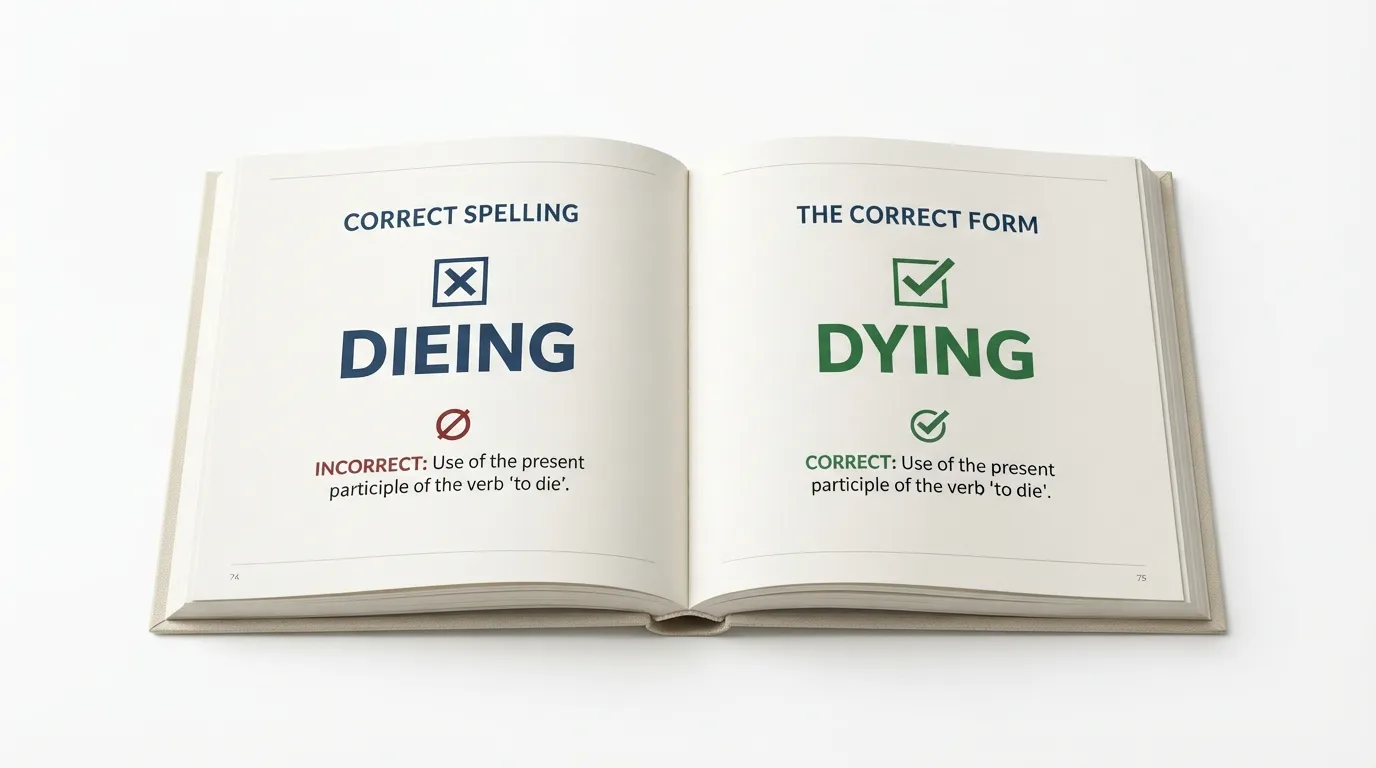
If you have ever been unsure about these two words, you are not alone. The correct spelling depends on what you want to say.
In most cases, dying is the correct word when you mean “coming to an end” or “losing life.” For example, you might say, “The plant is dying.”
Dieing is a real word, but it is rarely used. It usually refers to the process of working with a die, such as cutting, stamping, or shaping materials.
In this guide, you’ll learn the difference between dieing and dying, when to use each spelling, and see simple examples to help you remember the rule.
Table of Contents
- Quick Answer
- Quick Rule
- Why “Dieing” Looks Right But Isn’t
- The ie-to-y Spelling Rule
- Comparison Table
- Example Sentences
- Common Mistakes
- Dying vs Dyeing: Don’t Mix Them Up
- Expert Tip
- FAQs
- Conclusion
- Key Takeaways
Quick Answer Box
The correct spelling is dying, not “dieing.” When a verb ends in “ie,” English changes the “ie” to “y” before adding “-ing.” This same rule applies to words like “lie” (lying) and “tie” (tying).
⚡ Quick Rule in 1 Line
Verbs ending in “ie” swap the “ie” for “y” before adding “-ing” — so die becomes dying.
Why “Dieing” Looks Right But Isn’t
Most verbs simply drop a silent “e” before adding “-ing,” like “make” becoming “making.” Applying that same logic to “die” would suggest “dieing,” but English treats words ending in “ie” differently. Instead of just dropping the “e,” the whole “ie” changes to “y” first.
The ie-to-y Spelling Rule
This rule isn’t unique to “die.” It also applies to “lie” (becoming “lying”) and “tie” (becoming “tying”). Without the rule, these words would end in an awkward double “i,” like “diing” or “liing,” which English avoids entirely.
Comparison Table
| Base Verb | Incorrect -ing Form | Correct -ing Form |
|---|---|---|
| Die | Dieing | Dying |
| Lie | Lieing | Lying |
| Tie | Tieing | Tying |
| Vie | Vieing | Vying |
Example Sentences
- The plant is dying because I forgot to water it.
- My phone battery is dying, so I need to charge it.
- The old tradition is slowly dying out in this town.
- He looked like he was dying of laughter at the joke.
- The patient’s condition worsened, and doctors feared she was dying.
- Interest in the project seems to be dying down.
- The crops are dying because of the ongoing drought.
- She’s dying to see the new movie this weekend.
- The fire was dying out by the time we arrived.
- The animal population is dying due to habitat loss.
❌ Incorrect: “My plants are dieing because I forgot to water them.” ✅ Correct: “My plants are dying because I forgot to water them.”
❌ Incorrect: “The crops are dieing because of the drought.” ✅ Correct: “The crops are dying because of the drought.”
Common Mistakes
- Writing “dieing” instead of “dying” when talking about death, decline, or fading.
- Confusing “dying” with “dyeing,” which relates to changing color, not death.
- Assuming the standard “-e” drop rule applies here without the extra “ie to y” swap.
Dying vs Dyeing: Don’t Mix Them Up
“Dying” comes from “die” and relates to death or something coming to an end. “Dyeing” comes from “dye” and relates to changing color, like dyeing fabric or hair. These two words are pronounced differently but often get confused in writing, so double-check which one you actually mean.
Expert Tip 💡
If you’re ever unsure, test the word with “lying” instead. If you can picture “lie” becoming “lying,” the same ie-to-y swap applies to “die” becoming “dying.”
FAQs
Is “dieing” ever a correct word?
Only in a rare, technical manufacturing context involving a tool called a die. For anything related to death or decline, “dying” is correct.
Why does “die” become “dying” instead of “dieing”?
English changes “ie” to “y” before adding “-ing” for a small group of verbs, including die, lie, and tie, to avoid an awkward double “i.”
Is this rule the same in British and American English?
Yes, both British and American English use “dying” as the correct -ing form of “die.”
What’s the difference between “dying” and “dyeing”?
“Dying” relates to death or something ending, while “dyeing” relates to changing the color of something using dye.
Does “lying” follow the same rule as “dying”?
Yes, “lie” follows the same ie-to-y pattern, becoming “lying” instead of “lieing.”
Is “dieing” a spelling error or a real word?
It’s a real, though rare, technical term in manufacturing — but it’s a spelling error when used to mean death or decline.
How can I remember this spelling rule?
Think of the pattern: die to dying, lie to lying, tie to tying — the “ie” always becomes “y” before “-ing.”
Is “dying” used only for literal death?
No, it’s also used figuratively, like “dying to know” or “the trend is dying out,” meaning strong desire or fading popularity.
Conclusion
So, dieing or dying which one should you use? In everyday English, dying is almost always the correct choice when you mean the opposite of living or something coming to an end.
Dieing has a different and uncommon meaning related to using a die to shape or cut something.
A simple way to remember it is: die → dying, not dieing, when talking about death or something ending.
If you’re writing a normal sentence about someone or something losing life, choose dying.

Hi, I’m Olivia Harper. I love turning complex English grammar into simple, practical lessons that help readers write and speak with confidence.