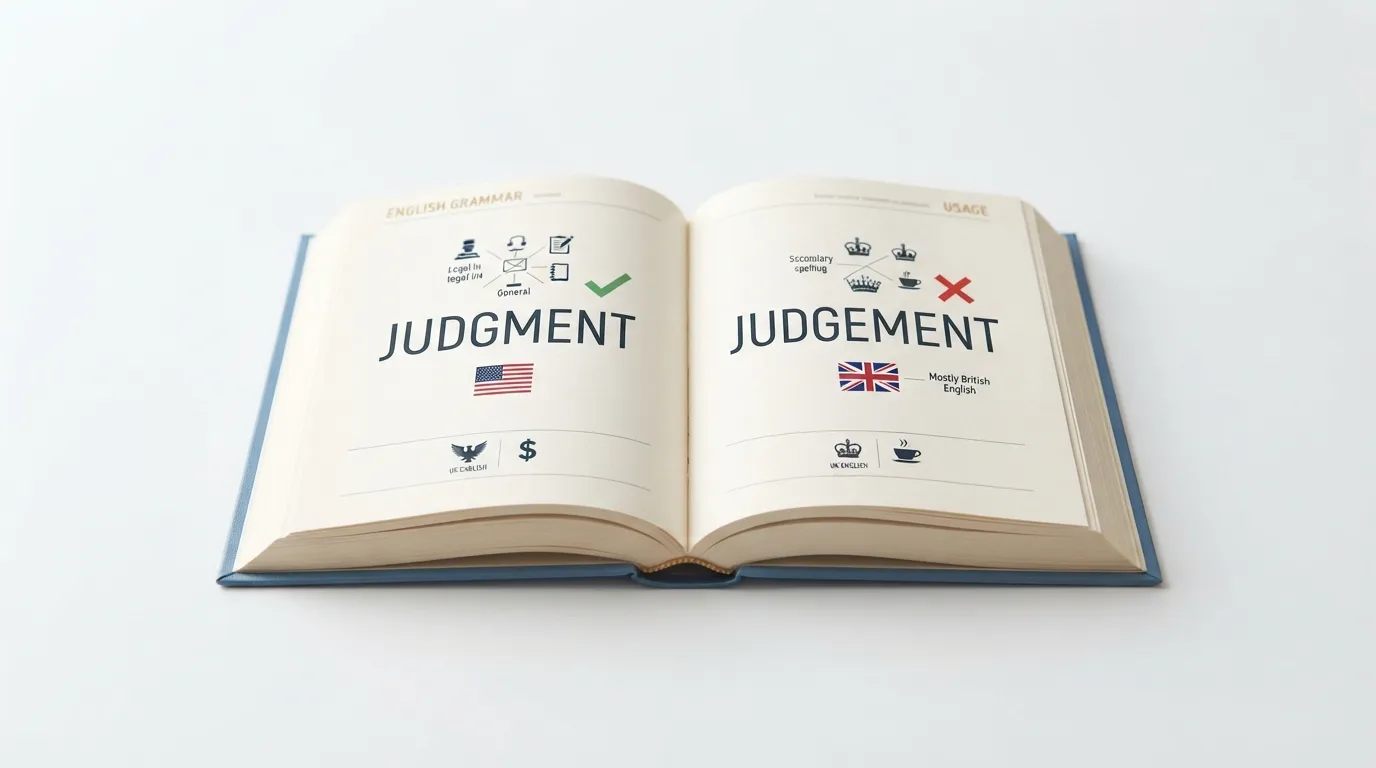
Both spellings are accepted in English, but the preferred form depends on the variety of English you are using.
Judgment is the standard spelling in American English. It is also commonly used in British English, especially in legal and formal contexts.
Judgement is more common in British English and other varieties that follow British spelling conventions.
The good news is that neither spelling is simply wrong. The main difference is US vs. UK spelling preference.
In this guide, you’ll learn when to use judgment and judgement, with simple examples to help you choose the right spelling.
Table of Contents
- Quick Answer
- Quick Rule
- American vs British Spelling
- The Legal Exception
- Comparison Table
- Example Sentences
- Judgments or Judgements? The Plural Form
- Judgmental or Judgemental: The Adjective Form
- Synonyms for Judgment/Judgement
- Common Mistakes
- Which One Should You Use?
- Expert Tip
- Judgment or Judgement: Quick Answers
- Why Is the E Dropped in Judgment?
- Judgment or Judgement by Country
- Judgment or Judgement in Legal Writing
- Judgment Day, the Bible, and the Tarot Card
- Judgment-Free or Judgement-Free?
- Judgmental, Judgemental, and Judgy
- Judgment Meaning and Synonyms
- How to Spell Judgment and Judgement
- More Examples
- Judgment or Judgement in Other Languages: Quick Answers
- FAQs
- Conclusion
Quick Answer Box
In American English, the correct spelling is judgment, without the “e.” In British English, judgement, with the “e,” is standard in everyday writing.
However, legal writing in both the US and UK typically drops the “e,” using judgment even in Britain.
⚡ Quick Rule in 1 Line
Drop the “e” for American English and legal writing; keep it for everyday British English.
American vs British Spelling
American English uses judgment exclusively, with no accepted variant.
Merriam-Webster lists judgment as the primary spelling and judgement only as a secondary variant.
British English generally prefers judgement with the “e” in casual and general writing, following the pattern of similar words like “acknowledgement.”
The Legal Exception
Here’s where it gets interesting. Even though British English usually keeps the “e,” UK courts and legal documents traditionally use judgment without it.
This means a British newspaper might write “judgement,” while a British court ruling on the very same topic writes “judgment.”
Comparison Table
| Context | Spelling Used | Notes |
|---|---|---|
| American English (general) | judgment | Only accepted spelling |
| British English (general) | judgement | Standard, everyday use |
| British legal writing | judgment | Follows legal tradition, drops the “e” |
| American legal writing | judgment | Same as general American use |
Example Sentences
I trust your judgment on this decision. (American English)
Her judgement was fair and well-reasoned. (British English)
The court delivered its judgment early Monday morning. (Legal, both regions)
He acted against his better judgment before the meeting. (American English)
The jury reached a judgement after two days of deliberation. (British, non-legal)
Good judgment is essential for this role.
The Supreme Court’s judgment set a new legal precedent.
I always listen to my mother because of her sound judgement.
We need someone with strong judgment to lead this project.
The panel’s judgement on the proposal was unanimous.
❌ Incorrect (for American writing): “Use your best judgement on this.”
✅ Correct: “Use your best judgment on this.”
❌ Incorrect (for British legal writing): “The judgement was issued Friday.”
✅ Correct: “The judgment was issued Friday.”
Judgments or Judgements? The Plural Form
The plural follows the same regional rule as the singular.
American English and legal writing use “judgments” (no “e”); British general writing uses “judgements” (with “e”)
Example: “The court issued two judgments this week” (US/legal) vs. “Several judgements were handed down” (British, general).
Judgmental or Judgemental: The Adjective Form
The adjective follows the same pattern: “judgmental” is standard American spelling; “judgemental” is the British variant.
Example: “Try not to be so judgmental” (US) / “judgemental” (UK).
What about Canada and Australia?
Canadian English typically follows British convention, preferring “judgement.”
Australian English does the same, generally using “judgement” outside legal writing.
Synonyms for Judgment/Judgement
Depending on context, several words can substitute for judgment/judgement: “assessment,” “opinion,” “verdict,” “ruling,” or “discernment.”
Common Mistakes
Using “judgement” in formal American writing, where “judgment” is the only accepted spelling.
Assuming British English always uses “judgement,” even in legal contexts where “judgment” is standard.
Switching spellings inconsistently within the same document — pick one and stick with it.
Which One Should You Use?
If you’re writing for an American audience, always use judgment.
If you’re writing for a British or general international audience in a non-legal context, judgement is the safer, more expected choice.
For any legal writing, regardless of country, judgment without the “e” is the standard.
Expert Tip 💡
When in doubt, default to judgment without the “e” — it’s correct in American English, accepted in British legal writing, and increasingly common across British general writing too, according to Grammarly’s usage research.
Judgment or Judgement: Quick Answers
Here are fast answers to the most common versions of the question.
What Is Correct, Judgment or Judgement?
Both are correct. “Judgment” is standard in American English and legal writing, and “judgement” is common in everyday British English.
Is It Judgement or Judgment?
Choose based on your audience. If you aren’t sure, “judgment” is the safer choice.
Is It Judgement or Judgment in the UK?
In the UK, “judgement” is common in everyday writing, and “judgment” is used in legal writing.
Judgment or Judgement in American English
Use “judgment.” It’s the standard American spelling.
Does Judgment Have an E?
In American English, no. “Judgment” has no “e” before “-ment.”
In everyday British English, “judgement” has the “e.”
Is Judgement Spelled With an E?
Yes, the British spelling “judgement” includes the “e.”
Judgment or Judgement AP Style
AP Style uses “judgment,” without the “e.”
Duplicate Searches
If you searched “judgment or judgment,” “judgement vs judgement,” or “judgement judgment,” you probably meant “judgment or judgement.”
Judgment or Judgement on Reddit and Other Forums
If you’ve seen this debated on forums like Reddit, the short answer is the same: both are correct, and the choice depends on region and context.
Why Is the E Dropped in Judgment?
In American English, the silent “e” in “judge” is usually dropped before the ending “-ment.”
That’s why American writers also write “acknowledgment” and “abridgment.”
Why Does British English Keep the E?
British English often keeps the “e” before “-ment” in general writing, as in “judgement” and “acknowledgement.”
Why Is It Judgment and Not Judgement?
In American spelling, dropping the silent “e” is the standard, shorter form.
Neither version is a mistake. It’s a regional spelling habit.
Judge Becomes Judging
Note that “judge” also drops its “e” before “-ing”: “judging.”
Judgment or Judgement by Country
Here’s a quick guide by region.
| Place | Typical spelling |
|---|---|
| United States | judgment |
| United Kingdom (general) | judgement |
| United Kingdom (legal) | judgment |
| Canada | judgement is common, judgment is used too |
| Australia | judgement is common, judgment in legal writing |
| Kenya and other Commonwealth countries | usually follows British habits |
Judgement vs Judgment in Canada
Canadian writing often follows British habits, but both spellings appear.
Follow your publisher’s style guide.
Judgement or Judgment in Australia
Australian general writing often uses “judgement,” while legal writing uses “judgment.”
Judgement in Kenya
Kenya follows British conventions in general writing, with “judgment” used for court decisions.
Judgement in the UK
UK general writing often uses “judgement.”
Legal writing uses “judgment.”
Judgment or Judgement Oxford Dictionary
Dictionaries such as Oxford list both spellings.
Check the one your style guide uses to see which is shown first.
Judgment or Judgement in Legal Writing
In law, the court’s decision is called a “judgment.”
This spelling is used in both the US and UK.
Legal Judgment or Judgement
For legal writing, use “judgment,” as in “summary judgment” and “default judgment.”
Judgments in Court
“The court issued its judgment on Friday” is correct in legal writing in both countries.
Judgment Day, the Bible, and the Tarot Card
Some phrases and titles have their own spelling habits.
Judgment Day or Judgement Day
“Judgment Day” is the most common spelling for the phrase.
If you’re quoting a title or a name, use the spelling the title uses.
The Bible
Many English Bible translations, including the KJV, use “judgment.”
The Tarot Card
The tarot card is traditionally spelled “Judgement.”
If you’re writing about the card, use that spelling.
Judgment-Free or Judgement-Free?
Both can appear: “judgment-free” (US) and “judgement-free” (UK).
In a phrase like “a judgment-free zone,” use a hyphen before the noun.
Judgement Free or Judgment Free?
Use “judgment-free” for American readers and “judgement-free” for British readers.
Judgmental, Judgemental, and Judgy
The adjective form follows the same rule.
- Judgmental: American spelling.
- Judgemental: British spelling.
- Judgy: an informal slang word, spelled without the “e.”
Is Judgement an Adjective?
No. “Judgement” is a noun. The adjective is “judgmental” or “judgemental.”
Judgmental Correct Spelling
Use “judgmental” for American readers. “Judgemental” is a British variant.
Spelling Judgemental
J-U-D-G-E-M-E-N-T-A-L (British) or J-U-D-G-M-E-N-T-A-L (American).
Judgment Meaning and Synonyms
“Judgment” means the ability to make good decisions, or an opinion, or a court’s decision.
Both spellings mean the same thing.
Judgment or Judgement Meaning
There’s no difference in meaning. The only difference is spelling.
Judgment Synonyms
- Assessment
- Opinion
- Verdict
- Ruling
- Discernment
Judgment or Judgement Synonym
For example, “good judgment” can be replaced by “good sense” or “sound discernment.”
How to Spell Judgment and Judgement
Here’s how each version is spelled.
- Judgment: J-U-D-G-M-E-N-T
- Judgement: J-U-D-G-E-M-E-N-T
- Judging: J-U-D-G-I-N-G
How Do You Spell Judgment?
J-U-D-G-M-E-N-T, with no “e” in the middle.
How Do You Spell Judgement?
J-U-D-G-E-M-E-N-T, with an “e” after the “g.”
Common Misspellings
- Ejudment, judegement
- Jugdement, judgemant
- Judment, judgemnt
If you searched “spell judging,” the correct spelling is “judging,” with no “e.”
More Examples
Here are a few more sentences with each spelling.
- She showed good judgment in the meeting. (US)
- His judgement was clouded by stress. (UK)
- The court’s judgment is final.
- Please withhold your judgment until you see the results.
- It was a judgement call. (UK)
- It was a judgment call. (US)
Judgment or Judgement in Other Languages: Quick Answers
Many readers search this in their own language.
- Indonesian: Tulisan yang benar dalam bahasa Inggris Amerika adalah “judgment.” Dalam bahasa Inggris Britania, “judgement” juga benar.
- Spanish: “¿Qué es judgement?” Es la variante británica de “judgment,” que significa juicio.
- Vietnamese: “Judgement” hay “judgment”? Cả hai đều đúng. “Judgment” phổ biến trong tiếng Anh Mỹ, “judgement” trong tiếng Anh Anh.
- Roman Urdu: “Judgment” American spelling hai, aur “judgement” British spelling hai. Dono ka matlab ek hi hai.
FAQs
Question: Is judgement a real word?
Answer: Yes, it’s the standard British English spelling and a recognized variant in American English, though rarely used formally in the US.
Question: Which spelling should I use for legal documents?
Answer: Use “judgment” without the “e,” since legal writing in both the US and UK generally favors this spelling.
Question: Does Merriam-Webster prefer judgment or judgement?
Answer: Merriam-Webster lists “judgment” as the primary spelling and “judgement” as a secondary variant.
Question: Is judgement wrong in American English?
Answer: It’s not technically wrong, but it’s considered nonstandard and rarely used in formal American writing.
Question: Why does British legal writing drop the “e”?
Answer: It follows a long legal tradition that predates the more general British preference for “judgement” in everyday writing.
Question: Is there a difference in meaning between judgment and judgement?
Answer: No, both spellings mean the same thing — they only differ by region and, in Britain, by context (legal vs. general).
Question: Which spelling does AP Style use?
Answer: AP Style follows American English conventions, so it uses “judgment” without the “e.”
Question: Can I use either spelling interchangeably?
Answer: Within a single document, no — pick one spelling based on your audience and stay consistent throughout.
Question: Is it “judgments” or “judgements” for the plural?
Answer: It follows the same regional rule: “judgments” in American/legal writing, “judgements” in general British writing.
Question: Is it “judgmental” or “judgemental”?
Answer: “Judgmental” is the standard American spelling; “judgemental” is the British variant.
Question: Is it “Judgment Day” or “Judgement Day”?
Answer: As a set phrase, it’s most commonly spelled “Judgment Day” even in British English, since the phrase is heavily influenced by American usage and media.
Question: How is it spelled in the Bible?
Answer: Most English Bible translations, including the KJV, use “judgment” without the “e,” following the older convention common in widely distributed Bible printings.
Question: Is the Tarot card called “Judgement” or “Judgment”?
Answer: The traditional tarot card is spelled “Judgement,” following the older British spelling convention used when tarot terminology was standardized.
People Also Search For
Question: What is correct, judgment or judgement?
Answer: Both are correct. “Judgment” is standard in American English and legal writing, and “judgement” is common in everyday British English.
Question: Why is the e dropped in judgment?
Answer: American English usually drops the silent “e” before “-ment,” as in “judgment” and “acknowledgment.” British English often keeps it.
Question: Is it judgement or judgment in the UK?
Answer: Both are used. “Judgement” is common in general writing, and “judgment” is standard in legal writing.
Question: Is it judgement free or judgment free?
Answer: “Judgment-free” is the American form and “judgement-free” is the British one. Use a hyphen before a noun.
Question: Judgment or judgement day
Answer: “Judgment Day” is the most common spelling.
Question: Judgment or judgement synonym
Answer: Assessment, opinion, verdict, ruling, and discernment.
Question: Judgment or judgement meaning
Answer: Both mean the ability to make good decisions, or an opinion, or a court’s decision.
Question: Judgment or judgement legal
Answer: Use “judgment” in legal writing in both the US and UK.
Question: Judgment or judgement tarot
Answer: The tarot card is traditionally spelled “Judgement.”
Question: Judgment or judgement examples
Answer: “She showed good judgment” (US) and “his judgement was clouded” (UK). See the examples above.
Question: Judgment or judgement Reddit
Answer: Forum discussions reach the same answer: both are correct, depending on region and context.
Question: Judgement or judgment Oxford Dictionary
Answer: Oxford and other major dictionaries list both spellings. Check which one is shown first in your preferred dictionary.
More Questions About Judgment and Judgement
Question: How do you spell judgment?
Answer: J-U-D-G-M-E-N-T.
Question: How do you spell judgement?
Answer: J-U-D-G-E-M-E-N-T.
Question: Does judgment have an e?
Answer: Not in the American spelling. The British spelling “judgement” does.
Question: What is the plural of judgment?
Answer: “Judgments” (or “judgements” in British general writing).
Question: Is judgement an adjective?
Answer: No. It’s a noun. The adjective is “judgmental” or “judgemental.”
Question: Is it judgement or judgment in Canada?
Answer: Both appear, and “judgement” is common. Follow your style guide.
Question: Is it judgement or judgment in Australia?
Answer: “Judgement” is common in general writing, and “judgment” is used legally.
Question: Is “judgy” spelled with an e?
Answer: No. “Judgy” is spelled without an “e.”
Question: Is it “judging” or “judgeing”?
Answer: “Judging.”
Judgement ki spelling kya hai?
Answer: British spelling “judgement” hai (e ke sath), aur American spelling “judgment” hai (e ke bina).
Judgment ya judgement, kaunsa sahi hai?
Answer: Dono sahi hain. American English aur legal likhai mein “judgment,” aur British English mein “judgement” aam hai.
Conclusion
So, judgment or judgement—which one should you use? Both spellings are correct, but judgment is generally preferred in American English, while judgement is more common in British English.
If you are writing for a US audience, choose judgment. If you follow British English, judgement is also a standard choice.
The most important thing is to stay consistent with your chosen style throughout your writing.

Hi, I’m Daniel Carter. I’m passionate about helping learners improve their English with practical grammar tips and clear writing advice.