You wrote “please insure the document is signed,” and your manager quietly corrected it before sending it out.
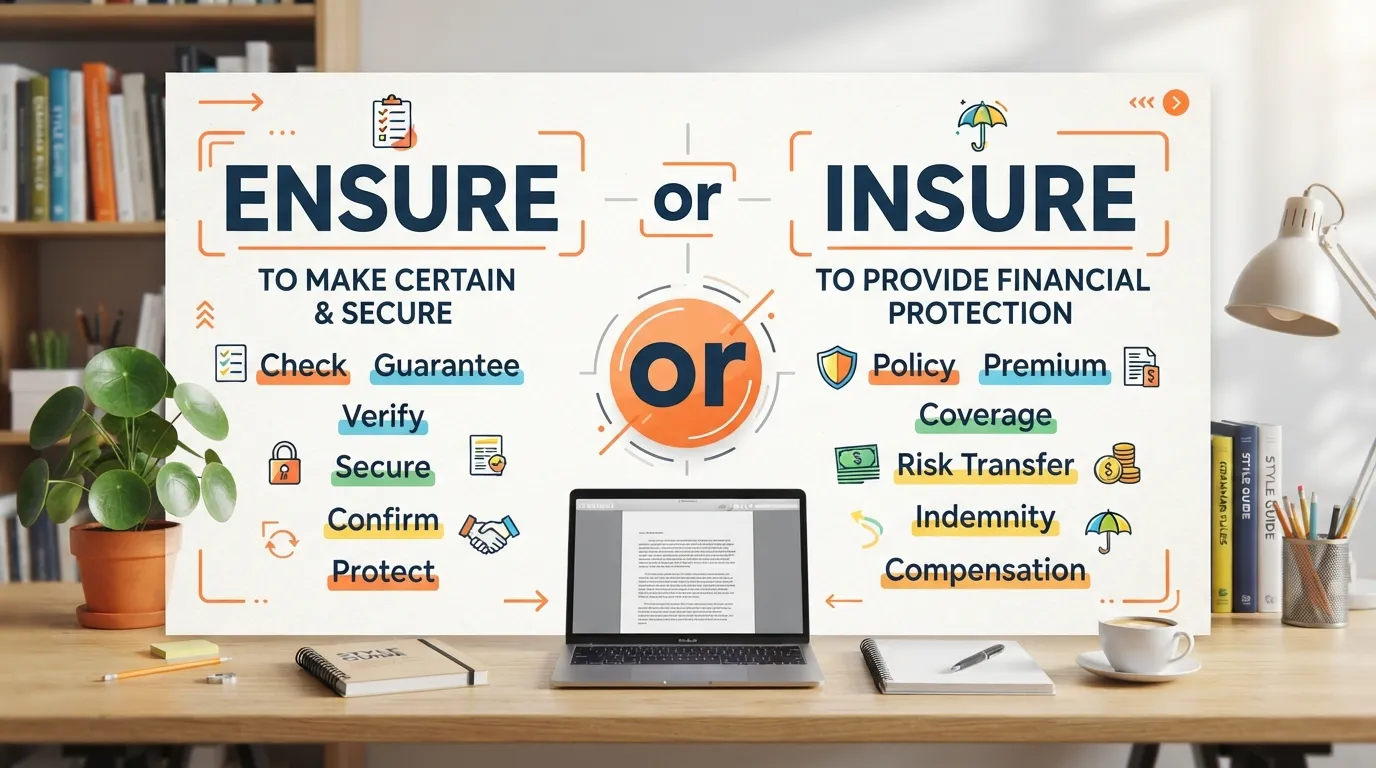
Here’s the quick fix: ensure means to make certain something happens, while insure means to protect against financial loss with insurance.
These words look and sound similar, but their meanings don’t overlap at all.
Once you separate “certainty” from “financial protection,” this mix-up disappears for good.
Quick Answer
Ensure means to make sure or guarantee something happens (“Ensure the door is locked”).
Insure means to protect against loss or damage through an insurance policy (“Insure your car against theft”).
They’re not interchangeable, even though they sound alike and are often confused in everyday writing.
⚡ Quick Rule
Ensure means “make certain”; insure means “get insurance” — never swap the two.
Ensure vs Insure: The Core Difference
Say “I’ll ensure the report is finished” (guarantee), but “I’ll insure my house against fire” (financial protection).
This guarantee-versus-financial-protection distinction is the entire difference between these two words.
Grammar Rule Explained
There’s no grammar rule that changes these spellings — this is a meaning difference, not a regional or grammatical one.
Both words function the same way as verbs, but they describe entirely different actions.
“Ensure” applies broadly to nearly any situation where you want certainty.
“Insure” applies narrowly to situations involving insurance policies, coverage, or financial risk protection.
Ensure vs Insure Comparison Table
| Feature | Ensure | Insure |
|---|---|---|
| Meaning | To make certain, guarantee | To protect financially through insurance |
| Common context | General, everyday situations | Insurance, finance, risk protection |
| Example | Ensure the door is locked | Insure your car against theft |
| Grammar | Correct verb usage | Correct verb usage |
Memory Trick
Remember: “Ensure” starts like “en-sure,” which sounds like making something “sure” or certain.
“Insure” starts like “in-surance,” directly connecting it to insurance policies and financial coverage.
If money, risk, or a policy is involved, use insure. If you just mean “make certain,” use ensure.
Real Example Sentences
Using Ensure:
- Please ensure the lights are turned off before leaving.
- We must ensure everyone understands the new policy.
- The teacher wants to ensure all students pass the exam.
- Double-check to ensure your flight details are correct.
- The company took steps to ensure customer safety.
Using Insure:
- You should insure your home against natural disasters.
- The company insures its vehicles for accidents and theft.
- He decided to insure his jewelry separately.
- Many drivers insure their cars for the minimum required coverage.
- The business insures its equipment against damage.
What About “Assure”? The Third Confused Word
“Assure” is often confused with both ensure and insure, but it means something different again: to tell someone something confidently to remove their doubt.
Example: “I assure you the report will be finished on time” — this is about reassuring a person, not guaranteeing an outcome or buying insurance.
A simple way to separate all three: assure a person, ensure an outcome, insure something valuable against loss.
Keeping this three-way distinction in mind prevents nearly every common mix-up between these words.
Common Mistakes
1. Using “insure” instead of “ensure” Incorrect: Please insure the door is locked before you leave. Correct: Please ensure the door is locked before you leave.
2. Using “ensure” instead of “insure” Incorrect: I need to ensure my car against theft. Correct: I need to insure my car against theft.
3. Confusing “assure” with “ensure” Incorrect: I ensure you everything will be fine. Correct: I assure you everything will be fine.
4. Assuming all three words are interchangeable Each word has a distinct meaning — assure reassures a person, ensure guarantees an outcome, and insure protects financially.
When to Use Each Word
Use Ensure When:
- You want to guarantee an outcome
- No insurance or financial policy is involved
- Describing a general action to make something certain
Examples: ensure accuracy, ensure safety, ensure compliance
Use Insure When:
- Discussing insurance policies or coverage
- Protecting against financial loss or risk
- Referring to cars, homes, health, or valuables
Examples: insure your home, insure a vehicle, insure against loss
FAQs
Is it ensure or insure?
It depends on meaning: ensure means “make certain,” while insure means “protect with insurance.” They aren’t interchangeable.
What does “ensure” mean?
“Ensure” means to guarantee or make certain that something happens.
What does “insure” mean?
“Insure” means to protect against financial loss through an insurance policy.
Is “assure” the same as “ensure”?
No. “Assure” means to reassure a person and remove their doubt, while “ensure” means to guarantee an outcome.
Can I use “insure” instead of “ensure” in casual speech?
In American English, some speakers use them interchangeably in casual speech, but formal writing keeps them distinct.
What’s an easy way to remember the difference?
Think: insure connects to insurance and money; ensure connects to making something certain.
Is it “please ensure” or “please insure” in a business email?
“Please ensure” is correct when asking someone to guarantee something happens, like ensuring a task is completed.
Do British and American English use these words differently?
No, this isn’t a regional spelling difference — both ensure and insure carry the same meanings in American and British English.
Conclusion
Ensure and insure sound similar, but their meanings are completely different.
Ensure means to make certain something happens; insure means to protect against loss through insurance.
Keep this distinction in mind, along with “assure” for reassuring people, and you’ll never mix up these words again.

Hi, I’m Sophia Bennett. My goal is to make grammar easy, clear, and useful through simple explanations and real-life examples.