A student once wrote, “The list of items are on the table,” and it read a little wrong.
The subject was “list,” not “items,” so it needed “is” instead of “are.”
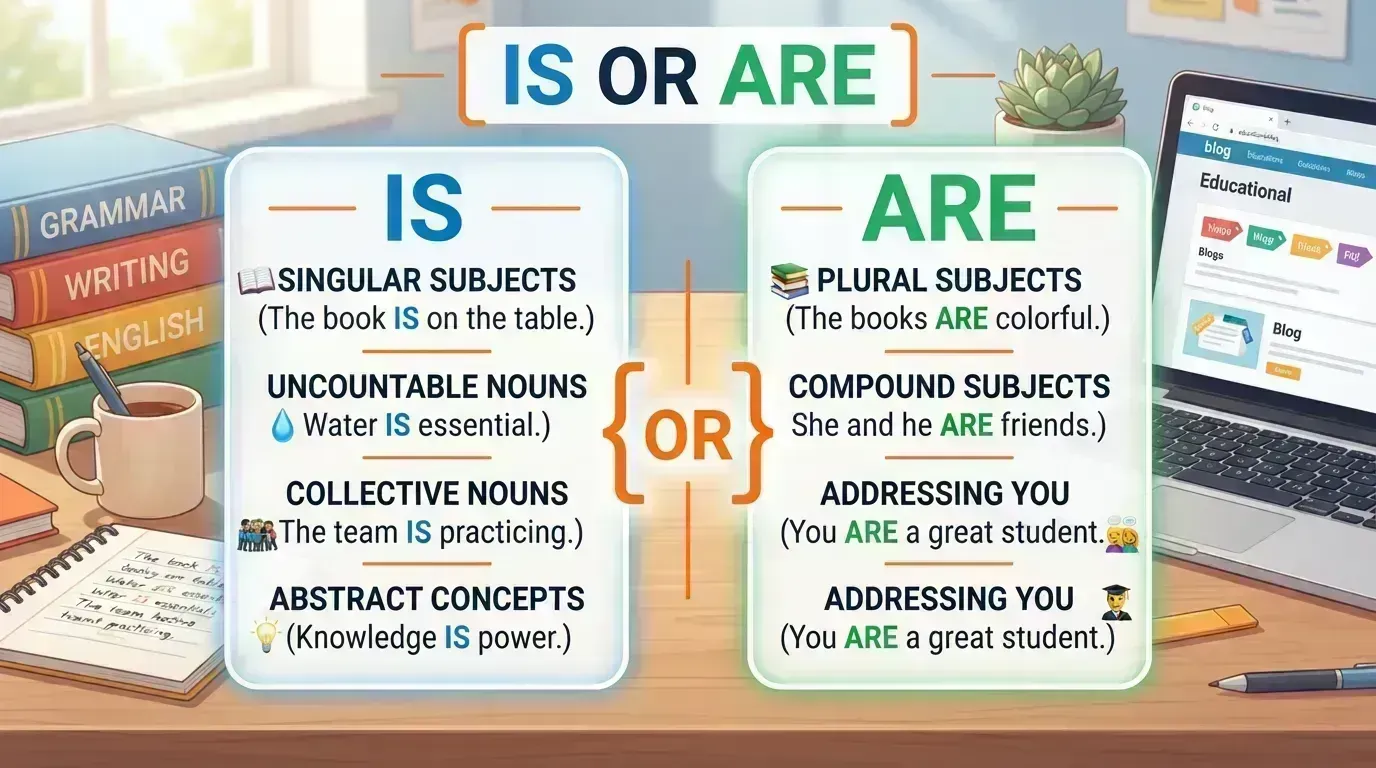
Is goes with a singular subject. Are goes with a plural subject. Match the verb to the true subject of the sentence, not just the nearest noun.
That single rule solves almost every confusion between these two words.
Once you learn to spot the real subject, this becomes second nature.
Quick Answer Box 🎯
Use “is” with singular subjects, like “she is” or “the dog is.” Use “are” with plural subjects, like “they are” or “the dogs are.” Always match the verb to the true subject, not the closest noun in the sentence.
⚡ Quick Rule in 1 Line
Is goes with singular, are goes with plural — match the subject.
Is vs Are: The Real Difference
are and is are both forms of the verb “to be,” used in the present tense.
“Is” pairs with singular subjects: he, she, it, or one specific person or thing.
“Are” pairs with plural subjects: we, you, they, or multiple people or things.
“The cat is sleeping” uses “is” because “cat” is singular.
“The cats are sleeping” uses “are” because “cats” is plural.
This basic pattern covers most everyday sentences without much difficulty.
The Subject-Matching Test Explained
Here’s the simplest way to check which word fits: find the true subject of the sentence first.
Ignore any extra descriptive phrases sitting between the subject and the verb.
Ask, “Is the subject one thing, or more than one thing?”
For example: “The box of chocolates is on the table” has the subject “box,” which is singular.
Even though “chocolates” is plural, it’s not the subject, so “is” is correct.
Try another: “The players on the team are tired” has the subject “players,” which is plural, so “are” is correct.
This test prevents you from mistakenly matching the verb to the wrong noun.
Tricky Cases That Confuse Everyone
Some sentences hide the true subject, making this rule harder to apply correctly.
Collective nouns like “team,” “family,” or “group” usually take “is,” since they act as one unit.
“The team is winning” treats the team as a single entity.
Indefinite pronouns like “everyone,” “everybody,” and “nobody” also take “is,” even though they feel plural.
“Everyone is welcome” is correct, not “everyone are welcome.”
Words like “neither” and “either” typically take “is” when used alone as the subject.
“Neither of the options is perfect” follows this same singular pattern.
The word “data” technically takes “are” in strict formal writing, though “is” has become widely accepted in casual use.
Correct vs Incorrect Examples
| Incorrect | Correct | Why |
|---|---|---|
| The list of names are long. | The list of names is long. | Subject is “list,” singular |
| Everyone are invited. | Everyone is invited. | “Everyone” is singular |
| The team are playing well. | The team is playing well. | Collective noun, singular unit |
| Neither of them are ready. | Neither of them is ready. | “Neither” is singular |
| There is many reasons. | There are many reasons. | Subject “reasons” is plural |
Comparison Table
| Subject Type | Correct Verb | Example |
|---|---|---|
| Singular noun | Is | The dog is barking. |
| Plural noun | Are | The dogs are barking. |
| Collective noun | Is | The family is arriving soon. |
| Indefinite pronoun (everyone, nobody) | Is | Everybody is here. |
| Compound subject (X and Y) | Are | Tom and Jerry are friends. |
Memory Trick to Never Mix Them Up
Think of it this way: “Is” is short, just like “one” is a single, short idea.
“Are” has more letters, just like it covers more than one thing.
When a sentence has extra words between the subject and verb, cover them up mentally.
Reading just the subject and verb together makes the correct match obvious almost instantly.
Example Sentences
She is studying for her exam tonight.
They are traveling to Spain next month.
The box of supplies is in the garage.
My friends are coming over this weekend.
Everyone is excited about the concert.
The committee is reviewing the proposal.
Neither of the answers is correct.
The children are playing in the yard.
This bouquet of flowers is beautiful.
Both of the movies are worth watching.
Nobody is answering the phone right now.
The players on the field are exhausted.
Either choice is acceptable for the project.
The news is surprising to everyone.
My keys are somewhere in this bag.
Common Mistakes to Avoid
Many writers match the verb to the closest noun instead of the true subject.
This happens often with phrases like “the group of students,” where “students” sits right before the verb.
Collective nouns confuse writers who assume any group word automatically takes “are.”
Indefinite pronouns like “everyone” and “everybody” get mistakenly paired with “are” surprisingly often.
Sentences starting with “there is” or “there are” also cause frequent subject-verb mismatches.
Always locate the true subject before choosing between “is” and “are.”
When to Use Each Word
Use “is” for singular subjects, collective nouns acting as one unit, and most indefinite pronouns.
Use “are” for plural subjects and compound subjects joined by “and.”
In casual speech, some regional dialects blur this rule, though standard English keeps it strict.
In formal writing, resumes, or professional documents, subject-verb agreement is closely checked for accuracy.
When unsure, isolate the subject alone with the verb to test which one sounds correct.
FAQs ❓
Is it “is” or “are” after “there”?
It depends on what follows. “There is one reason” uses a singular noun; “there are many reasons” uses a plural noun.
Does “everyone” take is or are?
“Everyone” always takes “is,” since it’s grammatically treated as singular, even though it refers to a group.
Is “the team is” or “the team are” correct?
In American English, “the team is” is standard, treating the team as one unit. British English sometimes uses “are.”
Which is correct: “neither is” or “neither are”?
“Neither is” is grammatically correct when “neither” stands alone as the subject of the sentence.
Does “data” take is or are?
Formally, “data” takes “are” as a plural noun, though “data is” has become common and accepted in everyday use.
How do I find the true subject in a long sentence?
Ignore descriptive phrases between the subject and verb, then match the verb only to the main noun.
Is “you is” ever correct?
No, “you” always takes “are,” regardless of whether it refers to one person or multiple people.
Why do collective nouns take “is”?
Collective nouns like “team” or “family” represent one unified group, so they’re treated as singular subjects.
Conclusion
Is and are follow a clear, testable rule.
Use “is” for singular subjects and most indefinite pronouns.
Use “are” for plural subjects and compound subjects.
Find the true subject first, and this pair becomes simple every time.

Hi, I’m Sophia Bennett. My goal is to make grammar easy, clear, and useful through simple explanations and real-life examples.