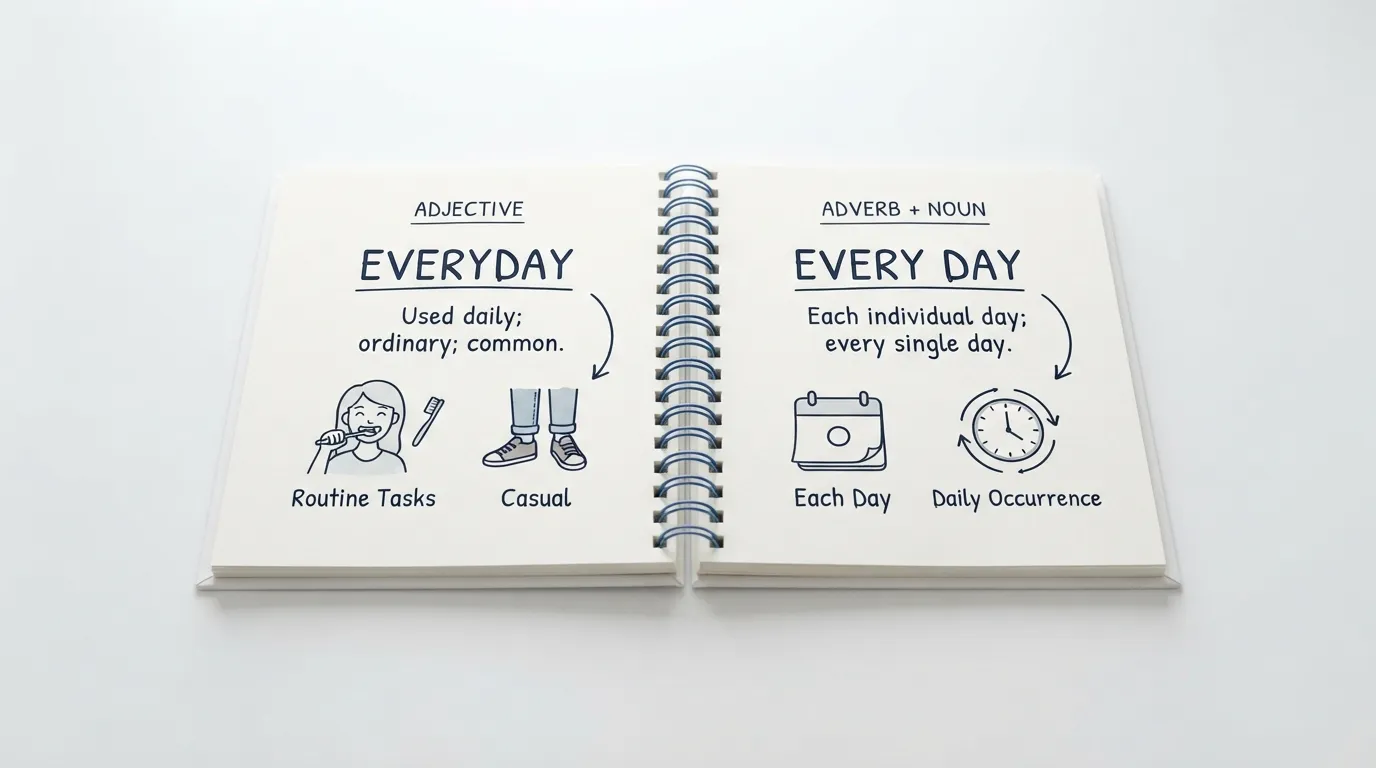
Everyday (one word) is an adjective meaning “ordinary” or “commonplace,” and it always comes before a noun.
Every day (two words) is an adverbial phrase meaning “each day,” and it describes when something happens, usually near a verb.
These two expressions look almost identical, but they have different meanings and uses.
Everyday is one word and works as an adjective. It means ordinary, common, or usual. For example, “These are my everyday shoes.”
Every day is two words and means each day. For example, “I walk every day.”
The easiest way to remember the difference is to check what comes after it. If you are describing a noun, everyday is usually correct. If you mean “each day,” use every day.
In this guide, you’ll learn the simple rule, common mistakes, and easy examples to help you use everyday and every day correctly.
⚡ Quick Rule in 1 Line
One word before a noun, two words when you mean “each day” near a verb.
Everyday as an Adjective
Everyday, written as one word, is an adjective. It describes a noun and means “ordinary,” “routine,” or “used daily.” For example, “everyday shoes” means your regular, ordinary shoes — not shoes you necessarily wear on all 365 days of the year.
Every Day as an Adverbial Phrase
Every day, written as two words, functions as an adverbial phrase. It answers the question “when” and typically follows a verb. For example, “I walk every day” tells you how often the walking happens — literally, each day.
Comparison Table
| Form | Part of Speech | Function | Example |
|---|---|---|---|
| Everyday | Adjective | Describes a noun | “She wore her everyday jacket.” |
| Every day | Adverbial phrase | Describes a verb (when) | “She jogs every day.” |
Example Sentences
- I brought my everyday backpack instead of the fancy one. (adjective)
- We practice piano every day after school. (adverb phrase)
- Crime is sadly an everyday occurrence in some areas. (adjective)
- He calls his mom every day to check in. (adverb phrase)
- These are just my everyday work clothes. (adjective)
- I read for at least ten minutes every day. (adverb phrase)
- Our everyday routine includes coffee and the news. (adjective)
- The store restocks its shelves every day at dawn. (adverb phrase)
- That’s an everyday problem for most small businesses. (adjective)
- She reviews her notes every day before the exam. (adverb phrase)
❌ Incorrect: “I go to the gym everyday.” ✅ Correct: “I go to the gym every day.”
❌ Incorrect: “These are my every day shoes.” ✅ Correct: “These are my everyday shoes.”
Common Mistakes
- Using “everyday” after a verb, where “every day” belongs, as in “I exercise everyday.”
- Using “every day” before a noun, where “everyday” belongs, as in “my every day clothes.”
- Assuming both spellings mean the same thing — they don’t, even though they sound identical.
The Easy Memory Trick
Try inserting the word “single” between “every” and “day.” If “every single day” fits and still makes sense, you need the two-word form, every day. If it sounds awkward or doesn’t fit grammatically, you likely need the one-word adjective, everyday.
Expert Tip 💡
Check what the word is modifying. If it’s sitting right next to a noun, it’s almost always “everyday.” If it’s near a verb telling you when something happens, it’s “every day.”
Answer: I miss you every day.
Because it means each day.
FAQs
Is everyday one word or two?
It’s one word when used as an adjective describing a noun, meaning “ordinary” or “routine.”
When should I use every day as two words?
Use “every day” as two words when it functions as an adverbial phrase meaning “each day,” usually near a verb.
Can everyday ever be a noun?
Occasionally people use it informally as shorthand for daily routines, but this isn’t standard grammatical use.
Is “everyday” or “every day” more common?
Both are common, but they aren’t interchangeable — each has a distinct grammatical role.
What’s a simple trick to remember the difference?
Try adding “single” between the words. If “every single day” works, use the two-word form.
Does British English follow the same rule?
Yes, both American and British English follow the same adjective vs. adverbial phrase distinction.
Is “everyday” ever correct after the verb “to be”?
No, using “everyday” directly after “is” or “are” to describe timing is incorrect; use “every day” instead.
Why do people confuse these so often?
Because they sound identical when spoken, so the visual spelling difference is easy to overlook in casual writing.
Conclusion
The difference between everyday and every day is simple once you know what each expression means.
Use everyday as an adjective for something ordinary or usual, such as “everyday clothes.” Use every day when you mean each day, such as “She reads every day.”
A quick trick is to replace every day with “each day.” If the sentence still makes sense, every day is the right choice.
Remember: everyday = ordinary, while every day = each day.

Hi, I’m Daniel Carter. I’m passionate about helping learners improve their English with practical grammar tips and clear writing advice.