You started a work email with “Goodmorning team,” and your manager quietly fixed it before forwarding the message.
Here’s the quick fix: “good morning” is always correct, written as two separate words, and “goodmorning” is a common misspelling in everyday writing.
This mistake likely happens because the greeting is spoken as one smooth phrase, making it feel like a single word.
Once you compare it to similar greetings, you’ll see why it should always stay as two words.
Quick Answer
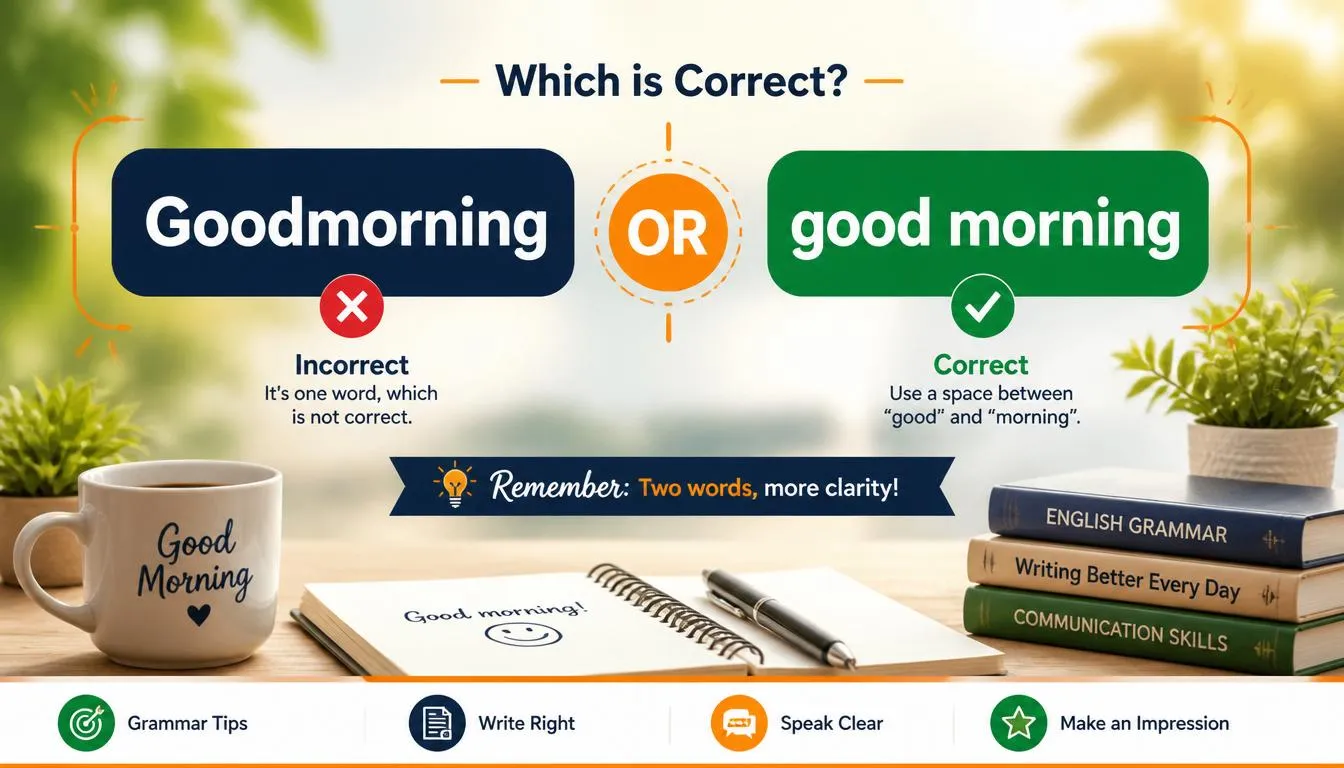
“Good morning” (two words) is the only correct spelling, used as a greeting or well-wish for the morning hours.
“Goodmorning” (one word) is a common misspelling and doesn’t appear in standard English dictionaries.
The same rule applies to “good afternoon,” “good evening,” and “good night.”
⚡ Quick Rule
“Good morning” is always two words — “goodmorning” simply isn’t a recognized word.
Goodmorning vs Good Morning: The Core Difference
“Good morning” combines the adjective “good” with the noun “morning,” used as a greeting or expression of well-wishing.
“Goodmorning” is not found in any standard English dictionary, despite frequently appearing in texting, emails, and social media captions.
Say “Good morning, everyone!” (correct), never “Goodmorning, everyone!” (incorrect).
This pattern holds true across all similar time-based greetings in English.
Grammar Rule Explained
“Good” functions as an adjective describing “morning,” the same way it describes “afternoon,” “evening,” and “night” in related greetings.
None of these related phrases — good afternoon, good evening, good night — ever merge into single words in standard English.
Since all four greetings follow the exact same grammatical structure, “good morning” logically follows the same two-word rule.
This consistency across the entire greeting family makes it easy to remember once you notice the pattern.
Why Do People Write “Goodmorning” as One Word?
Because “good morning” is spoken as a smooth, quick phrase, it can feel like a single greeting rather than two separate words.
This is a similar pattern to other common merging mistakes, like “alot” instead of “a lot” or “atleast” instead of “at least.”
Frequent appearances of “goodmorning” in texting, social media captions, and casual writing have also visually normalized the error for many readers.
Despite this, no major dictionary, including Merriam-Webster or Oxford, recognizes “goodmorning” as a standard single word.
Goodmorning vs Good Morning Comparison Table
| Feature | Good Morning | Goodmorning |
|---|---|---|
| Correct spelling | ✅ Yes | ❌ No |
| Recognized in dictionaries | ✅ Yes | ❌ No |
| Meaning | A morning greeting or well-wish | Not a real word |
| Formal writing | Always acceptable | Never acceptable |
Memory Trick
Remember: “Good morning” belongs to a family of four greetings — good morning, good afternoon, good evening, and good night — all written as two words.
Picture these four greetings standing in a row, each with a consistent space between “good” and the time of day.
If “goodafternoon” and “goodevening” look wrong to you, “goodmorning” should look just as incorrect.
Real Example Sentences
Correct (Good Morning):
- Good morning! I hope you slept well.
- She always says good morning to her neighbors.
- Good morning, team — let’s get started.
- He texted her a simple “good morning” every day.
- Good morning sunshine, it’s time to wake up.
Incorrect (Goodmorning):
- Goodmorning! I hope you slept well. ❌
- She always says goodmorning to her neighbors. ❌
- Goodmorning, team — let’s get started. ❌
Good Morning, Good Afternoon, and Good Evening — The Full Pattern
All time-based greetings in English follow the exact same two-word structure, without exception.
Good afternoon: used from around noon until early evening, as in “Good afternoon, how can I help you?”
Good night: used specifically as a farewell before sleep, as in “Good night, sleep well.”
Recognizing this full family of greetings reinforces why “goodmorning” should never be written as a single word either.
Common Mistakes
1. Writing “goodmorning” as one word Incorrect: Goodmorning everyone, hope you have a great day. Correct: Good morning everyone, hope you have a great day.
2. Assuming casual greetings don’t need standard spelling Even in casual texting, “goodmorning” remains a spelling error, though it’s commonly seen online.
3. Forgetting the pattern across all four time-based greetings Since “good afternoon” and “good evening” stay as two words, “good morning” should follow the exact same rule.
4. Capitalizing incorrectly when starting a sentence Only capitalize “Good” at the start of a sentence or greeting, as in “Good morning,” not “good Morning.”
When to Use “Good Morning”
Use Good Morning When:
- Greeting someone during the morning hours
- Starting an email, message, or conversation politely
- Wishing someone well at the start of their day
Examples: good morning email greeting, good morning text, good morning wishes
Never Use “Goodmorning”
There is no correct context for “goodmorning” as a single word in standard English writing.
FAQs
Is “goodmorning” ever a correct spelling?
No, “goodmorning” is never correct in standard English. The only proper spelling is “good morning,” as two separate words.
Why do people write “goodmorning” as one word?
Because it’s spoken quickly as a smooth greeting, making it feel like a single word, similar to how “a lot” is often misspelled as “alot.”
Do “good afternoon” and “good evening” follow the same rule?
Yes, all time-based greetings — good morning, good afternoon, good evening, and good night — always stay as two separate words.
Is “good morning” capitalized in a sentence?
Only the first word, “Good,” is capitalized at the start of a sentence or greeting, as in “Good morning, everyone.”
Does spell check always catch “goodmorning”?
Most modern spell checkers do flag it, though it remains a common typing habit, especially in casual texting.
Is this a regional spelling difference, like color and colour?
No, this isn’t a US/UK variation — “goodmorning” is incorrect in every English-speaking region.
Can “good morning” be used as a noun?
It’s primarily used as a greeting or interjection, though it can function informally as a noun, as in “He gave her a quick good morning.”
Conclusion
Like other common merging mistakes, this word pair has a clear, absolute answer: “goodmorning” is never correct.
The only proper spelling is “good morning,” written as two separate words, following the same pattern as “good afternoon” and “good evening.”
Remember this consistent family of greetings, and you’ll always spell “good morning” correctly in your writing.

Hi, I’m Ethan Brooks. I create easy-to-follow grammar guides, writing tips, and vocabulary resources to make English learning enjoyable for everyone.