You wrote “I’ll come aswell,” and your teacher circled the word, though you weren’t sure what the correction was for.
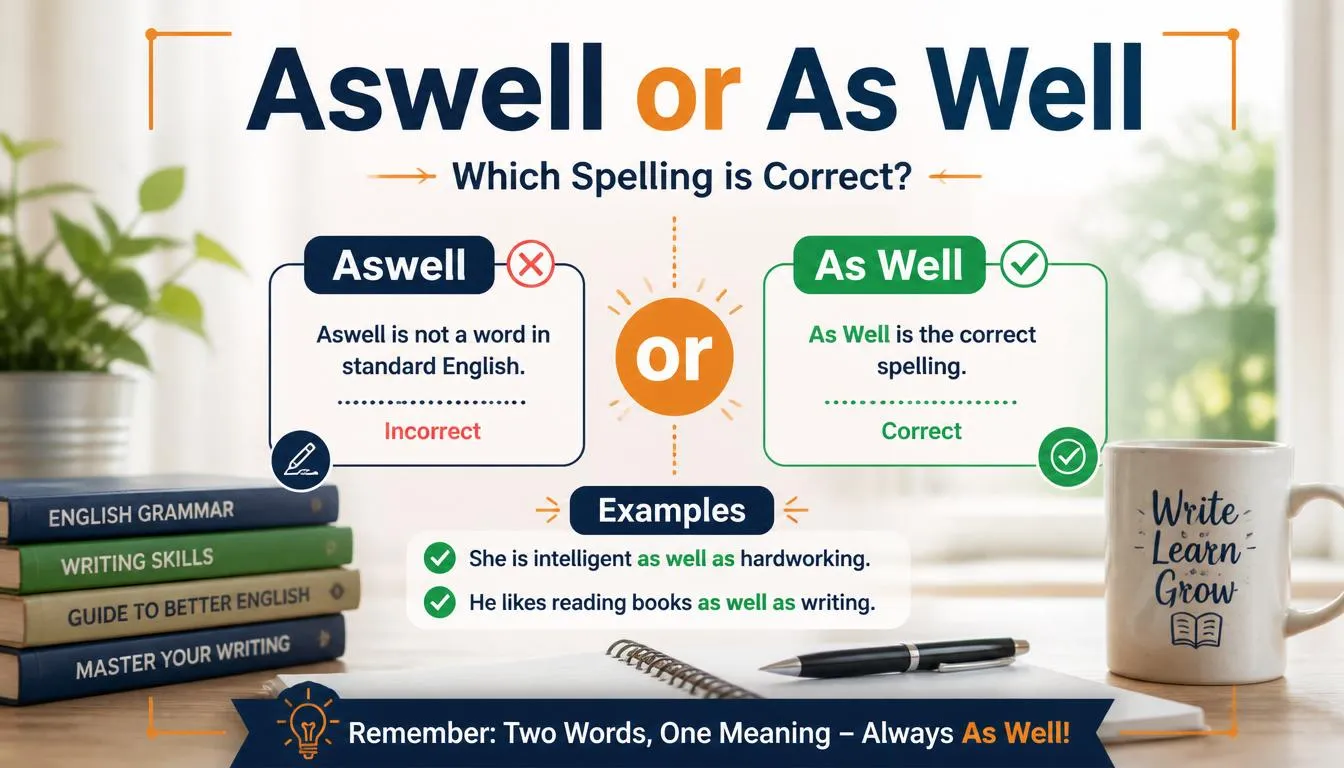
Here’s the quick fix: “as well” is always correct, written as two separate words, meaning “also” or “in addition.”
“Aswell” is a common misspelling, following the same pattern as “alot” and “atleast,” where two frequently paired words blend together in casual writing.
Once you understand why “as” and “well” always stay apart, this mistake becomes easy to avoid.
Quick Answer
“As well” (two words) is the only correct spelling, meaning “also” or “in addition to.”
“Aswell” (one word) is a common misspelling and doesn’t exist in standard English.
There’s no context where “aswell” is grammatically acceptable.
⚡ Quick Rule
“As well” is always two words — “aswell” simply isn’t a recognized word.
Aswell vs As Well: The Core Difference
“As well” combines the conjunction “as” with the adverb “well,” together meaning “also” or “in addition.”
“Aswell” is not found in any standard English dictionary, despite frequently appearing in casual writing, texting, and social media.
Say “She’s coming to the party as well” (correct), never “She’s coming to the party aswell” (incorrect).
Just like “a lot” and “at least,” this phrase never merges into a single word in standard English.
Grammar Rule Explained
“As” functions as a conjunction here, connecting the idea of addition to the rest of the sentence.
“Well” functions as an adverb, meaning “also” or “in addition,” similar to its use in phrases like “as well as.”
Since these two words each carry their own grammatical function, they don’t naturally combine into a single compound word.
This pattern matches other multi-word phrases like “as far as” or “as much as,” which also never merge into one word.
Why Do People Write “Aswell” as One Word?
Because “as well” is spoken quickly and smoothly in casual conversation, it can feel like a single sound rather than two distinct words.
This is the same reasoning behind similar mistakes like “alot” instead of “a lot” and “atleast” instead of “at least.”
Frequent appearances of “aswell” in texting and informal writing have also visually normalized the error for many readers.
Despite this, no major dictionary, including Merriam-Webster or Oxford, recognizes “aswell” as a legitimate word.
Aswell vs As Well Comparison Table
| Feature | As Well | Aswell |
|---|---|---|
| Correct spelling | ✅ Yes | ❌ No |
| Recognized in dictionaries | ✅ Yes | ❌ No |
| Meaning | Also, in addition | Not a real word |
| Formal writing | Always acceptable | Never acceptable |
Memory Trick
Remember: “As well” follows the same pattern as “as far” and “as much” — none of these phrases ever merge into a single word.
Picture “as” and “well” as two separate stepping stones you cross one at a time, never fused into one.
If “asfar” and “asmuch” look wrong to you, “aswell” should look just as incorrect.
Real Example Sentences
Correct (As Well):
- I’d like to order dessert as well.
- She speaks French and Spanish as well.
- He finished his homework and studied for the test as well.
- We should invite them as well.
- The manager approved the request as well.
Incorrect (Aswell):
- I’d like to order dessert aswell. ❌
- She speaks French and Spanish aswell. ❌
- He finished his homework and studied for the test aswell. ❌
As Well As — A Related Phrase to Remember
“As well as” is a related phrase meaning “in addition to” or “and also,” often used to connect two related ideas.
Example: “She manages the team as well as handling client relationships” — meaning she does both tasks.
Just like “as well,” this phrase always stays as three separate words, never merging into “aswellas” or any single-word variation.
Remembering that “as well” never merges helps reinforce that “as well as” follows the exact same rule.
Common Mistakes
1. Writing “aswell” as one word Incorrect: I want to come aswell. Correct: I want to come as well.
2. Assuming “aswell” is a casual, acceptable shortcut “Aswell” is not accepted in any formal or informal standard English writing — it’s always a spelling error.
3. Forgetting the comparison to “as far” and “as much” Since these similar phrases never merge, “as well” shouldn’t either.
4. Misspelling “as well as” as “aswellas” Incorrect: She cooks aswellas she bakes. Correct: She cooks as well as she bakes.
When to Use “As Well”
Use As Well When:
- Meaning “also” or “in addition”
- Adding extra information to a sentence
- Writing formally, casually, or professionally
Examples: come along as well, mentioned that as well, works here as well
Never Use “Aswell”
There is no correct context for “aswell” as a single word in standard English writing.
FAQs
Is “aswell” ever a correct spelling?
No, “aswell” is never correct in standard English. The only proper spelling is “as well,” as two separate words.
Why do people write “aswell” as one word?
Because it’s spoken quickly and smoothly, making it feel like a single word, similar to how “a lot” is often misspelled as “alot.”
Is “as well” the same as “also”?
Yes, “as well” and “also” both mean “in addition,” though “as well” typically appears at the end of a sentence, while “also” can appear earlier.
Does “as well as” follow the same rule?
Yes, “as well as” always stays as three separate words, following the same pattern as “as well.”
Does spell check always catch “aswell”?
Most modern spell checkers do flag it, though not every autocorrect tool catches it consistently during fast typing.
Is this a regional spelling difference, like color and colour?
No, this isn’t a US/UK variation — “aswell” is incorrect in every English-speaking region.
What does “as well” mean in a sentence?
It typically means “also” or “in addition,” as in “He plays guitar and sings as well.”
Conclusion
Like “alot” and “atleast,” this word pair has a clear, absolute answer: “aswell” is never correct.
The only proper spelling is “as well,” written as two separate words, following the same pattern as “as far” and “as much.”
Whenever you’re tempted to write “aswell,” remember these similar phrases, and you’ll always spell it correctly.

Hi, I’m Daniel Carter. I’m passionate about helping learners improve their English with practical grammar tips and clear writing advice.