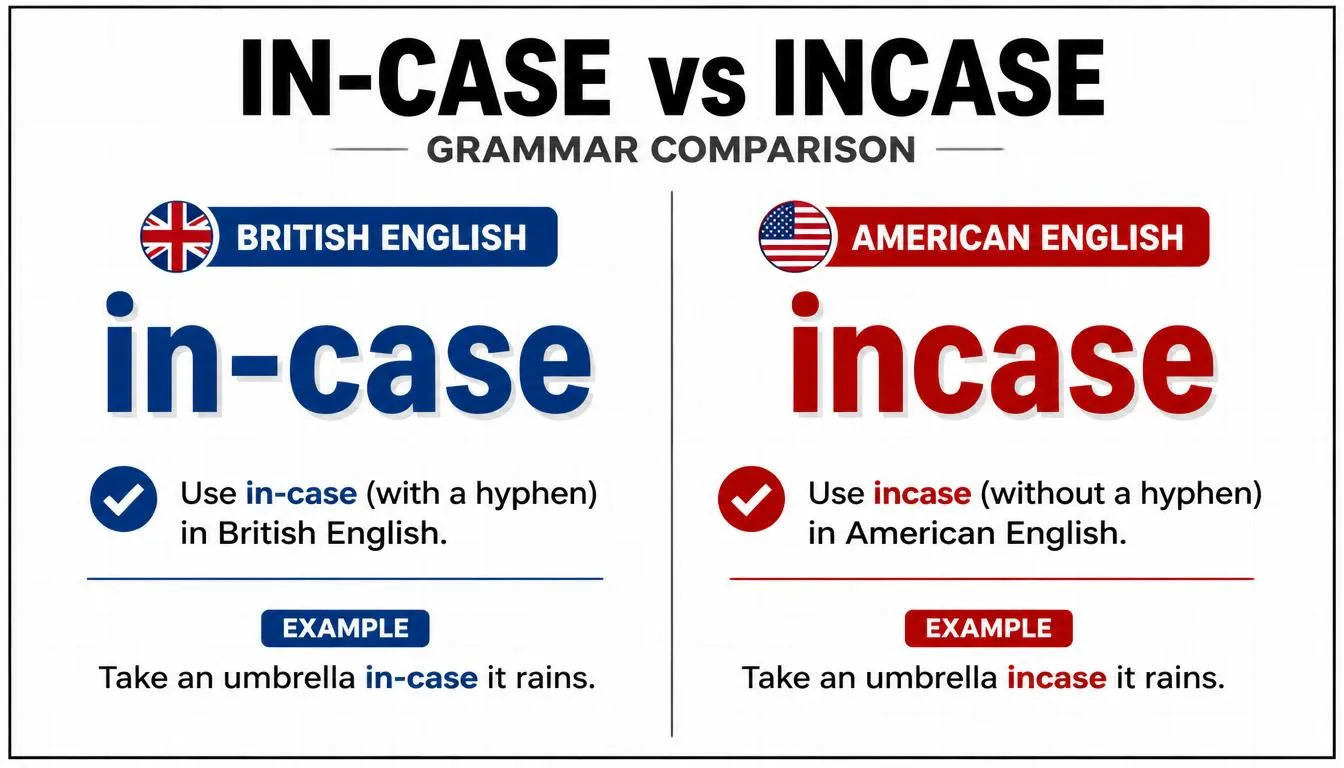
“Incase” is never correct — the phrase is always two words: “in case.”
You typed “bring a jacket incase it gets cold” and hit send before you noticed anything wrong.
Something felt slightly off, but you couldn’t place it. That instinct was right.
“Incase” isn’t a real word, even though it looks harmless enough sitting there in a text or email.
The correct spelling is always two words: “in case.” It’s an easy slip to make, mostly because the phrase sounds like one single word when you say it fast in conversation.
Your ear hears “incase,” so your fingers type it that way too.
The good news is this mistake is simple to fix once you know the rule. There’s no exception hiding here, no regional spelling variant, and no context where the one-word version becomes acceptable.
Quick Answer Box
“Incase” is not a recognized English word.
The correct spelling is always “in case” — two separate words meaning “as a precaution” or “if something happens.”
No context makes “incase” correct.
Table of Contents
- In Case vs Incase: The Real Difference
- Comparison Table
- Memory Trick
- Example Sentences
- Common Mistakes
- When to Use Each Form
- Expert Tip
- Engagement Add-On
- FAQs
- Conclusion
- Key Takeaways
In Case vs Incase: The Real Difference
“In case” is a two-word phrase, made from the preposition “in” and the noun “case.”
It works as a conjunction or adverb, meaning “if something happens” or “as a precaution against a possible event.”
“Take an umbrella in case it rains” is one example. You’re preparing for a possibility, not stating a fact.
“Incase” doesn’t follow any real rule of English spelling. It’s simply a habit that comes from how fast the phrase sounds in speech.
There’s a second layer of confusion here too. “Incase” is sometimes mistaken for a different, genuinely real word: “encase.”
“Encase” means to enclose or cover something completely. “Please encase the wire in plastic” is one example.
So “incase” isn’t just a misspelling of “in case.” It’s also sometimes a misspelling of “encase” — two completely different meanings colliding into one wrong word.
Comparison Table
| Form | Word(s) | Meaning | Correct? |
|---|---|---|---|
| Two words | in case | as a precaution, if something happens | Always correct |
| One word | incase | — | Never correct |
| Different word | encase | to enclose or cover completely | Correct, but different meaning |
Memory Trick
“In case” starts with “if” in meaning — and both “in” and “if” start with the letter I.
Whenever you’re tempted to write “incase,” swap it mentally for “if.” If “if” fits the sentence, you need the two-word “in case,” not one fused word.
Example Sentences
Correct (in case):
- Bring a jacket in case it gets cold.
- I saved a copy in case the file gets deleted.
- She packed extra snacks in case they got hungry.
- Call me in case you need help.
- Keep the receipt in case you need a refund.
- He left early in case there was traffic.
- We printed extra copies in case some got lost.
- In case of emergency, use the stairs.
- In case it rains later, I brought an umbrella.
- Save your work in case something happens to the file.
Incorrect (incase):
- Bring a jacket incase it gets cold.
- I saved a copy incase the file gets deleted.
- Call me incase you need help.
Common Mistakes
“I’ll bring snacks incase we get hungry.” Correct version: “I’ll bring snacks in case we get hungry.”
Confusing “incase” with the real word “encase.” “Encase” means to enclose something completely. It’s spelled with an E, not an I, and it’s a genuinely different word with its own correct use.
Assuming “incase” is fine in casual texting. It’s still incorrect everywhere. A grammar checker will flag it in a text message the same way it would in an essay.
When to Use Each Form
Always use “in case” as two words when describing a precaution or a possible future event.
No context — formal, informal, academic, or casual — makes “incase” the correct spelling.
Mean “to enclose or cover something”? Use “encase” instead. That’s a completely different, correctly spelled word.
💡 Expert Tip
Prone to typing “incase” out of habit? Try reading your sentence aloud and replacing the phrase with “if.”
“Bring a jacket if it gets cold” still makes sense. That’s your cue you need the two-word “in case,” never the fused version.
Engagement Add-On: Quick Quiz
- True or False: “Incase” is an acceptable informal spelling of “in case.” Answer: False. “Incase” is never correct.
- “Please ___ the wire in plastic for safety” should use: a) incase b) encase c) in case Answer: b) encase
FAQs
Is “incase” one word or two words?
“Incase” written as one word is never correct in standard English. The phrase always splits into two separate words: “in” and “case.” Whether you’re writing casually or formally, “in case” stays two words in every situation.
What does “incase” mean?
“Incase” has no meaning of its own because it isn’t a standard word. People typing “incase” almost always mean one of two things: “in case” (as a precaution, if something happens) or “encase” (to enclose or cover something completely). Check the sentence context to know which one you’re actually reaching for.
What does “in case” mean?
“In case” means “as a precaution” or “if something happens.” It’s used to describe an action taken now to prepare for a possible future event — for example, “Take a jacket in case it gets cold” means you’re preparing for the possibility of cold weather, not stating that it will definitely happen.
Incase or encase — what’s the difference?
These are two different real concerns hiding in one typo. “Encase” is a genuine English word meaning to enclose or cover something completely, as in “Encase the wire in plastic.” “In case” (two words) means “as a precaution.” “Incase” (one word) is correct in neither situation — it’s simply a misspelling of one or the other, depending on what you meant.
Is it “just incase” or “just in case”?
It’s “just in case,” written as three separate words. Adding “just” in front doesn’t change the spelling rule — “in case” still splits into two words, so the full phrase reads “just in case,” never “just incase.”
Is “if in case” correct?
No — “if in case” is redundant. “In case” already carries the meaning of “if,” so pairing them together repeats the same idea twice. Use one or the other: “in case it rains” or “if it rains,” not both together.
Does UK English spell “in case” differently?
No. “In case” is spelled the same way — two words — in both British and American English. There’s no regional variant that makes “incase” acceptable anywhere in the English-speaking world.
Is “incase” a real word?
No. It’s not recognized in any standard English dictionary. The correct form is always “in case.”
Why do people write “incase” instead of “in case”?
The phrase sounds like one word when spoken quickly, so writers blend the spelling without noticing.
Is “incase” the same as “encase”?
No, though it’s often confused with it. “Encase” is a real verb meaning to enclose or cover something completely.
Is “incase” acceptable in texting?
No. It’s still incorrect in any casual or informal writing, though the mistake is more noticeable in formal documents.
Will “incase” get marked wrong on an essay or resume?
Yes. Most teachers, editors, and employers will flag it as a spelling error.
What part of speech is “in case”?
It functions as a conjunction or adverb, and sometimes as a preposition when paired with “of,” as in “in case of emergency.”
Does British English spell it differently?
No. “In case” stays two words in both American and British English.
How can I stop making this mistake?
Search your document specifically for “incase” using find-and-replace, since some spellcheckers miss it.
What does “in case” mean in Urdu?
“In case” ka Urdu meaning hai “agar aisa ho,” “ehtiyatan,” ya “kisi possibility ke pesh-e-nazar.” Jaise “Take a jacket in case it gets cold” ka matlab hai “Jacket sath rakho, agar sardi ho jaye (ehtiyatan).”
Conclusion
“Incase” is simply a misspelling of “in case,” and it’s sometimes confused with the unrelated word “encase” too.
The fix is easy once you know it: keep “in case” as two words, every single time, in every context — texts, emails, essays, and formal documents alike.
There’s no exception waiting to trip you up here, and no regional spelling difference to memorize either.
If you ever catch yourself typing “incase,” pause and swap it mentally for “if.” That one quick check will keep your writing clean and correct going forward.

Hi, I’m Daniel Carter. I’m passionate about helping learners improve their English with practical grammar tips and clear writing advice.