You’re typing quickly, “the kids left thier bikes outside,” and hit send before noticing anything looks wrong.
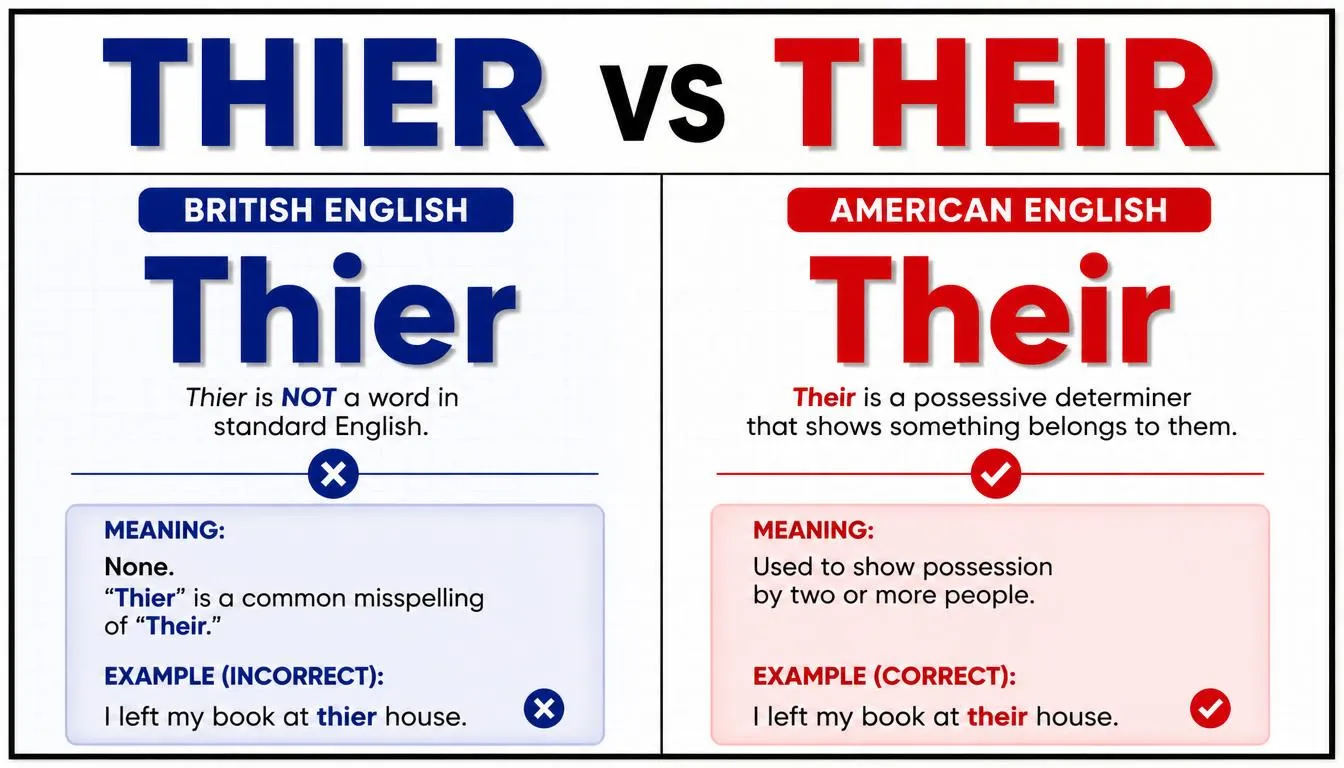
Quick answer: The correct spelling is “their.” “Thier” is not a word; it’s simply a letter-swap typo, most often caused by fingers moving faster than the “i before e” exception this word actually follows.
Table of Contents
- Quick Answer Box
- Quick Rule in One Line
- The Difference Explained
- Grammar Rule: Why “I Before E” Doesn’t Apply Cleanly Here
- Comparison Table
- Memory Trick
- Example Sentences
- Common Mistakes
- When to Use Each Form
- Expert Tip
- FAQs
- Conclusion
- Key Takeaways
Quick Answer Box
“Their” is the only correct spelling of the possessive pronoun meaning “belonging to them.” “Thier” is always a misspelling, with no valid use in any context.
The mix-up happens because “their” is one of many common exceptions to the “i before e” spelling guideline.
⚡ Quick Rule in 1 Line
“Their has an E before the I, breaking the usual ‘i before e’ pattern.”
The Difference Explained
There’s no real choice between these two spellings. “Their” is the possessive pronoun showing that something belongs to more than one person: their car, their idea, their house.
“Thier” simply swaps the I and E, creating a string of letters that isn’t a recognized English word in any dictionary.
Grammar Rule: Why “I Before E” Doesn’t Apply Cleanly Here
Many English learners are taught “i before e, except after c.” That rule works for words like “believe” and “receive,” but it has far more exceptions than most people realize.
“Their” is one of those exceptions. So are “weird,” “height,” and “foreign.” None of these words follow the simple version of the rule taught in school.
Because writers instinctively apply “i before e” out of habit, “their” ends up mistyped as “thier” more often than almost any other common word.
Comparison Table
| Feature | Their | Thier |
|---|---|---|
| Status | Correct, standard spelling | Misspelling, not a word |
| Part of speech | Possessive pronoun | N/A |
| Meaning | Belonging to them | No valid meaning |
| Follows “i before e”? | No, genuine exception | N/A |
| Example | Their house is on the corner. | Not valid in any context |
Memory Trick
Remember the hidden word inside “their”: H-E-I-R, as in an heir who inherits something. Both words relate to ownership, and both spell the E before the I. If you can picture an heir inheriting “their” belongings, the correct order sticks.
Example Sentences
- Their house is the blue one on the corner.
- The students turned in their assignments on time.
- We admired their garden during the visit.
- The company updated their logo last year.
- Their flight was delayed by two hours.
- The kids left their bikes in the driveway.
- Their opinions on the movie were very different.
- The team celebrated their win with pizza.
- I borrowed their ladder to fix the gutter.
- Their dog barks every time the doorbell rings.
Common Mistakes
❌ The kids left thier backpacks at school. ✅ The kids left their backpacks at school.
❌ We visited thier new apartment last weekend. ✅ We visited their new apartment last weekend.
Thier flight got delayed by two hours. ✅ Their flight got delayed by two hours.
When to Use Each Form
Always use “their” whenever you’re showing that something belongs to more than one person or thing. “Thier” should never appear in any context; if you catch yourself typing it, it’s simply a typo to correct.
Expert Tip 💡
Most modern spell checkers catch “thier” automatically, since it isn’t a recognized word at all. Still, for anything important, like a resume or client email, do a quick manual scan, since autocorrect settings occasionally miss quick typos in casual typing apps.
FAQs
Is “thier” ever a correct spelling?
No. It’s always a typo or misspelling of “their,” with no valid meaning of its own.
Why do people type “thier” instead of “their”?
Mostly because of the “i before e” habit learned in school, plus simple finger-speed typos while typing quickly.
Does “their” follow the “i before e, except after c” rule?
No. “Their” is a well-known exception to that rule, along with words like “weird” and “height.”
What does “their” mean?
It’s a possessive pronoun showing that something belongs to more than one person or thing, as in “their car” or “their idea.”
How can I remember the correct spelling?
Look for the hidden word “heir” inside “their.” Both relate to ownership, and both spell E before I.
Is “thier” a word in any dialect or region?
No. It’s considered a misspelling in every English-speaking region, with no regional exception.
Will spell check always catch “thier”?
Most modern spell checkers catch it immediately, since it isn’t a recognized word, though it’s still worth a manual check in important documents.
What’s the difference between “their” and “theirs”?
“Their” is followed by a noun (“their car”), while “theirs” stands alone without a noun (“The car is theirs”).
Conclusion
“Their” is the only correct spelling; “thier” is simply a common typo, usually caused by an instinctive “i before e” habit that doesn’t apply to this particular word.
Once you connect “their” to the hidden word “heir,” both relating to ownership and both spelling E before I, this typo becomes much easier to catch before you hit send.

Hi, I’m Olivia Harper. I love turning complex English grammar into simple, practical lessons that help readers write and speak with confidence.