In person or in-person? Learn the hyphen rule, when each form is correct, and see real examples for both.
You’re scheduling a meeting and type ‘in-person meeting’ without thinking twice. Then, a sentence later, you write ‘let’s meet in-person,’ and something feels inconsistent.
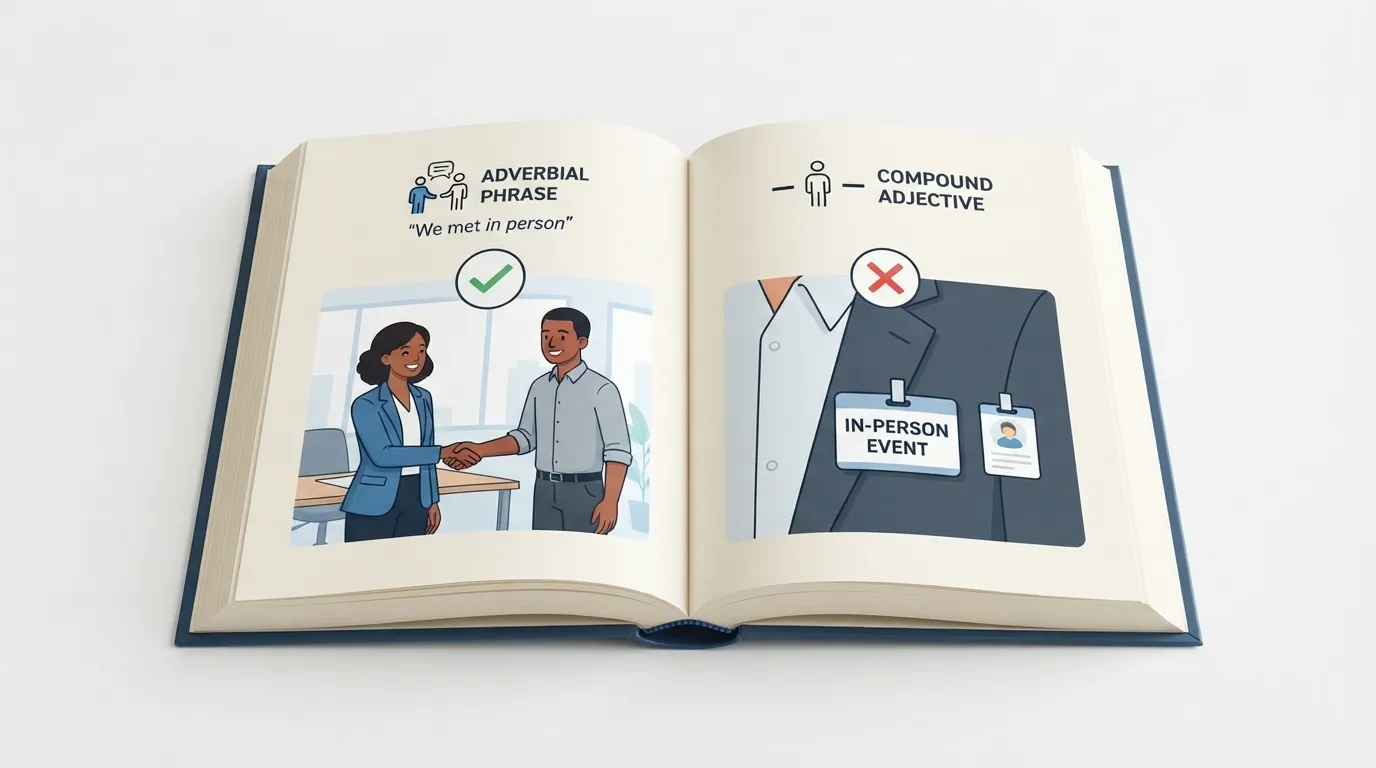
Here’s the quick answer: in-person, hyphenated, is a compound adjective used before a noun. In person, no hyphen, is an adverbial phrase that describes how an action happens, usually after a verb.
Quick Answer Box
Use in-person (hyphenated) when it directly describes a noun, as in ‘an in-person meeting.’ Use in person (no hyphen) when it describes how something is done, usually after a verb, as in ‘we met in person.’ AP Style, Chicago Manual of Style, and APA all agree on this rule.
⚡ Quick Rule in One Line
Hyphenate before a noun, drop the hyphen after a verb: ‘in-person meeting’ but ‘we met in person.’
What Does ‘In Person’ Mean?
‘In person’ means physically present in the same place, face-to-face, rather than communicating remotely through phone, video, or email. As an adjective before a noun it’s written ‘in-person’ with a hyphen, and as a phrase describing an action it’s written ‘in person’ with no hyphen, but the underlying meaning stays the same in both cases: being physically there.
In-Person as a Compound Adjective
When ‘in-person’ sits directly before a noun, it acts as a compound adjective, describing that noun the same way ‘well-known’ or ‘high-quality’ would. For example, in ‘in-person interview,’ the hyphenated form tells you what kind of interview it is, one held face-to-face rather than virtually.
In Person as an Adverbial Phrase
When ‘in person’ comes after a verb, it functions as an adverbial phrase, describing how the action was carried out. For example, in ‘she preferred to discuss it in person,’ the phrase explains how the discussion happened, face-to-face rather than by phone or email.
Is ‘Inperson’ (One Word) Correct?
No. ‘Inperson,’ written as a single word with no space or hyphen, is not correct in standard English. The phrase is always written either as ‘in-person’ (hyphenated, before a noun) or ‘in person’ (two separate words, after a verb), never merged into one word.
❌ Incorrect: ‘We had an inperson meeting.’ ✅ Correct: ‘We had an in-person meeting.’
Comparison Table
| Form | Function | Position | Example |
|---|---|---|---|
| In-person | Compound adjective | Before a noun | ‘We scheduled an in-person interview.’ |
| In person | Adverbial phrase | After a verb | ‘We discussed it in person.’ |
Example Sentences
In-person (hyphenated, before a noun):
The company scheduled an in-person meeting for next Tuesday.
Students attended an in-person class after months online.
The clinic offers both in-person and virtual appointments.
We conducted an in-person evaluation of the property.
The annual in-person conference returns this year.
In person (no hyphen, after a verb):
We finally met in person after months of video calls.
The CEO appeared in person at the event.
Customers can apply in person at the office.
I prefer to have this conversation in person.
Please attend in person to learn more.
❌ Incorrect: ‘We conducted interviews in-person.’ ✅ Correct: ‘We conducted interviews in person.’
❌ Incorrect: ‘We had an in person event last night.’ ✅ Correct: ‘We had an in-person event last night.’
Common Mistakes
Hyphenating ‘in-person’ after a verb, where it should stay as two words, like ‘we met in-person’ (incorrect).
Leaving out the hyphen before a noun, like ‘in person meeting’ instead of ‘in-person meeting.’
Writing it as a single word, like ‘inperson,’ which is never correct in either position.
Being inconsistent within the same document. Pick the correct form for each context and stay consistent throughout.
The Noun Test
A simple way to check: ask whether the phrase is directly describing a noun right next to it. If yes, hyphenate it, as in ‘in-person training,’ ‘in-person appointment.’ If the phrase comes after a verb and explains how something happened, skip the hyphen, as in ‘attend in person,’ ‘meet in person.’
Other Ways to Say ‘In Person’
If you want to vary your wording, several phrases carry a similar meaning to ‘in person,’ depending on context: ‘face-to-face,’ ‘in the flesh,’ ‘physically present,’ ‘on-site,’ and ‘live’ (as in ‘a live event’). These alternatives can work well in writing where ‘in person’ has already been used once and repeating it would feel clunky.
Expert Tip 💡
When editing, scan for the word immediately after the phrase. If it’s a noun, keep the hyphen. If it’s the end of the sentence or a different part of speech, drop it.
FAQs
Is ‘in-person’ always hyphenated?
No, only when it functions as a compound adjective directly before a noun, like ‘in-person meeting.’ After a verb, it’s written as two words without a hyphen.
Do AP Style and Chicago Manual of Style agree on this rule?
Yes, both style guides recommend hyphenating ‘in-person’ when it modifies a noun, and using two words without a hyphen elsewhere.
Is this rule different in British English?
No, both American and British English generally follow the same hyphenation pattern for ‘in-person’ versus ‘in person.’
What’s an easy way to remember the rule?
Check if the phrase sits right before a noun. If it does, hyphenate it. If it follows a verb instead, leave out the hyphen.
Is ‘in person’ ever used as a noun on its own?
No, ‘in person’ functions as an adverbial phrase describing how an action is done, not as a standalone noun.
Can I use ‘in-person’ and ‘in person’ interchangeably?
No, they serve different grammatical roles, so swapping them incorrectly can look like an error in formal or professional writing.
Does this rule apply to similar words like ‘face-to-face’?
Yes, ‘face-to-face’ follows the same pattern, hyphenated before a noun, like ‘face-to-face meeting,’ and often unhyphenated elsewhere depending on style guide preference.
Why does the hyphen matter so much?
It signals to the reader that two words are working together as a single descriptive unit, which improves clarity, especially in professional writing.
What does ‘in person’ mean exactly?
It means being physically present with someone, face-to-face, rather than communicating by phone, video call, or email.
Is ‘inperson’ a real word?
No. It should always be written as either ‘in-person’ (hyphenated) or ‘in person’ (two words), never combined into a single word.
What’s a good synonym for ‘in person’?
‘Face-to-face’ is the closest and most common alternative, though ‘physically present’ and ‘on-site’ also work depending on context.
Conclusion
The difference between in-person and in person comes down to one simple test: is it sitting next to a noun, or following a verb?
Hyphenate it before a noun, like ‘in-person meeting,’ and drop the hyphen after a verb, like ‘we met in person.’ Never merge it into a single word like ‘inperson.’
Major style guides agree on this rule, so it’s a safe one to lean on.

Hi, I’m Daniel Carter. I’m passionate about helping learners improve their English with practical grammar tips and clear writing advice.