You type ‘meet me their at noon’ and hit send before you catch it. Now you’re rereading old texts, wondering how many times you’ve done that.
Here’s the quick answer: ‘there’ points to a place or says something exists, while ‘their’ shows something belongs to a group of people. A cousin word, ‘they’re’, is simply short for ‘they are’. Mixing these up is one of the most common slips in English, and once you learn the two-second test, you won’t make it again.
Table of Contents
- Did You Know?
- Quick Answer Box
- Quick Rule in One Line
- The Real Difference Between Their and There
- The Grammar Rule (Plus the Third Word Everyone Forgets)
- Their vs. There vs. They’re Comparison Table
- The Easiest Memory Trick
- 16 Real Example Sentences
- Common Mistakes
- When to Use Each Form
- Expert Tip
- Quick Quiz
- FAQs
- Conclusion
- Key Takeaways
Did You Know? 🔍
‘There’ actually hides its own memory trick inside its spelling. It contains the word ‘here’, and both words describe a place, just at different distances. ‘Their’ doesn’t share that pattern at all, which is one reason spelling checkers still catch this mistake so often, since the words look almost identical but aren’t built the same way.
Quick Answer Box
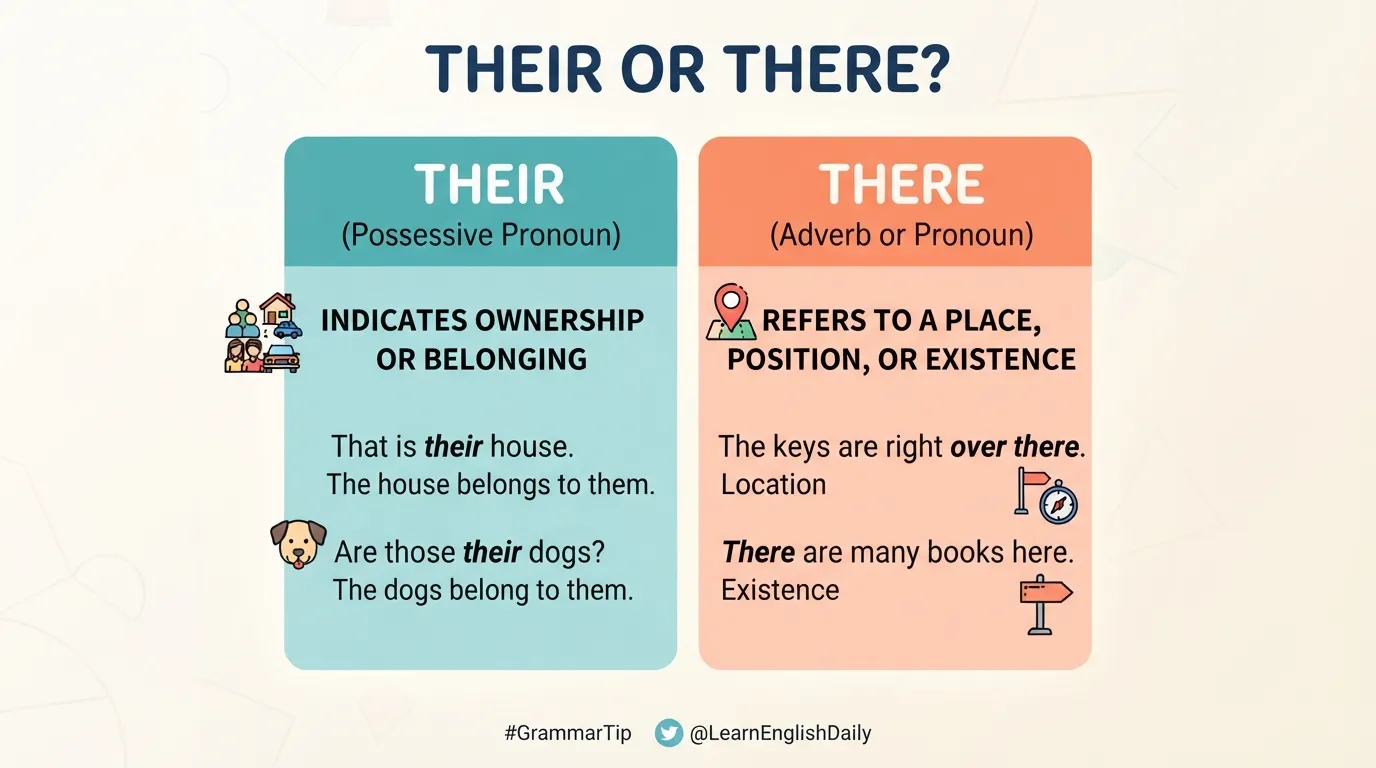
‘There’ refers to a place, a location, or introduces something that exists, as in ‘the keys are over there’. ‘Their’ is a possessive word showing something belongs to a group, as in ‘their car is parked outside’. A third word, ‘they’re’, is short for ‘they are’ and is often mixed up with both.
⚡ Quick Rule in One Line
If you can swap in ‘here’, use there; if you can swap in ‘our’, use their.
The Real Difference Between Their and There
There is an adverb that points to a location or introduces existence, while their is a possessive determiner showing ownership by a group of people. They sound exactly the same, which is the whole reason this pair causes so much trouble, but their jobs in a sentence couldn’t be more different.
‘There’ answers the question ‘where’. ‘Their’ answers the question ‘whose’. Once you know which question your sentence is actually asking, the correct word becomes obvious almost every time.
The Grammar Rule (Plus the Third Word Everyone Forgets)
There works as an adverb of place (‘put it there’) or as an introductory word before a verb like ‘is’ or ‘are’ (‘there is a problem’). Their works only as a possessive determiner, always sitting in front of a noun it modifies (‘their house’, ‘their plans’). The part most guides skip: a third word, ‘they’re’, belongs in this same conversation because it’s pronounced identically and gets swapped in by mistake just as often.
‘They’re’ is simply a contraction of ‘they are’. If you can expand the word back into ‘they are’ and the sentence still makes sense, ‘they’re’ is correct. If expanding it breaks the sentence, you need either ‘there’ or ‘their’ instead, and the location versus ownership test settles which one.
Try it on a real sentence:
___ going to move ___ furniture into ___ new apartment over ___.
Working through it one blank at a time: ‘they are going’ works, so the first blank is they’re. The furniture belongs to them, so the second blank is their. Same for the apartment, their again. The last blank points to a place, so it’s there.
Their vs. There vs. They’re Comparison Table
| Feature | There | Their | They’re |
|---|---|---|---|
| Grammatical role | Adverb of place / introductory word | Possessive determiner | Contraction |
| Answers to | Where | Whose | Expands to ‘they are’ |
| Test | Swap in ‘here’ | Swap in ‘our’ | Expand to ‘they are’ |
| Example | The dog ran over there. | Their dog ran off. | They’re walking the dog. |
| Common mistake | Used instead of their | Used instead of there | Used instead of the other two |
The Easiest Memory Trick
For ‘there’, spot the word ‘here’ hiding inside it. Both point to a place, so if your sentence is about location, that’s your word. For ‘their’, remember the letter ‘i’ as a stand-in for ownership, since the word means something belongs to them. For ‘they’re’, just try expanding it. If ‘they are’ fits the sentence, the apostrophe version is correct.
16 Real Example Sentences
There (place or existence) examples:
- The car is parked over there.
- There is a spider on the ceiling.
- We flew there for the wedding last spring.
- There are three empty seats in the back row.
- Put the boxes down right there.
- There used to be a bakery on this corner.
- She stood there without saying a word.
- There will be a storm later tonight.
Their (possession) examples:
- Their flight got delayed by two hours.
- The students left their backpacks in the hallway.
- That is their decision to make.
- Their garden looks amazing this year.
- I borrowed their ladder to fix the roof.
- The team celebrated their first win of the season.
- Their kids go to the same school as mine.
- She admired their new kitchen renovation.
Common Mistakes
❌ ‘Their is a coffee shop nearby.’ ✅ ‘There is a coffee shop nearby.’ (introduces existence, not ownership)
❌ ‘That is there dog.’ ✅ ‘That is their dog.’ (shows the dog belongs to them)
‘There going to be late.’ ✅ ‘They’re going to be late.’ (short for ‘they are’)
❌ ‘I left my keys over their.’ ✅ ‘I left my keys over there.’ (points to a place)
When to Use Each Form
Use there whenever the sentence describes a location or introduces something existing, such as ‘there is’, ‘there are’, or ‘over there’.
THE Use their whenever the sentence shows something belongs to a group of people, always right before a noun, such as ‘their house’ or ‘their choice’.
Use they’re only when you can replace it with ‘they are’ and the sentence still reads correctly, such as ‘they’re arriving soon’ becoming ‘they are arriving soon’.
Expert Tip 💡
Before sending an important email or publishing a post, run a quick search through your draft for ‘there’, ‘their’, and ‘they’re’, and test each one individually with the swap tricks above. Spell checkers rarely catch this mistake, since all three words are spelled correctly on their own, just used in the wrong spot.
Quick Quiz
- ‘The kids left ___ shoes by the door.’ (there / their)
- ‘___ is a package waiting for you.’ (There / Their)
- ‘___ meeting new clients this afternoon.’ (There / They’re)
Answers: 1. their (shows ownership) 2. There (introduces existence) 3. They’re (expands to ‘they are meeting’)
FAQs
1. What is the easiest way to remember there versus their?
Check whether the sentence is about a place or about ownership. If it’s about place, use there, since it contains ‘here’. If it’s about ownership, use their.
2. Is they’re the same as there or their?
No. They’re is a contraction of ‘they are’ and only fits where that full phrase would make sense.
3. Why do these three words sound the same?
All three are pronounced the same way in standard English, which is exactly why spelling them correctly takes a little extra attention.
4. Can there ever show possession?
No. There never shows ownership. If a sentence is about something belonging to a group, their is the only correct choice.
5. Is there a British versus American difference in this rule?
No, the rule is identical in both American and British English. This isn’t a regional spelling split.
6. What’s a quick test for they’re specifically?
Expand it to ‘they are’ in your head. If the sentence still makes sense, they’re is correct.
7. Is ‘their’ ever used for a single person?
Yes, in modern usage ‘their’ is commonly used as a singular possessive when someone’s gender is unknown or unspecified, such as ‘each student should bring their own laptop’.
8. Does autocorrect usually catch this mistake?
Not reliably. Since there, their, and they’re are all correctly spelled words, most spell checkers won’t flag the wrong one being used.
9. What part of speech is ‘there’ when it starts a sentence, like ‘there is a problem’?
In that position, ‘there’ functions as an introductory word (sometimes called an expletive or dummy subject) rather than pointing to an actual location.
10. Is one of these three words more formal than the others?
No, all three are standard in both formal and casual writing. The only issue is choosing the right one for the sentence.
Conclusion
The their, there, and they’re mix-up comes down to one question: what job is the word doing in your sentence? it points to a place, you need there.
If it shows something belongs to a group, you need their. If it can be expanded to ‘they are’, you need they’re. Run that quick mental test before you hit send, and this classic mistake stops showing up in your writing for good.

Hi, I’m Olivia Harper. I love turning complex English grammar into simple, practical lessons that help readers write and speak with confidence.