You’re writing a report on employee health.
‘Wellbeing’ or ‘well-being’? Both look like they could work.
Here’s the quick answer: ‘well-being,’ with a hyphen, is the standard, dictionary-preferred spelling.
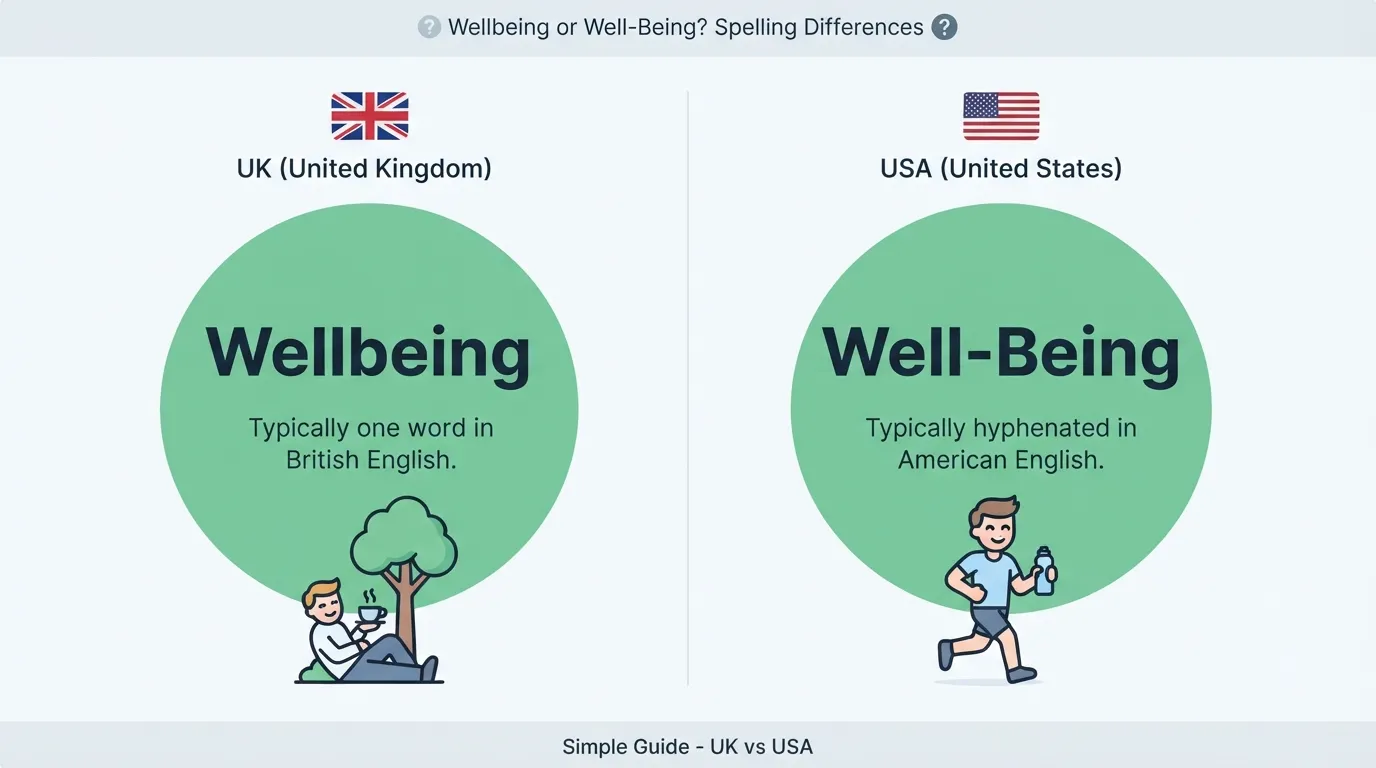
‘Wellbeing,’ as one word, is a increasingly common variant, especially in British English and casual or marketing writing.
Table of Contents
Did You Know?
Quick Answer Box
Quick Rule in One Line
Why the Hyphen Exists
Wellbeing as One Word
Comparison Table
Memory Trick
Example Sentences
Common Mistakes
When to Use Each Form
Expert Tip
FAQs
Conclusion
Key Takeaways
Did You Know? 🔍
‘Well-being’ has been in continuous use since the 16th century, with Merriam-Webster recording its first known use back in 1561, making it nearly five centuries old.
Quick Answer Box
‘Well-being,’ with a hyphen, is the standard spelling recognized by Merriam-Webster and most style guides, meaning the state of being healthy, happy, or prosperous.
‘Wellbeing,’ as one closed word, is a growing variant, more common in British English, marketing copy, and some organizational style guides.
‘Well being,’ as two separate words with no hyphen, is not correct for this meaning.
⚡ Quick Rule in One Line
Well-being, hyphenated, is the standard spelling; wellbeing as one word is an accepted, growing variant.
Why the Hyphen Exists
‘Well-being’ combines ‘well,’ an adjective, with ‘being,’ a noun or verb form, into a single compound noun.
Joining two words from different parts of speech typically requires a hyphen in English, which is exactly what happens here.
This is different from compounds like ‘football’ or ‘backyard,’ which combine two nouns and eventually merged into single closed words over time.
Because ‘well’ and ‘being’ come from different parts of speech, the hyphenated form has remained the standard for centuries.
Wellbeing as One Word
Despite the hyphen’s long history, ‘wellbeing’ as a single word has become increasingly common, especially in British English.
Some dictionaries and organizations now accept it, though many, including Merriam-Webster, still list ‘well-being’ as the primary, preferred form.
This shift follows a common pattern in English, where hyphenated compounds slowly merge into single words over time, similar to how ‘to-day’ eventually became ‘today.’
For now, ‘wellbeing’ is best considered an accepted but secondary variant, not yet the dominant standard.
Comparison Table
| Form | Status | Common In |
|---|---|---|
| Well-being | Standard, dictionary-preferred | American English, formal writing, most style guides |
| Wellbeing | Accepted, growing variant | British English, marketing, some corporate style guides |
| Well being | Incorrect for this meaning | Not standard (has a different meaning as two separate words) |
Memory Trick
Remember that ‘well’ and ‘being’ are two different parts of speech joining together, and that combination almost always needs a hyphen in English.
Think of other ‘well-‘ compounds that stay hyphenated before a noun, like ‘well-known’ and ‘well-informed,’ as a reminder of the pattern.
Example Sentences
We have to consider the well-being of the child in this decision.
Doctors work to protect the well-being of their patients.
The company launched a new wellbeing program for employees.
Diet and sleep both affect your overall well-being.
Employee wellbeing has become a major focus for HR departments.
Common Mistakes
❌ ‘The teacher checked on the well being of her students.’
✅ ‘The teacher checked on the well-being of her students.’ (needs the hyphen for this meaning)
Note: ‘well being’ without a hyphen can be correct in a different sense, such as ‘She did well being the youngest winner,’ but that’s an unrelated meaning, not this compound noun.
When to Use Each Form
Use ‘well-being,’ hyphenated, for formal writing, academic work, and most American style guides.
‘Wellbeing’ as one word is acceptable if your organization’s style guide prefers it, or if you’re writing primarily for a British audience where it’s more widely used.
Avoid ‘well being’ as two separate unhyphenated words when referring to health, happiness, or prosperity.
Expert Tip 💡
Check your organization’s or publication’s style guide first. Many companies, especially in the UK, have shifted deliberately to the closed ‘wellbeing’ form, while most traditional American style guides still prefer the hyphen.
FAQs
Is ‘wellbeing’ wrong?
Not exactly. It’s an accepted, growing variant, though ‘well-being’ with a hyphen remains the more traditional, dictionary-preferred spelling.
Why does ‘well-being’ need a hyphen?
Because it joins two different parts of speech, an adjective (‘well’) and a noun or verb form (‘being’), into a single compound noun, which typically requires a hyphen in English.
Is ‘wellbeing’ more common in British or American English?
It’s more commonly used in British English, though it’s gaining ground in American writing and marketing as well.
Is ‘well being,’ with no hyphen and as two words, ever correct?
Only in an unrelated sense, such as ‘she did well being the team captain,’ which isn’t the compound noun meaning health, happiness, or prosperity.
Which spelling should I use for a professional document?
‘Well-being,’ with the hyphen, is the safer, more traditionally correct choice for formal or professional American writing.
Conclusion
‘Well-being,’ with a hyphen, remains the standard, dictionary-preferred spelling, tracing back nearly five centuries.
‘Wellbeing,’ as one word, is an accepted and growing variant, especially in British English and modern marketing writing.
For formal or traditional writing, the hyphenated form is still the safer choice.
Key Takeaways
‘Well-being,’ hyphenated, is the standard, dictionary-preferred spelling.
‘Wellbeing,’ one word, is an accepted, growing variant, especially in British English.
‘Well being,’ unhyphenated as two words, isn’t correct for this meaning.
Check your style guide, since organizational preferences vary.

Hi, I’m Olivia Harper. I love turning complex English grammar into simple, practical lessons that help readers write and speak with confidence.