You’re telling a story.
‘I use to live in Boston’ or ‘I used to live in Boston’?
One letter changes everything here.
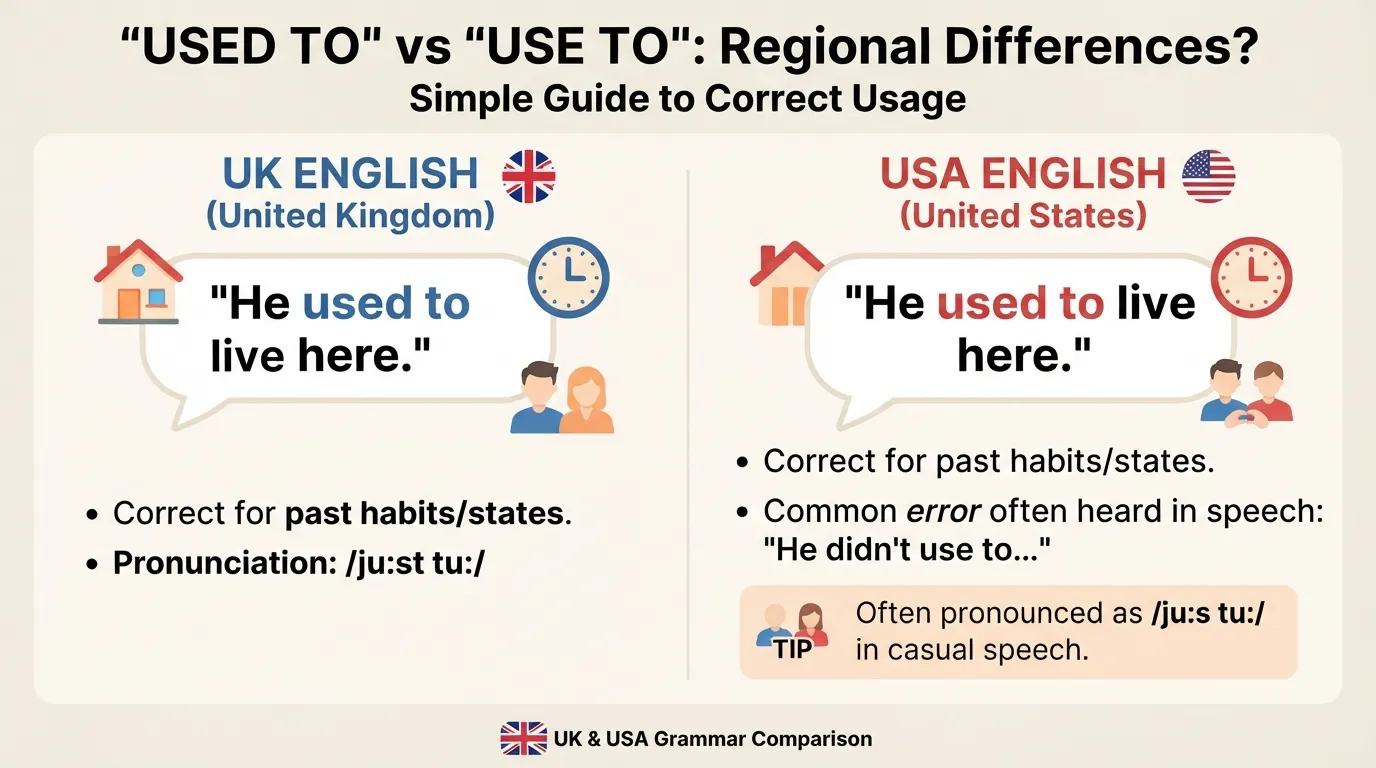
Here’s the quick answer: ‘used to’ is correct for describing past habits or states.
‘Use to’ only appears correctly after ‘did,’ ‘didn’t,’ or similar helping verbs.
Table of Contents
Did You Know?
Quick Answer Box
Quick Rule in One Line
The Real Difference Explained
Why ‘Did’ Changes the Rule
Comparison Table
Memory Trick
Example Sentences
Common Mistakes
When to Use Each Form
Expert Tip
FAQs
Conclusion
Key Takeaways
Did You Know? 🔍
‘Used to’ and ‘use to’ sound almost identical when spoken quickly, since the ‘d’ in ‘used’ often blends into the following ‘t’ sound.
This is a big reason the mistake shows up so often in writing, even from careful speakers.
Quick Answer Box
‘Used to’ describes something that happened regularly in the past but no longer does, as in ‘I used to play piano.’
‘Use to’ is only correct after ‘did’ or ‘didn’t,’ as in ‘Did you use to live here?’
Outside of that pattern, ‘used to’ is almost always the correct choice.
⚡ Quick Rule in One Line
Use ‘used to’ on its own; use ‘use to’ only right after ‘did’ or ‘didn’t.’
The Real Difference Explained
‘Used to’ describes a habit, state, or repeated action that was true in the past but isn’t anymore.
‘I used to live in Chicago’ means you lived there before, but don’t now.
On its own, in a positive statement, it’s always ‘used to,’ with the ‘d.’
The confusion mostly happens because in speech, ‘used to’ and ‘use to’ sound nearly identical.
Why ‘Did’ Changes the Rule
When a sentence uses ‘did’ or ‘didn’t’ as a helping verb, the main verb drops its past tense ending.
This is the same reason we say ‘did you go’ instead of ‘did you went.’
Following that same rule, ‘did you use to’ is correct, not ‘did you used to.’
The ‘did’ already carries the past tense, so ‘use’ stays in its base form.
Comparison Table
| Sentence Type | Correct Form | Example |
|---|---|---|
| Positive statement | used to | I used to play soccer. |
| Negative statement | used to (usually) | I didn’t use to like coffee. |
| Question with ‘did’ | use to | Did you use to live here? |
| Negative with ‘didn’t’ | use to | I didn’t use to smoke. |
Memory Trick
Remember: ‘did’ already did the work of showing past tense, so the verb after it doesn’t need to.
If you see ‘did’ or ‘didn’t’ right before it, drop the ‘d’ and use ‘use to.’
Otherwise, keep the ‘d’: ‘used to.’
Example Sentences
I used to play the guitar every day.
She used to live two blocks from here.
We used to visit that beach every summer.
Did you use to work at that restaurant?
I didn’t use to like spicy food, but I do now.
They didn’t use to allow pets in this building.
Common Mistakes
❌ ‘I use to live in Miami.’
✅ ‘I used to live in Miami.’ (no ‘did’ before it, so keep the ‘d’)
❌ ‘Did you used to play tennis?’
✅ ‘Did you use to play tennis?’ (‘did’ already shows past tense)
When to Use Each Form
Use ‘used to’ in positive statements describing a past habit or state that’s no longer true.
Use ‘use to’ only immediately after ‘did,’ ‘didn’t,’ or ‘does’ in questions and negatives.
If you’re not using ‘did’ or ‘didn’t’ right before it, you almost always want ‘used to.’
Expert Tip 💡
A quick test: try replacing the phrase with ‘was accustomed to.’ If that phrase fits naturally on its own, you need ‘used to.’ If your sentence already has ‘did’ or ‘didn’t’ right before the verb, you need ‘use to’ instead.
FAQs
Is ‘use to’ ever correct without ‘did’?
Rarely, and generally no in standard writing. Outside of questions or negatives with ‘did’/’didn’t,’ ‘used to’ is the correct form.
Why does ‘did you used to’ sound natural to some people?
Because in spoken English, the ‘d’ sounds tend to blend together, making both versions sound similar, even though only ‘did you use to’ is grammatically correct.
What does ‘used to’ actually mean?
It describes a habit, state, or repeated action that was true in the past but no longer is, like ‘I used to bike to work.’
Is ‘usedta’ or ‘usta’ ever correct in writing?
No, those are informal spoken contractions, not accepted spellings in standard written English.
Does this rule apply to ‘get used to’ as well?
No, ‘get used to’ means becoming accustomed to something and follows different rules; it’s a separate phrase from the past-habit meaning discussed here.
Conclusion
‘Used to’ is the correct form for describing past habits or states on their own.
‘Use to’ only appears correctly right after ‘did,’ ‘didn’t,’ or ‘does,’ since those words already carry the past tense.
Keeping this one rule in mind will clear up nearly every instance of this common mix-up.
Key Takeaways
‘Used to’ is correct for standalone past habit statements.
‘Use to’ is correct only after ‘did’ or ‘didn’t.’
The confusion comes from how similar the two sound in speech.
Test with ‘was accustomed to’ to check which form fits.

Hi, I’m Ethan Brooks. I create easy-to-follow grammar guides, writing tips, and vocabulary resources to make English learning enjoyable for everyone.