You wrote “she works as a teaching aid,” and a coworker gently pointed out that described a poster, not a person.
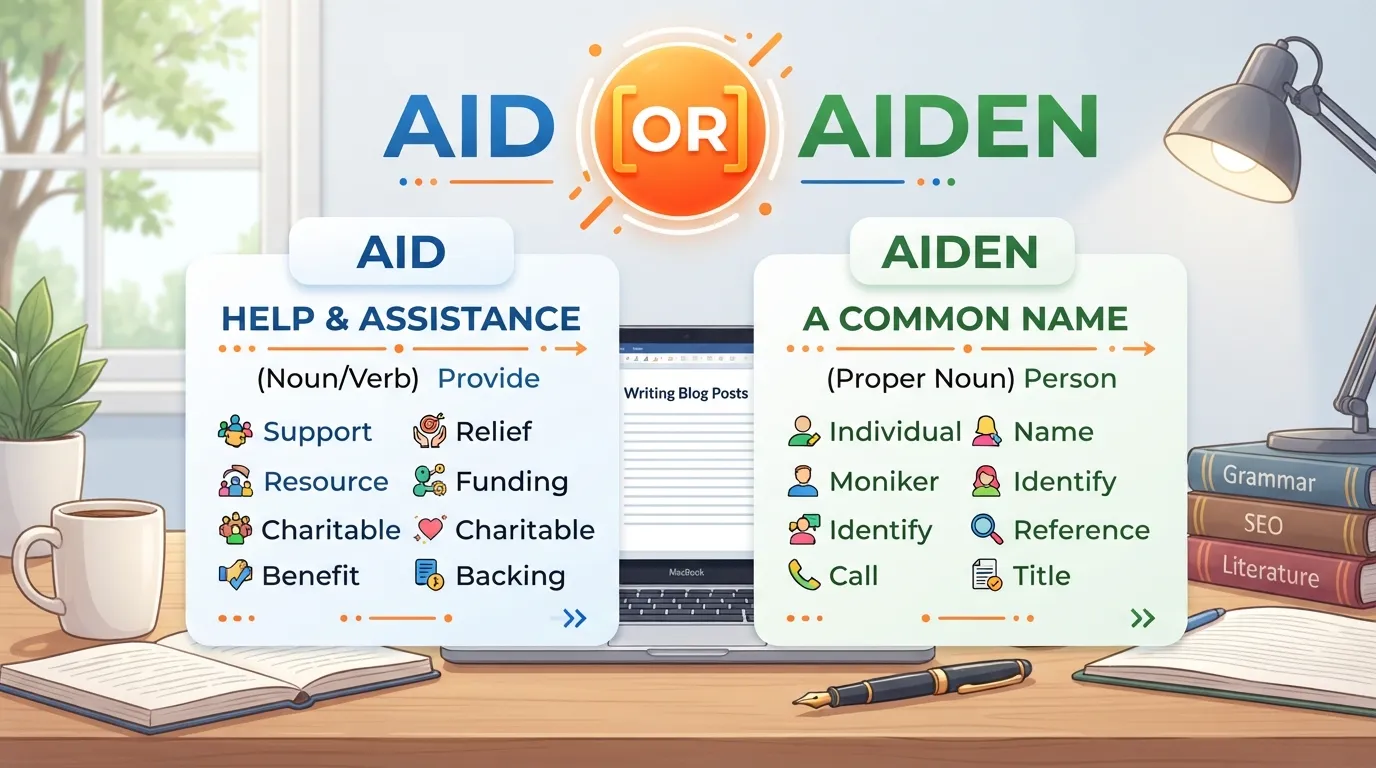
Here’s the quick fix: aid means help or assistance, or something that provides help, while aide refers to a person who assists someone else.
These words are pronounced identically, but one refers to a concept or object, while the other refers specifically to a person.
Once you remember this person-versus-thing distinction, you’ll never mix them up again.
Quick Answer
Aid refers to help, assistance, or something that provides help (“financial aid,” “a hearing aid”).
Aide refers to a person whose job is to assist someone else (“a teacher’s aide,” “a presidential aide”).
If you’re talking about a person, use “aide.” If you’re talking about help itself, use “aid.”
⚡ Quick Rule
Aid is help or a helpful thing; aide is a helpful person — the extra “e” means a human being.
Aid vs Aide: The Core Difference
The “Aid” refers broadly to assistance, support, or a device designed to help, functioning as both a noun and a verb.
“Aide” refers specifically to a person employed or assigned to assist someone else, functioning only as a noun.
Say “She needs financial aid for college” (assistance), versus “The senator’s aide scheduled the meeting” (a specific person).
This concept-versus-person distinction is the entire key to using these words correctly.
Grammar Rule Explained
“Aid” can function as a noun (financial aid) or a verb (to aid someone), describing help or the act of helping.
“Aide” only functions as a noun, always referring to a specific person in a helping or assisting role.
A simple test: if the word refers to a human being with a job title, use “aide.” If it refers to help, support, or a device, use “aid.”
This human-versus-concept test resolves nearly every situation where these words might be confused.
Aid vs Aide Comparison Table
| Feature | Aid | Aide |
|---|---|---|
| Part of speech | Noun or verb | Noun only |
| Meaning | Help, assistance, or a helpful device | A person who assists someone |
| Example | She needs financial aid. | The senator’s aide answered questions. |
| Refers to a person? | No | Yes, always |
Memory Trick
Remember: “Aide” has an extra “e,” just like the word “employee” — both refer to a person.
“Aid” has no extra “e,” matching words like “help” or “support” — concepts, not people.
If you can replace the word with “helper” or “assistant” (a person), use “aide.” If you can replace it with “help” or “support,” use “aid.”
Real Example Sentences
Using Aid (help, assistance, or device):
- The organization provides aid to disaster victims.
- She relies on a hearing aid every day.
- The medicine acts as an aid to digestion.
- Financial aid helped him afford college.
- First aid training can save lives.
Using Aide (a person):
- The governor’s aide handled the press conference.
- She works as a teacher’s aide in a local school.
- The nurse’s aide assisted with daily patient care.
- His personal aide managed his busy schedule.
- The senator relies heavily on her chief aide.
Teacher’s Aide or Teacher’s Aid? First Aid Explained
“Teacher’s aide” is the correct spelling when referring to a person who assists a teacher in the classroom.
“Teacher’s aid” would technically refer to a helpful object or tool, not a person, making “aide” the correct choice here.
“First aid”, on the other hand, always uses “aid,” referring to immediate assistance or treatment given during an emergency, not a person.
The key distinction remains consistent: use “aide” for people, and “aid” for help, assistance, or devices.
Common Mistakes
1. Using “aid” instead of “aide” for a person Incorrect: The senator’s aid scheduled the meeting. Correct: The senator’s aide scheduled the meeting.
2. Using “aide” instead of “aid” for assistance Incorrect: She needs financial aide for college. Correct: She needs financial aid for college.
3. Misspelling “teacher’s aide” as “teacher’s aid” Incorrect: She works as a teacher’s aid. Correct: She works as a teacher’s aide.
4. Misspelling “first aid” as “first aide” Incorrect: Everyone should learn basic first aide. Correct: Everyone should learn basic first aid.
When to Use Each Word
Use Aid When:
- Referring to help, assistance, or support
- Describing a helpful device or tool
- Using the word as a verb meaning “to help”
Examples: financial aid, hearing aid, first aid
Use Aide When:
- Referring to a specific person who assists someone
- Describing a job title or role
- The word could be replaced with “assistant” or “helper”
Examples: teacher’s aide, presidential aide, nurse’s aide
FAQs
What’s the difference between aid and aide?
“Aid” refers to help, assistance, or a helpful device. “Aide” refers specifically to a person who assists someone else.
Is it “teacher’s aide” or “teacher’s aid”?
It’s “teacher’s aide,” since this refers to a person assisting the teacher, not an object or tool.
Is it “first aid” or “first aide”?
It’s always “first aid,” referring to emergency assistance or treatment, not a person.
Can “aid” ever refer to a person?
No, “aid” refers to help, assistance, or a device — never to a specific person. That role belongs to “aide.”
Can “aide” ever mean help in general?
No, “aide” only refers to a person in an assisting role, never to general help or assistance.
How do I remember which spelling to use?
“Aide” has an extra “e,” just like “employee” — both refer to people. “Aid” matches concepts like “help” or “support.”
Is “aid” ever used as a verb?
Yes, “aid” can function as a verb meaning “to help,” as in “The medicine aids digestion.”
What’s a quick way to test which word I need?
Ask if the word refers to a specific person (aide) or to help, support, or a device (aid).
Conclusion
Aid and aide sound identical, but one refers to help or assistance, while the other refers specifically to a person.
Aid describes help, support, or a helpful device. Aide describes a person whose role is to assist someone else.
Remember the extra “e” in “aide” signals a person, just like in “employee,” and you’ll always choose the correct spelling.

Hi, I’m Sophia Bennett. My goal is to make grammar easy, clear, and useful through simple explanations and real-life examples.