You ended an email with “Truely yours,” and only noticed the typo after your client had already replied.
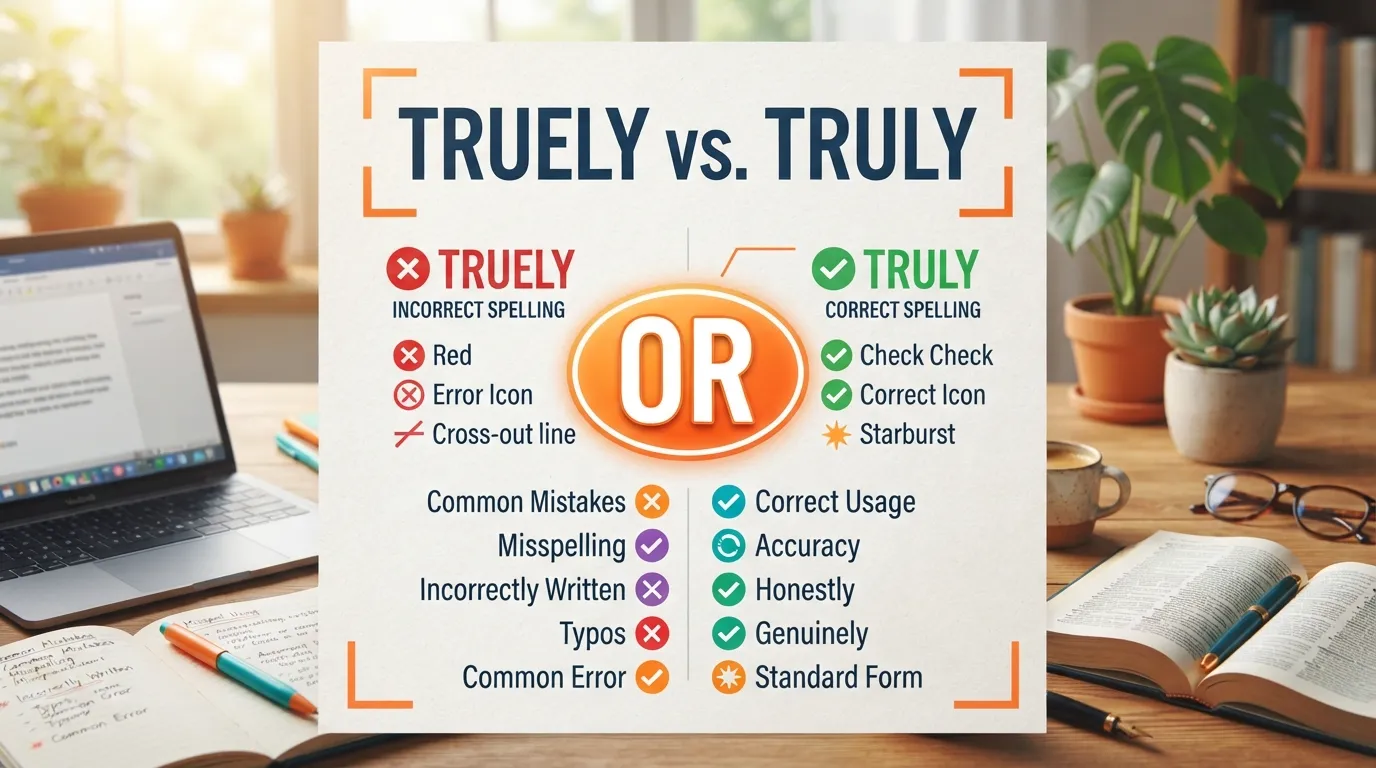
Here’s the quick fix: “truly” is always correct, and “truely” is a common misspelling that isn’t recognized in any standard dictionary.
This mistake happens because most adjectives simply add “-ly” without changing anything else.
Once you learn the small exception behind this word, you’ll spell it correctly every time.
Quick Answer
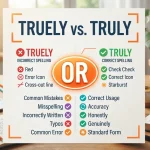
“Truly” is the only correct spelling, meaning “genuinely” or “in a true manner.”
“Truely” is a common misspelling and doesn’t exist in standard English.
There’s no situation where “truely” is acceptable, even in casual writing.
⚡ Quick Rule
Truly drops the “e” from “true” — truely simply isn’t a word.
Truely vs Truly: The Core Difference
“Truly” is an adverb formed from the adjective “true,” used to mean “genuinely” or “sincerely.”
“Truely” is not a recognized word in English, despite how naturally it seems to follow normal spelling patterns.
Say “She truly cares about her students” (correct), never “She truely cares about her students” (incorrect).
This isn’t a regional or stylistic choice — only “truly” is grammatically correct.
Grammar Rule Explained
Most adjectives form adverbs by simply adding “-ly,” like “quick” becoming “quickly” or “sad” becoming “sadly.”
“True,” however, drops its final “e” before adding “-ly,” creating “truly” instead of the expected “truely.”
This exception also applies to a few similar words, like “due” becoming “duly,” not “duely.”
Recognizing this small group of exceptions helps explain why “truly” looks slightly different from most other “-ly” adverbs.
Why Do People Misspell “Truly” as “Truely”?
Since most adjectives keep their spelling intact before adding “-ly,” writers naturally expect “true” to follow the same rule.
This expectation makes “truely” feel logical, even though it breaks an established spelling exception.
Frequent appearances of “truely” in casual writing and social media have also normalized the error visually for many readers.
Despite this, “truly” remains the only spelling recognized by every major dictionary, including Merriam-Webster and Oxford.
Truely vs Truly Comparison Table
| Feature | Truly | Truely |
|---|---|---|
| Correct spelling | ✅ Yes | ❌ No |
| Recognized in dictionaries | ✅ Yes | ❌ No |
| Meaning | Genuinely, sincerely | Not a real word |
| Formal writing | Always acceptable | Never acceptable |
Memory Trick
Remember: “True” loses its “e” before “-ly,” just like “due” loses its “e” to become “duly.”
Picture the “e” quietly stepping aside to make room for the ending “-ly.”
If you’re ever unsure, say the word slowly: “tru-ly,” not “true-ly” — the missing “e” matches the shorter sound.
Real Example Sentences
Correct (Truly):
- I truly appreciate your help today.
- She is truly talented at painting.
- We truly believe this plan will work.
- He was truly surprised by the announcement.
- Thank you, truly, for everything you’ve done.
Incorrect (Truely):
- I truely appreciate your help today. ❌
- She is truely talented at painting. ❌
- We truely believe this plan will work. ❌
Common Mistakes
1. Adding the “e” back before “-ly” Incorrect: Truely yours, Sarah. Correct: Truly yours, Sarah.
2. Assuming “truely” is a casual variant “Truely” is not accepted in any formal or informal standard English writing — it’s always a spelling error.
3. Confusing this rule with other “-ly” adverbs Remember, most words like “quick” or “sad” keep their spelling intact — “true” is an exception, not the rule.
4. Trusting autocorrect to always catch it Some spell checkers may not flag it consistently, especially in fast typing, so manual proofreading still helps.
When to Use “Truly”
Use Truly When:
- Expressing sincerity or genuineness
- Ending formal letters or emails (“Truly yours”)
- Emphasizing an emotion or opinion
Examples: truly grateful, truly amazing, truly sorry
Never Use “Truely”
There is no correct context for “truely” as a spelling in standard English writing.
FAQs
Is “truely” ever a correct spelling?
No, “truely” is never correct in standard English. The only proper spelling is “truly.”
Why does “truly” drop the “e” from “true”?
This follows a small spelling exception where certain words ending in silent “e” drop it before adding “-ly,” like “due” becoming “duly.”
Is “truly” used in formal writing?
Yes, “truly” is appropriate in both formal and informal writing, including formal letter closings like “Truly yours.”
What other words follow this same exception?
“Due” becomes “duly,” following the same silent-e-dropping pattern as “true” becoming “truly.”
Why do so many people misspell “truly” as “truely”?
Because most adjectives keep their spelling intact before adding “-ly,” making “truely” feel like the expected, logical spelling.
Does spell check always catch “truely”?
Most modern spell checkers do flag it, though not every autocorrect tool catches it consistently during fast typing.
Is “truly” the same in British and American English?
Yes, “truly” is spelled the same way in both British and American English — this isn’t a regional spelling difference.
Conclusion
Unlike many confused word pairs, this one has a simple, absolute answer: “truely” is never correct.
The only proper spelling is “truly,” which drops the silent “e” from “true” before adding “-ly.”
Whenever you’re about to write “truely,” remember the missing “e,” and you’ll spell this word correctly every time.

Hi, I’m Daniel Carter. I’m passionate about helping learners improve their English with practical grammar tips and clear writing advice.