You wrote “we drove passed the old house,” and a proofreader circled the word before returning your draft.
Here’s the quick fix: passed is the past tense of the verb “to pass,” while past refers to time, location, or serves as an adjective or preposition.
These words sound exactly alike, but only one of them can function as a verb.
Once you learn this one distinction, choosing between them becomes almost automatic.
Quick Answer
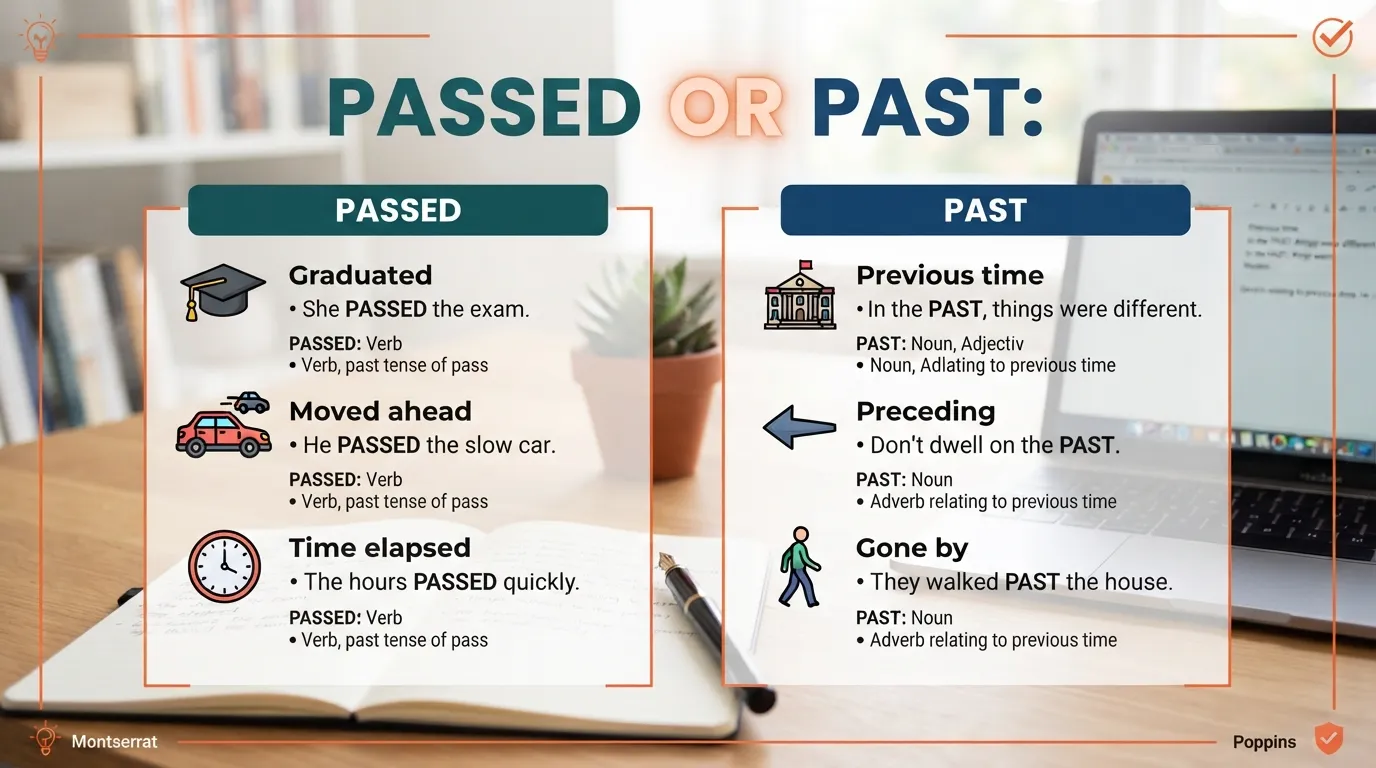
Passed is a verb, always describing an action that already happened (“She passed the exam”).
Past is not a verb — it functions as a noun, adjective, or preposition describing time or location (“That happened in the past”).
If the sentence needs an action verb, use “passed.” Otherwise, use “past.”
⚡ Quick Rule
Passed is always a verb; past is never a verb — that single test solves this pair every time.
Passed vs Past: The Core Difference
“Past” refers to time that has already occurred, a location beyond a point, or functions as an adjective describing something former.
Say “He passed the ball to his teammate” (action), versus “In the past, this was a small town” (time reference).
This verb-versus-non-verb distinction is the entire key to using these words correctly.
Grammar Rule Explained
“Passed” always functions as a verb — if you can’t identify an action happening, “passed” is not the correct word.
“Past” can function as a noun (“in the past”), an adjective (“past experiences”), a preposition (“past the store”), or an adverb (“she walked past”).
A reliable test: try replacing the word with another past-tense verb, like “moved” or “went.” If it fits, use “passed.” If it doesn’t, use “past.”
This verb-replacement test resolves nearly every situation where these words might be confused.
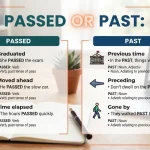
Passed vs Past Comparison Table
| Feature | Passed | Past |
|---|---|---|
| Part of speech | Verb (past tense) | Noun, adjective, or preposition |
| Meaning | Completed an action of passing | Refers to time or location beyond a point |
| Example | She passed the test. | That’s all in the past now. |
| Can replace with “moved”? | Yes | No |
Memory Trick
Remember: “Passed” ends in “-ed,” just like most other past-tense verbs, such as “walked” or “jumped.”
“Past” has no “-ed” ending, because it’s never a verb — it’s a description of time or place instead.
If the word could be swapped for another “-ed” verb, use “passed.” If not, use “past.”
Real Example Sentences
Using Passed (verb):
- She passed the driving test on her first try.
- He passed the salt across the table.
- Three years have passed since we last spoke.
- The car passed us on the highway.
- They passed the finish line together.
Using Past (noun, adjective, preposition):
- We should learn from the past.
- Her past experiences shaped her career.
- The store is just past the traffic light.
- It’s ten minutes past noon.
- He walked past without noticing us.
Walked Past or Walked Passed? Common Mistakes in Motion
“Walked past” is the correct spelling when describing movement beyond a point, as in “She walked past the coffee shop.”
“Walked passed” is incorrect here, since “past” functions as a preposition describing location, not as the verb itself.
The verb in this sentence is already “walked,” so “past” simply describes where the walking happened — no second verb is needed.
Common Mistakes
1. Using “passed” instead of “past” as a preposition Incorrect: We drove passed the old bridge. Correct: We drove past the old bridge.
2. Using “past” instead of “passed” as a verb Incorrect: She past the exam easily. Correct: She passed the exam easily.
3. Confusing “walked past” with “walked passed” Incorrect: He walked passed the store without stopping. Correct: He walked past the store without stopping.
4. Forgetting the verb-replacement test Always check if you can swap the word for “moved” or “went” — if yes, use “passed.”
When to Use Each Word
Use Passed When:
- Describing a completed action of passing
- The sentence already needs a past-tense verb
- You can replace it with “moved” or “went by”
Examples: passed the test, passed the ball, time passed quickly
Use Past When:
- Referring to time that has already occurred
- Describing location beyond a point
- Using it as an adjective or preposition
Examples: in the past, past experiences, past the corner
FAQs
What’s the difference between passed and past?
“Passed” is a verb, describing a completed action. “Past” refers to time, location, or functions as an adjective or preposition, never as a verb.
How do I remember which spelling to use?
“Passed” ends in “-ed,” like other past-tense verbs. “Past” has no “-ed” ending because it’s never a verb.
Is “past” ever used as a verb?
No, “past” never functions as a verb in modern English — that role always belongs to “passed.”
Is it “drove past” or “drove passed” the store?
It’s “drove past the store,” since “past” describes the location relative to driving, which is already the verb.
Why do people confuse passed and past so often?
Because they’re homophones, sounding exactly alike when spoken, even though only one can function as a verb.
What does “in the past” mean?
It refers to time that has already occurred, often contrasted with the present or future.
Is “past” always related to time?
No, “past” can also describe location (past the store) or serve as an adjective (past employees).
What’s a quick way to test which word I need?
Try replacing the word with “moved” or “went.” If it works, use “passed.” If not, use “past.”
Conclusion
Passed and past sound identical, but only one of them can function as a verb.
Passed always describes a completed action. Past describes time, location, or acts as an adjective or preposition.
Test any confusing sentence by trying to replace the word with “moved” — if that works, you need “passed” instead of “past.”

Hi, I’m Sophia Bennett. My goal is to make grammar easy, clear, and useful through simple explanations and real-life examples.