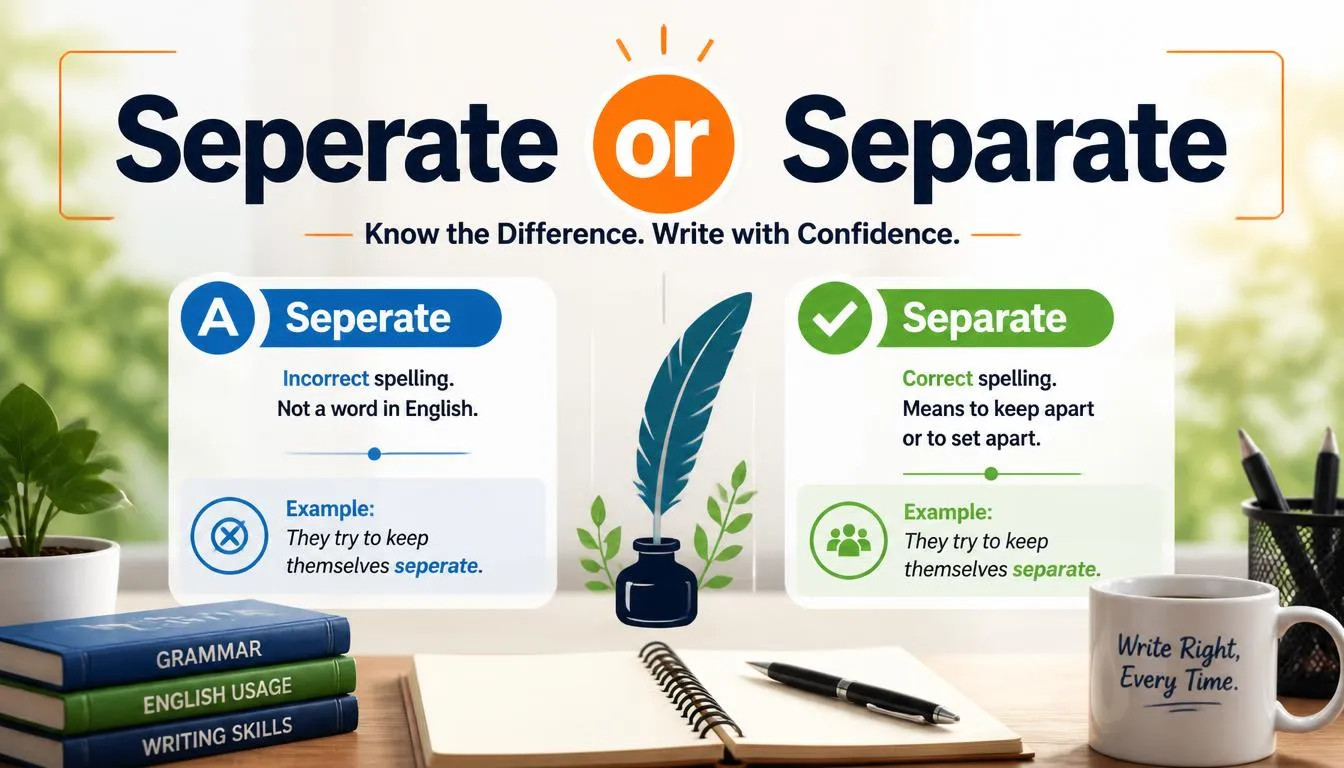
You wrote “please keep these files seperate,” and spell check flagged it instantly, though you weren’t sure what looked wrong.
Here’s the quick fix: “separate” is always correct, spelled with an “a” in the middle, and “seperate” is one of the most common misspellings in English.
This mistake happens because the word is pronounced with a sound that could easily be either an “a” or an “e.”
Once you learn the simple trick hidden inside the correct spelling, you’ll never doubt it again.
Quick Answer
“Separate” is the only correct spelling, meaning “divided” or “to divide something.”
“Seperate” is a common misspelling and isn’t recognized in any standard dictionary.
The middle vowel is always “a,” not “e,” regardless of how the word sounds when spoken.
⚡ Quick Rule
There’s “a rat” in separate — remember that, and you’ll never misspell it again.
Seperate vs Separate: The Core Difference
“Separate” functions as both an adjective, meaning divided or distinct, and a verb, meaning to divide or split something apart.
“Seperate” is not a recognized word in English, despite appearing frequently in casual writing and typos.
Say “Keep the paperwork separate from the receipts” (correct), never “Keep the paperwork seperate from the receipts” (incorrect).
This isn’t a stylistic or regional choice — only “separate” is grammatically correct in every context.
Grammar Rule Explained
“Separate” comes from the Latin word “separare,” meaning “to pull apart,” which explains the “a” spelling throughout the word.
English pronunciation often blends unstressed vowels, making the middle “a” in “separate” sound similar to an “e” when spoken quickly.
This pronunciation blur is the primary reason so many writers instinctively spell it with an “e” instead.
Remembering the Latin root, with its consistent “a,” helps reinforce the correct spelling even when the word sounds ambiguous out loud.
Why Do People Misspell “Separate” as “Seperate”?
Because unstressed vowels in English often sound identical regardless of spelling, “separate” can sound like it has an “e” in the middle.
This pronunciation-spelling mismatch makes “seperate” one of the most searched misspellings in English, especially in emails and casual writing.
Frequent appearances of “seperate” online have also visually normalized the error for many readers, despite it never being correct.
Every major dictionary, including Merriam-Webster and Oxford, recognizes only “separate” as the standard spelling.
Seperate vs Separate Comparison Table
| Feature | Separate | Seperate |
|---|---|---|
| Correct spelling | ✅ Yes | ❌ No |
| Recognized in dictionaries | ✅ Yes | ❌ No |
| Meaning | Divided, distinct, or to divide | Not a real word |
| Formal writing | Always acceptable | Never acceptable |
Memory Trick
Remember the phrase: there’s “a rat” hiding in sep-a-rat-e — both middle vowels are “a,” never “e.”
Picture a small rat sitting right in the middle of the word, reminding you of the correct spelling.
If you’re ever unsure while typing quickly, pause and check for the hidden “rat” before hitting send.
Real Example Sentences
Correct (Separate):
- Please keep your work and personal emails separate.
- They decided to separate the two teams for the project.
- The kids have separate bedrooms upstairs.
- We need a separate meeting to discuss this issue.
- The company operates as a separate entity from its parent brand.
Incorrect (Seperate):
- Please keep your work and personal emails seperate. ❌
- They decided to seperate the two teams for the project. ❌
- The kids have seperate bedrooms upstairs. ❌
Separately or Separation? Related Word Forms
The related word forms “separately” and “separation” both follow the same “a” spelling pattern as “separate.”
Example: “They filed their taxes separately” and “The couple went through a difficult separation” — both keep the “a” from the original root word.
If you remember the correct spelling of “separate,” these related forms become easy to spell correctly too.
Common Mistakes
1. Writing “seperate” with an “e” in the middle Incorrect: We need to seperate these documents. Correct: We need to separate these documents.
2. Misspelling related forms like “seperately” or “seperation” Incorrect: They live seperately now. Correct: They live separately now.
3. Assuming “seperate” is a casual, acceptable variant “Seperate” is not accepted in any formal or informal standard English writing — it’s always a spelling error.
4. Trusting pronunciation instead of the word’s Latin root Since the vowel sound is ambiguous when spoken, rely on the spelling rule instead of how the word sounds.
When to Use “Separate”
Use Separate When:
- Describing something divided or distinct
- Using it as a verb meaning to divide
- Writing formally, casually, or professionally
Examples: separate rooms, separate accounts, separate the mixture
Never Use “Seperate”
There is no correct context for “seperate” as a spelling in standard English writing.
FAQs
Is “seperate” ever a correct spelling?
No, “seperate” is never correct in standard English. The only proper spelling is “separate.”
Why is “separate” so commonly misspelled?
Because the middle vowel sound is unstressed and can sound like either “a” or “e” when spoken, making the correct spelling less obvious.
What’s an easy trick to remember the correct spelling?
Remember there’s “a rat” in sep-a-rat-e — both middle vowels are “a.”
Do “separately” and “separation” follow the same spelling rule?
Yes, both related words keep the same “a” spelling as “separate,” following the same Latin root.
Is “separate” spelled the same in British and American English?
Yes, “separate” is spelled identically in both British and American English — this isn’t a regional spelling difference.
Does spell check always catch “seperate”?
Most modern spell checkers do flag it, though it remains one of the most common typing errors even with autocorrect enabled.
Why does “separate” come from a Latin word?
It comes from “separare,” meaning “to pull apart,” which explains why the “a” spelling has remained consistent for centuries.
Conclusion
Unlike many confused word pairs, this one has a clear, absolute answer: “seperate” is never correct.
The only proper spelling is “separate,” with an “a” in the middle, tracing back to its Latin root “separare.”
Remember the hidden “rat” in sep-a-rat-e, and you’ll spell this commonly misspelled word correctly every time.