You’re writing a report and type, “Our team is benefitting from the new software.” Then you pause. Doesn’t that look like too many letters?
Here’s the quick answer: both “benefiting” and “benefitting” are correct, just in different places.
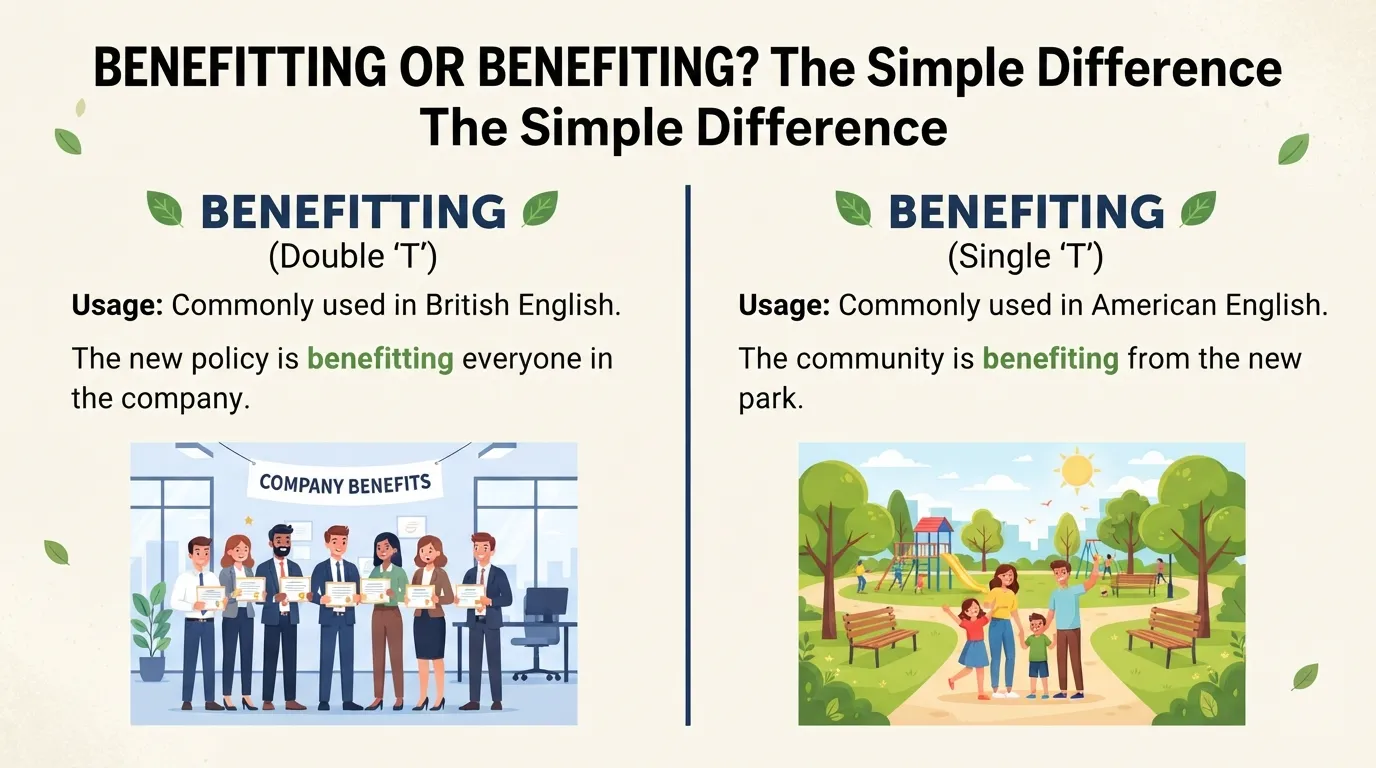
American English uses “benefiting,” while British English uses “benefitting.” The difference comes down to a small spelling rule most people never learned.
Once you see the pattern, you’ll never second-guess this word again.
Table of Contents
- Did You Know?
- Quick Answer Box
- Quick Rule in One Line
- The Difference Explained
- Grammar Rule: Why the Spelling Splits
- Comparison Table
- Memory Trick
- Example Sentences
- Common Mistakes
- When to Use Each Form
- Expert Tip
- Is It Benefiting or Benefitting?
- Benefiting or Benefitting in the UK, US, Australia, and Canada
- Benefited or Benefitted: The Past Tense
- Benefiting or Benefitting in Dictionaries
- Benefit Meaning and Definition
- Benefiting From, Benefited You, and Be Benefited
- Synonyms for Benefiting and Benefitting
- How to Spell Benefit, Benefits, Benefiting, and Benefitting
- More Examples
- Quick Quiz
- FAQs
- Conclusion
- Key Takeaways
Did You Know? 🔍
The same US/UK split shows up in the past tense too: Americans write “benefited,” while British writers often write “benefitted.” Both pairs follow the exact same doubling rule, just applied to different endings.
Quick Answer Box
“Benefiting” and “benefitting” are both correct spellings of the present participle of “benefit.” “Benefiting” is standard in American English. “Benefitting,” with the doubled T, is more common in British English. Neither spelling is a mistake; the right one depends on your audience.
⚡ Quick Rule in 1 Line
“One T for America, two Ts for Britain — the same rule as any doubled consonant.”
The Difference Explained
“Benefit” is a verb meaning to gain an advantage. When you add “-ing” to describe an ongoing action, English gives you two accepted spellings: “benefiting,” with a single T, and “benefitting,” with two.
This isn’t a case of one being wrong. It’s a regional spelling split, the same kind that separates “color” from “colour” or “traveling” from “travelling.” American style guides, including Merriam-Webster and AP Style, treat “benefiting” as standard. British dictionaries, including Oxford, list “benefitting” as the preferred form.
Both describe the exact same action. A company “benefiting” from new software and a company “benefitting” from new software are doing precisely the same thing.
Grammar Rule: Why the Spelling Splits
English has a general rule for adding “-ing” to a verb ending in a consonant: double that final consonant only if the stress falls on the last syllable. “Stop” becomes “stopping” because the stress lands right there, on that one syllable. “Visit” becomes “visiting,” with no doubling, because the stress falls on the first syllable, “VIS-it,” not the last.
“Benefit” follows the same logic in American English. The stress falls on the first syllable, “BEN-e-fit,” so American spelling doesn’t double the final T: benefiting.
British English applies a different, simpler convention: double the final consonant whenever a verb ends in a single consonant after a vowel, regardless of where the stress falls. That’s why British spelling doubles the T even though the stress rule wouldn’t technically require it: benefitting.
This same British doubling pattern shows up in words like “travelling,” “cancelling,” and “modelling,” all of which stay single-consonant in standard American spelling.
Comparison Table
| Feature | Benefiting | Benefitting |
|---|---|---|
| Region | American English | British English |
| Consonant | Single T | Double T |
| Style guide preference | Merriam-Webster, AP Style | Oxford, Cambridge |
| Stress pattern reasoning | Follows first-syllable stress rule | Follows general doubling convention |
| Related past tense | Benefited | Benefitted |
| Example | The team is benefiting from the change. | The team is benefitting from the change. |
Memory Trick
Count the letters: “benefiting” has one T, just like “America” has one clean, single spelling convention for most doubled consonants after an unstressed syllable. “Benefitting” has two Ts, matching the double letters British English tends to favor, the same double-L pattern seen in “travelling” and “cancelling.”
If you’re writing for a US audience, trim it down to one T. If you’re writing for a UK audience, let the second T stay.
Example Sentences
American English (benefiting)
The employees are benefiting from the new training program.
Local farmers are benefiting from the trade agreement.
Students are benefiting from smaller class sizes this year.
The charity is benefiting from a surge in donations.
Everyone in the office is benefiting from the flexible schedule.
Small businesses are benefiting from the tax changes.
Her health is clearly benefiting from the new routine.
The whole neighborhood is benefiting from the park renovation.
British English (benefitting)
The employees are benefitting from the new training programme.
Local farmers are benefitting from the trade agreement.
Students are benefitting from smaller class sizes this year.
The charity is benefitting from a surge in donations.
Everyone in the office is benefitting from the flexible schedule.
Small businesses are benefitting from the tax changes.
Common Mistakes
❌ Assuming “benefitting” is simply a misspelling. ✅ Recognizing it’s the standard British spelling, not an error.
Mixing both spellings in the same document. ✅ Picking one spelling and using it consistently throughout your writing.
❌ Applying the double-T rule to “benefited” in American writing. ✅ Using “benefited,” with one T, to match “benefiting” in US style.
When to Use Each Form
Use “benefiting” if you’re writing for an American audience, using AP Style, or following Merriam-Webster as your reference dictionary. Use “benefitting” if you’re writing for a British, Australian, or other audience that follows Oxford or Cambridge conventions.
If you’re not sure who your audience is, “benefiting” is the safer global default, since American spelling is widely understood and accepted even outside the US.
Expert Tip 💡
If your writing tool or CMS lets you set a regional dictionary, set it once and let it flag inconsistencies for you. That way, you won’t need to remember this rule every time you type the word, and your document stays consistent from top to bottom.
Is It Benefiting or Benefitting?
Both are accepted spellings of the same word. The one you choose should match your audience and stay consistent.
If you’re asking “is it benefiting or benefitting,” the safest everyday answer is “benefiting.”
Is Benefiting a Word?
Yes. “Benefiting” is a real word and a standard spelling.
It’s the present participle of the verb “benefit.”
Is Benefitting a Word?
Yes. “Benefitting” is also a real word.
It’s accepted as a variant, and some writers prefer it.
Does Benefiting Have Two Ts?
The usual spelling, “benefiting,” has one T before “-ing.”
The version with two Ts is “benefitting.”
Does Benefited Have Two Ts?
The usual spelling, “benefited,” has one T.
“Benefitted” is the variant with two Ts.
Benefiting or Benefitting Grammar Rule in Brief
When you add “-ing” to a verb that ends in a consonant, the final letter is often doubled when the stress is on the last syllable.
In “benefit,” the stress is on the first syllable, so a single T follows that rule.
The double-T form is accepted too, and it’s more often seen in British writing. Think of it as a variant, not an error.
Benefiting or Benefitting in the UK, US, Australia, and Canada
Usage differs a bit by region, and both forms appear everywhere.
Benefiting or Benefitting in the US
In American English, “benefiting” is the standard spelling.
If you search “benefiting or benefitting US,” that’s the answer.
Benefiting or Benefitting in the UK
In the UK, “benefitting” is common, and “benefiting” is also seen.
For “benefitting or benefiting UK,” either can be correct, so follow your publisher’s style guide.
Benefiting or Benefitting in Australia
Australian writing generally follows British conventions, so “benefitting” appears often.
“Benefiting” is also widely used, so check the style guide you’re working with.
Benefiting or Benefitting in Canada
Canadian writing mixes British and American habits.
Both spellings are used, so choose the one your editor or style guide prefers and stay consistent.
Benefited or Benefitted: The Past Tense
The past tense follows the same pattern as the “-ing” form.
What Is the Past Tense of Benefit?
The past tense of “benefit” is “benefited” or “benefitted.”
“Benefited” is the more common spelling, especially in American English.
Benefited or Benefitted in the UK
In UK writing, “benefitted” is common, though “benefited” is also used.
Searches for “benefited UK” and “benefitted UK” lead to the same answer: both are accepted.
Benefited or Benefitted in Australia and Canada
The same applies in Australia and Canada.
Both spellings appear, so match your style guide.
Benefitted From and Benefited Me
- She benefited from the training.
- He benefitted from the extra support.
- The change benefited me a great deal.
Benefited or Benefitted: Which Is Correct?
Both are correct. Pick one and use it throughout the same document.
Benefiting or Benefitting in Dictionaries
Major dictionaries, such as Oxford, Cambridge, and Merriam-Webster, record both spellings.
What differs is which form is listed first or marked as a variant.
Oxford and Other Dictionaries
If you want to confirm the preferred spelling for your project, look up “benefit” in the dictionary your style guide uses.
That’s the most reliable way to settle “benefitting or benefiting Oxford.”
Which Spelling Should You Use?
Choose one based on your audience and your style guide, then use it consistently.
If your readers are international, the single-T spelling is generally the safest option.
Benefit Meaning and Definition
“Benefit” means to gain an advantage, or to give someone an advantage.
“Benefiting” and “benefitting” are the forms you use for something happening now.
What Does Benefiting Mean?
“Benefiting” means gaining an advantage or being helped by something.
For example, “the team is benefiting from the new tools” means the team gains from them.
What Does Benefited Mean?
“Benefited” is the past tense. It means gained an advantage, or helped someone.
What Does Benefitted Mean?
“Benefitted” means exactly the same thing. It’s just the variant spelling.
Benefiting as a Noun?
“Benefit” can also be a noun, meaning an advantage or a payment, as in “health benefits.”
The plural noun is “benefits.”
Benefiting From, Benefited You, and Be Benefited
How you use the verb depends on who gains.
Benefit From
Use “benefit from” when someone gains something.
“Local farmers are benefiting from the agreement” and “she benefitted from the course” are both correct.
Benefit Someone
Use “benefit” directly when something helps a person.
“The change will benefit you” or “the new tool is benefiting you” both work.
Be Benefited
The passive form, as in “can be benefited” or “will be benefited,” is grammatical but less common.
Most writers prefer an active form, such as “will benefit.”
Who Is Benefiting?
“Who is benefiting?” asks which person or group gains.
It works the same way with the other spelling: “who is benefitting.”
Synonyms for Benefiting and Benefitting
If you want a different word, several alternatives work.
- Gaining
- Profiting
- Prospering
- Being helped
- Making progress
For example, “the team is gaining from the new software” can replace “benefiting.”
How to Spell Benefit, Benefits, Benefiting, and Benefitting
Spelling this family of words is easier letter by letter.
- Benefit: B-E-N-E-F-I-T
- Benefits: B-E-N-E-F-I-T-S
- Benefiting: B-E-N-E-F-I-T-I-N-G
- Benefitting: B-E-N-E-F-I-T-T-I-N-G
- Benefited: B-E-N-E-F-I-T-E-D
- Benefitted: B-E-N-E-F-I-T-T-E-D
How to Spell Benefit
It’s spelled B-E-N-E-F-I-T. The middle part is “nefi,” not “nifi.”
Spelling of Benefits
“Benefits” is simply “benefit” plus “s.”
It works as a plural noun (“health benefits”) or a verb (“it benefits everyone”).
Common Misspellings
Fast typing leads to lots of slips. None of these are correct.
- Benifit, benifits, benifiting: the “i” and “e” are swapped.
- Binefit, benfit, benfiting, benfitting: missing or wrong letters.
- Bennefitting, bennifitting, beniffiting: extra letters.
- Beneffitting, benefittinf, benefitiing, benefitng, benefeting, benefting: typos.
If you ever see a multiple-choice question asking you to choose the correct spelling among benefit, binefit, benfit, and benifit, the answer is “benefit.”
More Examples
Here are some more examples with each form.
- The community is benefiting from the new clinic.
- The community is benefitting from the new clinic.
- She benefited from extra coaching.
- She benefitted from extra coaching.
- Several families benefit from the program.
- The change benefits everyone.
- Who is benefiting most from the plan?
- I’m hoping to benefit from the discount.
Quick Quiz
“The students are ___ from the new library.” (US audience) — benefiting / benefitting
“The scheme is ___ thousands of families.” (UK audience) — benefiting / benefitting
Answers: 1. benefiting · 2. benefitting
FAQs
Is “benefitting” a real word?
Yes. It’s the standard British English spelling of the present participle of “benefit,” used correctly in UK, Australian, and other Commonwealth writing.
Is “benefiting” or “benefitting” correct in American English?
“Benefiting,” with a single T, is the standard American English spelling, matching Merriam-Webster and AP Style.
Why does “benefit” have two accepted spellings?
Because British and American English apply different rules for doubling a final consonant before adding “-ing,” and “benefit” happens to fall right at the point where the two conventions diverge.
Is “benefited” or “benefitted” correct?
Both are correct, following the same regional split: “benefited” is standard in American English, and “benefitted” is standard in British English.
Does Grammarly flag “benefitting” as wrong?
Some grammar checkers default to American English and may flag “benefitting,” but it’s not actually incorrect; it’s simply the British spelling.
Which spelling should I use for a global audience?
“Benefiting” is generally the safer choice for international or mixed audiences, since American spelling is widely recognized worldwide.
Is there a rule for when to double a consonant before “-ing”?
Yes, in American English, you double the final consonant only if the stress falls on the last syllable of the base word; otherwise, you don’t. British English tends to double it more broadly.
Are there other words that follow this same US/UK pattern?
Yes, including “traveling/travelling,” “canceling/cancelling,” and “modeling/modelling.”
People Also Search For
Benefitting or benefiting synonym
Synonyms include gaining, profiting, prospering, and being helped.
Benefitting or benefiting meaning
Both mean gaining an advantage or being helped by something.
Benefitting or benefiting Oxford dictionary
Major dictionaries list both spellings. Check the dictionary your style guide uses to see which one it shows first.
Benefitting or benefiting UK
Both are used in the UK. “Benefitting” is common, and “benefiting” also appears.
Benefitting or benefiting examples
“The team is benefiting from the new tools” and “the team is benefitting from the new tools” are both correct. See the More Examples section for others.
Benefitting or benefiting Oxford
Both spellings are recorded. Follow your project’s style guide to choose one.
Benefitting or benefiting grammar
The single-T form follows the stress rule for adding “-ing.” The double-T form is an accepted variant.
Benefiting meaning
“Benefiting” means gaining an advantage or being helped.
More Questions About Benefiting and Benefitting
Is it benefiting or benefitting?
Both are correct. “Benefiting” is the safer everyday choice, and “benefitting” is a common variant.
Does benefiting have two Ts?
The usual spelling has one T. The variant “benefitting” has two.
Does benefited have two Ts?
The usual spelling has one T. The variant “benefitted” has two.
How do you spell benefiting?
B-E-N-E-F-I-T-I-N-G.
How do you spell benefitting?
B-E-N-E-F-I-T-T-I-N-G.
How do you spell benefit?
B-E-N-E-F-I-T.
What is the spelling of benefits?
B-E-N-E-F-I-T-S.
What is the past tense of benefit?
It’s “benefited” or “benefitted.”
Is benefited a word?
Yes, “benefited” is the standard past tense.
Is benefitted a word?
Yes, “benefitted” is an accepted variant.
Is it benefiting or benefitting in Australia?
Both are used. Follow your style guide.
Is it benefiting or benefitting in Canada?
Both appear. Choose one and stay consistent.
Is it benifit or benefit?
It’s “benefit.” “Benifit” is a misspelling.
What does benefiting mean?
It means gaining an advantage or being helped by something.
What does benefitted mean?
It’s the past tense of “benefit,” meaning gained an advantage or helped someone.
Can you say “can be benefited” or “will be benefited”?
Yes, but it’s uncommon. “Will benefit” is usually clearer.
Who is benefiting or benefitting?
It asks who gains. Both spellings are fine, as long as you stay consistent.
Benefiting ya benefitting, kaunsa sahi hai?
Dono sahi hain. American English mein “benefiting” aam hai aur British English mein “benefitting” aam hai.
Benefit ki spelling kya hai?
Benefit ki spelling B-E-N-E-F-I-T hai.
Conclusion
“Benefiting” and “benefitting” aren’t a case of right versus wrong; they’re simply two regional spellings of the same word. American English keeps a single T, while British English doubles it, the same pattern you’ll find across dozens of similar verbs.
Pick the spelling that matches your audience, stay consistent throughout your writing, and this word stops being a guessing game for good.

Hi, I’m Olivia Harper. I love turning complex English grammar into simple, practical lessons that help readers write and speak with confidence.