You’re writing a smoothie recipe, “add two ripe mangoes,” then wonder if it should be “mangos” instead, since you’ve genuinely seen both online.
Quick answer: Both “mangoes” and “mangos” are correct plurals of “mango.”
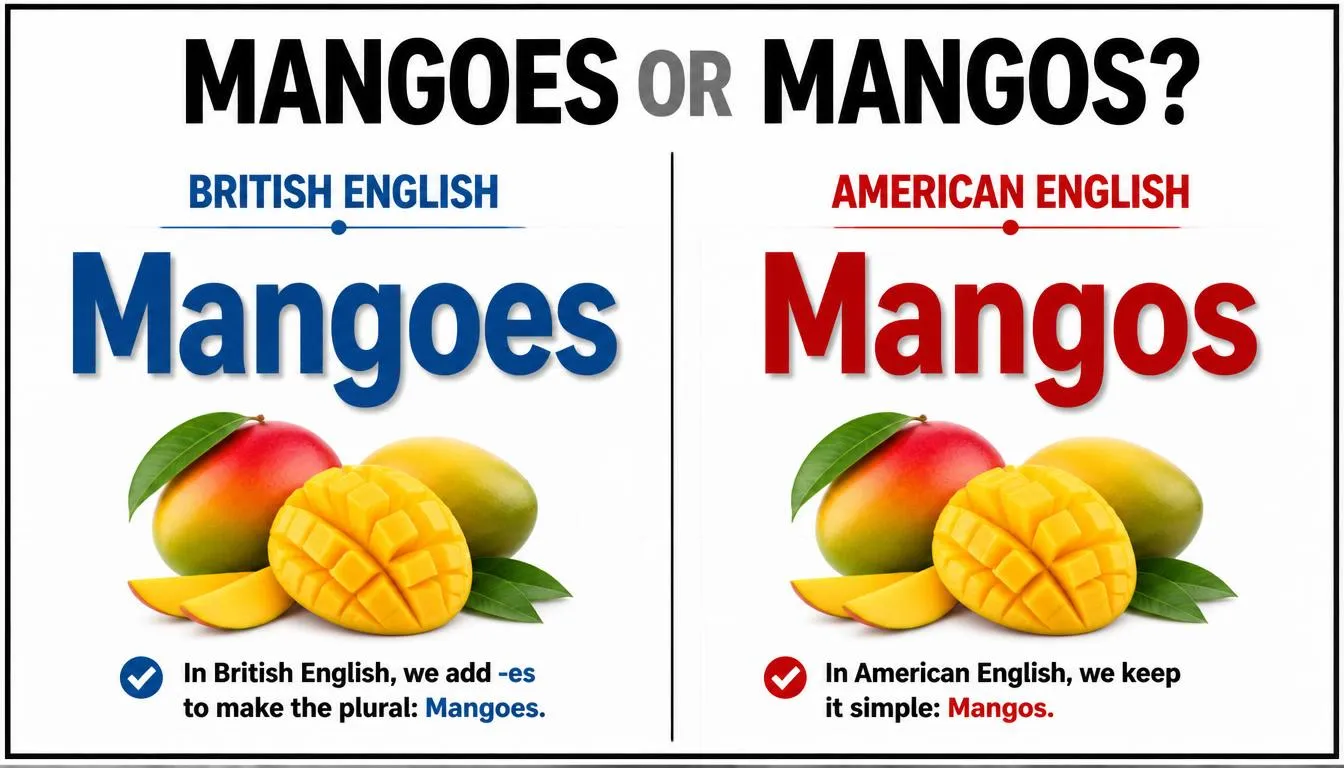
“Mangoes” tends to be preferred in British, Australian, and formal writing; “mangos” appears more often in casual American English.
Table of Contents
- Quick Answer Box
- Quick Rule in One Line
- The Difference Explained
- How Do You Spell Mango (Singular)?
- Manggo or Mango? Clearing Up the Confusion
- Grammar Rule: Why Consonant + O Words Are Inconsistent
- Is “Mangoes” Correct?
- Is “Mangos” Correct?
- Mangoes or Mangos: Which Is Better?
- Mangoes or Mangos in UK English
- Mangoes or Mangos in US English
- How to Pronounce Mango, Mangoes, and Mangos
- Comparison Table
- Memory Trick
- Example Sentences
- Common Mistakes
- When to Use Each Form
- Expert Tip
- Common Misconception Callout
- Mangoes or Mangos: More Quick Answers
- Plural of Mango: Singular and Plural Forms
- How to Spell Mango, Mangoes, and Mangos
- Mango and Mangoes Pronunciation Tips
- Plural of Mango in the Oxford Dictionary and Other Dictionaries
- A Mango or An Mango? Mango’s or Mangoes?
- Mangoes Meaning
- Mangonada or Mangoñada?
- Mango Questions: Diabetes, Pakistani Varieties, and Gender
- Mangoes or Mangos in Other Languages: Quick Answers
- FAQs
- Conclusion
Quick Answer Box
Unlike “tomato” or “potato,” which have exactly one correct plural, “mango” genuinely has two accepted spellings: “mangoes” and “mangos.”
Both appear in major dictionaries. “Mangoes” leans more traditional and formal; “mangos” is common in everyday American writing.
⚡ Quick Rule in 1 Line
“Both mangoes and mangos are correct; pick one and stay consistent.”
The Difference Explained
Most consonant + O nouns pick one clear plural pattern. “Potato” always becomes “potatoes.” “Piano” always becomes “pianos.” “Mango” is one of a small handful of words that never fully settled on one form.
Early English writing from the 17th and 18th centuries mostly used “mangoes,” following the traditional consonant + O, “-es” pattern. Over the 20th century, especially after 1950, “mangos” gained ground, particularly in American publishing.
Today, neither form has fully won out, and both remain genuinely correct.
How Do You Spell Mango (Singular)?
The singular form only has one correct spelling: ‘mango,’ m-a-n-g-o, with no flexibility at all.
The two-spelling situation only applies to the plural form.
You’ll sometimes see ‘manggo,’ with a double ‘g,’ which is simply a misspelling and never correct in English, regardless of region.
Similarly, ‘mangoe’ as a singular, with an extra ‘e,’ is also incorrect; that extra letter only ever appears in the ‘mangoes’ plural.
Manggo or Mango? Clearing Up the Confusion
“Manggo,” with a double “g,” is one of the most common misspellings of this word, searched almost as often as the real plural question.
The correct spelling always has a single “g”: m-a-n-g-o. This applies to the singular form and every accepted plural, “mangoes” and “mangos” alike.
The double-“g” spelling likely comes from how the word sounds, or from spelling patterns in other languages, but it isn’t correct in English in any context.
Grammar Rule: Why Consonant + O Words Are Inconsistent
English generally splits consonant + O nouns into an “-es” group (heroes, potatoes, tomatoes) and an “-s” group (pianos, photos, kilos). Most words clearly belong to one camp.
“Mango” sits in a small overlap zone, alongside a few other words like “avocado” (avocados/avocadoes) and “volcano” (volcanoes/volcanos). These words simply never fully standardized, so dictionaries list both spellings as acceptable.
This isn’t a mistake or a gray area to stress over; it’s a genuine, dictionary-confirmed flexibility.
Is “Mangoes” Correct?
Yes. “Mangoes” is a fully correct, dictionary-listed plural of “mango.”
It’s the older of the two spellings and remains the standard choice in British, Australian, and formal writing.
There’s no context where “mangoes” is considered wrong.
Is “Mangos” Correct?
Yes. “Mangos” is also a fully correct, dictionary-listed plural of “mango.”
It became common later, mainly in American English after 1950, but it’s just as accepted today as “mangoes.”
There’s no context where “mangos” is considered wrong either.
Mangoes or Mangos: Which Is Better?
Neither spelling is objectively better. Both are correct, and both appear in major dictionaries.
The real difference is regional habit and personal or house style, not correctness.
The only thing that matters is picking one spelling and staying consistent throughout the same piece of writing.
Mangoes or Mangos in UK English
British English leans toward “mangoes,” following the traditional consonant + O, “-es” pattern also seen in “potatoes” and “tomatoes.”
“Mangos” isn’t wrong in the UK, but “mangoes” is the more expected, formal choice.
Mangoes or Mangos in US English
American English uses both spellings, but “mangos” is common in casual, everyday writing, especially in food and grocery contexts.
“Mangoes” is also widely used and understood in the US, particularly in more formal or edited writing.
How to Pronounce Mango, Mangoes, and Mangos
All three words are pronounced the same way regardless of spelling.
“Mango” is pronounced MAN-goh.
“Mangoes” and “mangos” are both pronounced MAN-gohz, with a “z” sound at the end.
The spelling difference between “mangoes” and “mangos” has no effect on pronunciation at all.
Comparison Table
| Feature | Mangoes | Mangos |
|---|---|---|
| Status | Correct | Correct |
| Regional lean | British, Australian, formal writing | American, casual writing |
| Historical use | Older, dominant through the 19th century | Gained ground after 1950, mainly in the US |
| Dictionary support | Yes | Yes |
| Example | We bought fresh mangoes at the market. | We bought fresh mangos at the market. |
Memory Trick
Since both are correct, the real memory trick is about consistency, not correctness.
Pick whichever spelling feels more natural to you, then stick with it throughout the same piece of writing, the way you would with “gray” versus “grey.”
Example Sentences
Using “mangoes”:
We bought fresh mangoes at the farmers market.
The recipe calls for two ripe mangoes.
Mangoes are in season during the summer months.
She sliced the mangoes for the fruit salad.
The orchard grows several varieties of mangoes.
Using “mangos”:
We bought fresh mangos at the farmers market.
The recipe calls for two ripe mangos.
Mangos are in season during the summer months.
She sliced the mangos for the fruit salad.
The orchard grows several varieties of mangos.
Common Mistakes
❌ Assuming “mangos” is simply wrong because it skips the “-es” ending.
✅ Recognizing both “mangoes” and “mangos” are accepted, dictionary-confirmed spellings.
❌ Mixing both spellings within the same document without reason.
✅ Choosing one spelling and using it consistently throughout your writing.
❌ Writing “mangoe” as the singular form.
✅ Using “mango” as the singular; the extra E only appears in one plural variant.
❌ Writing “manggo” with a double G.
✅ Using “mango” with a single G; this applies to both the singular and every plural form.
When to Use Each Form
If you’re writing for a British, Australian, or more traditional/formal audience, “mangoes” is the safer, more expected choice.
If you’re writing casually for an American audience, “mangos” is common and completely acceptable.
For any single piece of writing, whichever you choose, stay consistent from start to finish.
Expert Tip 💡
If you’re writing for a specific publication, brand, or style guide, check their preference first; some explicitly choose one spelling for consistency across all their content (the National Mango Board, for example, uses “mangos”).
Absent a specific style guide, either spelling is a safe, correct choice.
Common Misconception Callout
Many writers assume there must be one “real” correct answer here, the way there is for “tomatoes” or “potatoes.” That’s not the case.
“Mango” is one of a small group of words, including “avocado” and “volcano,” where English genuinely never settled on a single standard plural.
Mangoes or Mangos: More Quick Answers
Here are the fast answers to the most common versions of this question.
Is It Mangos or Mangoes?
Both are correct. “Mangoes” is the traditional spelling, and “mangos” is common in casual American writing.
Mangoes or Mangos Plural
Both are plural forms of “mango.” The singular is always “mango.”
Which Is Better, Mangoes or Mangos?
Neither is better. Pick one and use it consistently.
Is Mangoes a Word?
Yes. “Mangoes” is a real word and a correct plural.
Mangos Fruit
“Mangos” is also correct when you’re writing about the fruit.
For example, “mangos are sweet” and “mangoes are sweet” both work.
Mangoes in English
“Mangoes” in English means more than one mango.
Mango or Mangoes?
“Mango” is one fruit, and “mangoes” is more than one.
The Mango and Mango, Mango or Mango
If you searched “mango or mango” or “mangoes mangoes,” you probably meant “mango or mangoes.”
Plural of Mango: Singular and Plural Forms
The singular is “mango.” The plural is “mangoes” or “mangos.”
| Singular | Plural |
|---|---|
| mango | mangoes |
| mango | mangos |
What Is the Plural of Mango?
The plural of mango is “mangoes” or “mangos.”
You can write the plural as either one, as long as you stay consistent.
Singular of Mangoes
The singular of “mangoes” is “mango.”
The same goes for “mangos,” whose singular is also “mango.”
Mango Plural in the UK
In the UK, “mangoes” is the more common plural.
If you’re looking for “mango plural UK” or “plural of mango in British English,” that’s the answer.
Plural of Mangoes or Mangos
“Mangoes” and “mangos” are already plural.
There’s no further plural form, so “plural of mangos” has no separate answer.
Is Mangoes Singular or Plural?
“Mangoes” is plural. “Mango” is singular.
Plural Mango Apostrophes
Don’t use an apostrophe for the plural. “Mango’s” and “man’gos” aren’t correct plurals.
If you see a quiz that asks for the plural of mango with options like mangos, mangoes, man’gos, or mango’s, the correct choices are “mangos” or “mangoes.”
How to Spell Mango, Mangoes, and Mangos
Here’s how each form is spelled.
- Mango: M-A-N-G-O
- Mangoes: M-A-N-G-O-E-S
- Mangos: M-A-N-G-O-S
Does Mango Have an E?
The singular, “mango,” doesn’t have an E.
The plural “mangoes” has an E before the “s,” and the plural “mangos” doesn’t.
How Do You Spell Mango Correctly?
It’s spelled with a single “g,” with no extra letters.
That’s the correct spelling of mango in English.
Common Misspellings
- Manggo, manggoe: the double “g” is wrong.
- Mangoe: the extra “e” only belongs in “mangoes.”
- Magoes, mngoes: missing letters.
- Mango’s: an apostrophe for the plural is wrong.
If you searched “mangos or magoes,” the correct spellings are “mangos” or “mangoes.”
Mango and Mangoes Pronunciation Tips
“Mango” is pronounced MAN-goh.
“Mangoes” and “mangos” are both pronounced MAN-gohz.
How to Pronounce Mango
Say “man,” then “go.” The first syllable gets the stress.
That’s the correct pronunciation of mango in English.
Why Do People Write Manggo?
The “ng” in “mango” makes a soft sound, like in “finger,” and then a hard “g” follows.
That’s why some people hear a double “g,” even though only one “g” is written.
Mango or Manggo Pronunciation
Both are said the same way. The difference is only in the spelling.
Plural of Mango in the Oxford Dictionary and Other Dictionaries
Major dictionaries, including Oxford and Merriam-Webster, list both “mangoes” and “mangos.”
If you’re searching for the “plural of mango Oxford dictionary,” the answer is that both spellings are recorded.
Which One Should You Use?
Choose the one your style guide prefers, or the one that matches your audience.
If there’s no guide, either spelling is a safe choice.
A Mango or An Mango? Mango’s or Mangoes?
Two small grammar questions come up often.
A Mango or An Mango?
It’s “a mango,” not “an mango.”
“Mango” starts with a consonant sound, so it takes “a.”
Mango’s or Mangoes?
“Mangoes” (or “mangos”) is the plural.
“Mango’s” with an apostrophe is possessive, as in “the mango’s skin.”
Mangoes Meaning
A mango is a sweet tropical fruit with a large seed and juicy flesh.
“Mangoes” means more than one of them.
Mangoes Meaning in Hindi and Indonesian
In Hindi and Urdu, a mango is called “aam” (आम).
In Indonesian, “mangoes” means “mangga,” and the word “artinya” simply means “meaning.”
Mangonada or Mangoñada?
“Mangonada” is a Mexican treat made with mango, often with chamoy.
The usual spelling is “mangonada,” without a tilde.
Mango Questions: Diabetes, Pakistani Varieties, and Gender
Here are answers to a few popular side questions about the fruit.
Are Mangoes Good for Diabetes?
Mangoes contain natural sugar and carbohydrates, but they also contain fiber and vitamins.
Many people with diabetes can include small portions as part of a balanced meal plan.
How much is right for you depends on your own needs, so ask your doctor or a dietitian. This is general information, not medical advice.
What Are Pakistani Mangoes Called?
Pakistan doesn’t have just one kind of mango. It grows many varieties.
Popular ones include Chaunsa, Sindhri, Anwar Ratol, Langra, Dussehri, and Fajri.
Does Mango Have a Gender?
In English, no. English nouns don’t have grammatical gender.
In Hindi and Urdu, however, “aam” is a masculine noun.
Mangoes or Mangos in Other Languages: Quick Answers
Many readers search this in their own language. The answer is the same: both “mangoes” and “mangos” are correct.
- Indonesian: Dalam bahasa Inggris, “mangos” atau “mangoes” sama-sama benar. Ejaan yang benar adalah “mango” (satu g), bukan “manggo.” Dalam bahasa Indonesia, kata bakunya “mangga.”
- Vietnamese: “Mangos” hay “mangoes”? Cả hai đều đúng.
- Spanish: ¿”Mangos” o “mangoes”? Ambos son correctos en inglés. En español, la fruta es “mango.”
- Italian: “Mangos” o “mangoes”? Entrambi sono corretti.
- Danish: Det rigtige engelske ord er “mango.”
- Arabic: جمع mango بالإنجليزية هو mangoes أو mangos.
- Hindi: मैंगो का प्लुरल “mangoes” या “mangos” होता है।
- Dutch and Afrikaans: In English, the plural is “mangoes” or “mangos.” In Dutch and Afrikaans, it’s “mango’s.”
- Roman Urdu: Mango ka plural “mangoes” ya “mangos” hai.
FAQs
Is one spelling more “correct” than the other?
No. Both “mangoes” and “mangos” are listed as correct in major dictionaries, including Merriam-Webster.
Which spelling is more common in the US?
“Mangos” tends to be slightly more common in casual American English, though “mangoes” is also widely used and understood.
Which spelling is more common in the UK?
“Mangoes” is generally preferred in British, Australian, and New Zealand English, and in more formal or academic writing.
Are there other fruit or food words with this same flexibility?
Yes, “avocado” also has two accepted plurals: “avocados” and “avocadoes,” with “avocados” being far more common today.
Does this affect the singular spelling too?
No. The singular is always “mango”; the flexibility only applies to the plural form.
Is it okay to mix both spellings in the same document?
It’s better to pick one and stay consistent, the same way you would with any other stylistic choice, like “gray” versus “grey.”
Why did English end up with two accepted plurals for this word?
Because “mango” sits in an overlap zone between the “-es” and “-s” patterns for consonant + O words, and neither form ever fully replaced the other historically.
Does a major style guide prefer one over the other?
Style guides vary; some publications and organizations pick one form for internal consistency, but there’s no single universal rule requiring one over the other.
Is “manggo,” with a double G, ever correct?
No. Regardless of which plural spelling you choose, the word is always spelled with a single “g”: mango, mangoes, or mangos.
What does the Oxford Dictionary say about the plural of mango?
Oxford Dictionary lists both “mangoes” and “mangos” as correct plurals, the same way Merriam-Webster does. Neither spelling is marked as more standard than the other.
Do “mangoes” and “mangos” mean the same thing?
Yes. The meaning is identical in both spellings. The only difference is stylistic, not a difference in what the word refers to.
Is it “a mango” or “an mango”?
“A mango” is correct. “Mango” starts with a consonant sound, so it takes “a,” not “an,” the same way you’d say “a banana” or “a melon.”
Is it “mango’s” or “mangoes”?
“Mangoes” (or “mangos”) is the plural, used for more than one fruit. “Mango’s,” with an apostrophe, is possessive, showing something belongs to one mango, which rarely comes up outside unusual sentences like “the mango’s skin.”
Does “mango” have a gender in English?
No. English nouns don’t carry grammatical gender the way some other languages do. “Mango” is simply neutral, with no masculine or feminine form.
Mangoes ki sahi spelling kya hai?
Dono spellings sahi hain: ‘mangoes’ aur ‘mangos.’ Singular hamesha ‘mango’ hota hai, aur plural ke liye dono forms dictionaries mein accepted hain, farq sirf regional preference ka hai.
Mango ka plural kya hota hai?
Mango ka plural ‘mangoes’ ya ‘mangos’ hota hai, dono sahi hain. English mein mango ko Hindi mein bhi ‘mango’ hi kaha jata hai, koi alag tarjuma nahi hai.
People Also Ask
Is it mangos or mangoes correct?
Both are correct. “Mangoes” is the traditional spelling, and “mangos” is common in casual American English.
Are mangoes good for diabetes?
Mangoes have natural sugar and carbs, but also fiber. Small portions can fit into many meal plans, but ask your doctor or dietitian about your own needs.
What are Pakistani mangoes called?
Pakistan grows many varieties, including Chaunsa, Sindhri, Anwar Ratol, Langra, and Dussehri.
Does mango have an E?
The singular “mango” doesn’t. The plural “mangoes” does, and “mangos” doesn’t.
People Also Search For
Mangoes or mangos plural
Both are plurals of “mango.” The singular is “mango.”
Mangoes or mangos which is better
Neither is better. Pick one and stay consistent.
Mangoes or mangos UK
British English leans toward “mangoes,” but “mangos” isn’t wrong.
Mangoes or mangos meaning
Both mean more than one mango, a sweet tropical fruit.
Mangoes or mangos pronunciation
Both are pronounced MAN-gohz.
Plural of mango Oxford Dictionary
Oxford lists both “mangoes” and “mangos.”
Mangoes spelling
M-A-N-G-O-E-S.
Mangos fruit
“Mangos” is the less formal plural spelling for the fruit. “Mangoes” is also correct.
More Questions About Mangoes and Mangos
What is the plural of mango?
“Mangoes” or “mangos.”
How do you spell mango?
M-A-N-G-O.
How do you spell mangoes?
M-A-N-G-O-E-S.
How do you spell mangos?
M-A-N-G-O-S.
What is the singular of mangoes?
The singular is “mango.”
Is mangoes a word?
Yes, it’s a correct plural.
Is “mangoe” a word?
No. The extra “e” only belongs in “mangoes.”
Is “mango’s” a plural?
No. “Mango’s” is possessive, not plural.
Is “mango” countable?
Yes. You can count mangoes: one mango, two mangoes.
How do you pronounce mango?
MAN-goh.
How do you pronounce mangoes?
MAN-gohz.
Is it “manggo” or “mango”?
It’s “mango,” with one “g.” “Manggo” is a misspelling.
What does mangoes mean?
It means more than one mango, a sweet tropical fruit.
What does mangoes mean in Hindi?
“Mangoes” means “aam” (आम) in Hindi and Urdu.
Is mangonada or mangoñada correct?
“Mangonada” is the usual spelling.
mughy btao Mango ki spelling kya hai?
Mango ki spelling M-A-N-G-O hai.
Mango ka plural kya hoga?
acha Mango ka plural “mangoes” ya “mangos” hoga.
Mango ka gender kya hai?
English mein mango ka koi gender nahi hota. Hindi aur Urdu mein “aam” mazakkar (masculine) hota hai.
Conclusion
“Mangoes” and “mangos” are both genuinely correct, a rare case in English where two plural spellings coexist without one being wrong.
“Mangoes” leans more traditional and is common in British English; “mangos” is common and accepted in casual American writing.
Whichever you choose, the only real rule is staying consistent within the same piece of writing.

Hi, I’m Daniel Carter. I’m passionate about helping learners improve their English with practical grammar tips and clear writing advice.