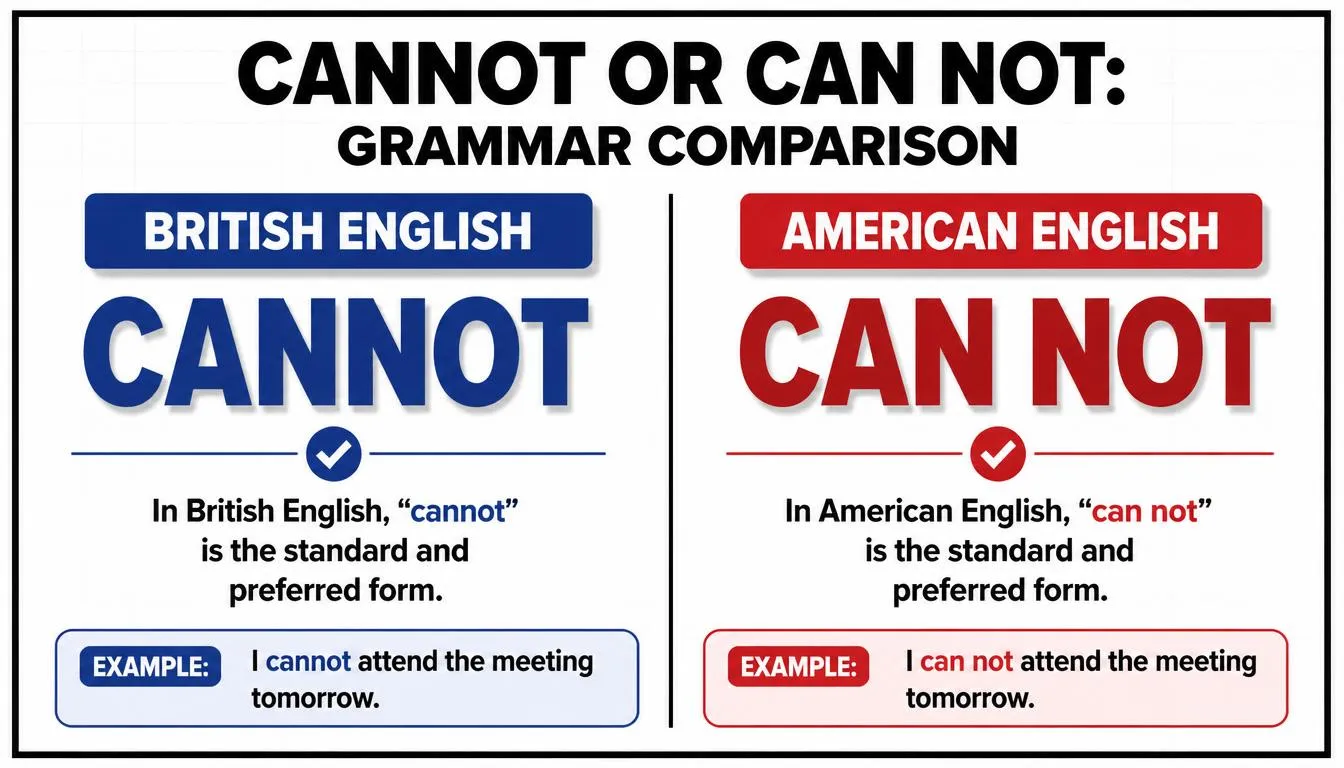
Use ‘cannot’ almost always. ‘Can not’ is only correct in rare, specific constructions.
You’re finishing an email and pause on one word.
Should it be ‘I cannot attend’ or ‘I can not attend’? Both look like they could be right.
They’re both technically valid. But they’re not interchangeable in everyday use.
Almost every sentence you write should use ‘cannot.’ The two-word form has one narrow job, and outside that job, it just reads like a typo.
Table of Contents
- Quick Answer
- Correct Spelling of Cannot
- Cannot vs Can Not: The Real Difference
- Comparison Table
- Common Misspellings of Cannot
- Cant, Can’t, or Cannot: Three Different Things
- Cannot vs Can’t Not (Different Meanings)
- Cannot vs Will Not
- Memory Trick
- Example Sentences
- Common Mistakes
- When to Use Each Form
- Expert Tip
- What Does “I Cannot” Mean?
- Cannot in a Sentence
- When to Use Can or Cannot
- How to Spell Cannot
- More Misspellings of Cannot
- Can’t or Cant: Which Is Correct?
- Cannot vs Can’t
- Can’t vs Cannot vs Can Not: Quick Guide
- Short Form and Contraction of Cannot
- Does Cannot Have an Apostrophe?
- Is Cannot Formal or Informal?
- Cannot or Can Not in Academic Writing and AP Style
- Cannot or Can Not in UK English
- Is Cannot a Word?
- Is It Cannot or Can Not?
- Is Cannot One Word or Two?
- Cannot Grammar: Part of Speech
- Using Cannot in Questions
- Can’t Not, Cannot Not, and Can Not Not
- Cannot vs Could Not, Should Not, and May Not
- Another Word for Cannot
- Cannot or Can Not in Other Languages
- Quick Quiz
- FAQs
- Conclusion
- Key Takeaways
Quick Answer Box
‘Cannot’ is the standard, preferred spelling in almost all writing.
‘Can not’ is grammatically valid but rare. It’s mostly reserved for sentences like ‘can not only… but also.’
When in doubt, use ‘cannot.’
Correct Spelling of Cannot
The correct spelling is ‘cannot,’ written as one single word with a double ‘n’ in the middle: c-a-n-n-o-t. Yes, ‘cannot’ is a real, standard English word, and it functions as a verb, specifically the negative form of the modal verb ‘can.’ It is not a conjunction, noun, or any other part of speech, it simply means ‘am/is/are not able to’ or ‘am/is/are not allowed to.’
Cannot vs Can Not: The Real Difference
‘Cannot’ and ‘can not’ mean exactly the same thing.
The only real difference is frequency. ‘Cannot’ is far more common in modern writing, spoken English, and every major style guide.
So why does ‘can not’ exist at all?
It shows up when ‘not’ belongs to a separate phrase rather than to ‘can’ itself. The clearest example is a ‘not only… but also’ sentence.
‘She can not only sing but also dance’ is one example. Here, splitting the words keeps that structure clear.
Outside that pattern, style guides agree. ‘Cannot’ is the form to use.
British usage guides go further. Some say ‘cannot’ is required unless ‘not’ needs particular emphasis.
A few writers also use the two-word form for extra emphasis in casual, speech-like writing. This stays far less common than the standard closed form.
Comparison Table
| Feature | Cannot | Can Not |
|---|---|---|
| Frequency of use | Very common, the standard form | Rare, used only in specific cases |
| Formal writing | Preferred | Rarely appropriate |
| ‘Not only… but also’ sentences | Not used here | Required here |
| Meaning | Identical to ‘can not’ | Identical to ‘cannot’ |
| Contraction | Can’t | Can’t |
Common Misspellings of Cannot
Because ‘cannot’ blends two familiar words into one, it’s easy to drop a letter or add an unnecessary apostrophe by mistake. None of the spellings below are correct in standard English.
| Misspelling | Correct Spelling |
|---|---|
| canot | cannot |
| cannto | cannot |
| cannnot | cannot |
| cannott | cannot |
| cannopt | cannot |
| cannit | cannot |
| cabnot | cannot |
| camnot | cannot |
| connot | cannot |
| can’not | cannot |
The apostrophe version, ‘can’not,’ is a particularly common mistake. It likely comes from confusing ‘cannot’ with the contraction ‘can’t,’ but ‘cannot’ never takes an apostrophe. Only ‘can’t’ does.
Cant, Can’t, or Cannot: Three Different Things
This one trips up a lot of writers, because ‘cant’ without an apostrophe isn’t just a misspelling of ‘can’t,’ it’s actually a completely different, real English word. ‘Cant’ (no apostrophe) is a noun meaning insincere or hypocritical talk, often used to describe empty moralizing, as in ‘political cant.’ It can also refer to the specialized jargon of a particular group, like ‘thieves’ cant’ or ‘legal cant.’
‘Can’t,’ with the apostrophe, is the contraction of ‘cannot’ or ‘can not,’ meaning unable to. ‘Cannot’ is the full, one-word form of the same meaning.
So all three look similar but serve different purposes: ‘cannot’ and ‘can’t’ both mean unable to, while ‘cant’ means something else entirely. If your sentence is about ability or permission, you want ‘cannot’ or ‘can’t,’ never the apostrophe-free ‘cant.’
Cannot vs Can’t Not (Different Meanings)
‘Cannot’ and ‘can’t not’ are not the same thing, and mixing them up changes the meaning of a sentence.
The ‘Cannot’ simply means unable to do something: ‘I cannot go’ means going isn’t possible.
‘Can’t not,’ on the other hand, is a double negative used informally to mean someone is unable to avoid doing something, essentially ‘must.’ For example, ‘I can’t not go’ means the speaker feels compelled to go, they can’t avoid going, which is nearly the opposite meaning of ‘I cannot go.’ ‘Can’t not’ is casual, spoken-style English and should generally be avoided in formal writing, where a clearer phrase like ‘I have to go’ or ‘I can’t avoid going’ works better.
Cannot vs Will Not
‘Cannot’ and ‘will not’ both express a kind of refusal, but they come from different modal verbs and mean different things.
The ‘Cannot’ relates to ability or permission, saying something isn’t possible or isn’t allowed: ‘I cannot attend’ means attending isn’t possible for some reason.
‘Will not’ relates to intention or willingness, saying something won’t happen because of a choice: ‘I will not attend’ means the person is choosing not to go, even if they technically could.
Swapping the two can change how a sentence is understood, so it’s worth choosing the one that actually matches what you mean.
Memory Trick
Think of ‘cannot’ like ‘today’ or ‘tomorrow.’
These words fused into one because people use them constantly. If your sentence isn’t a ‘not only… but also’ structure, default to one word. Every time.
Example Sentences
Cannot (standard use)
I cannot attend the meeting tomorrow.
She cannot find her keys.
We cannot guarantee same-day delivery.
He cannot believe the news.
They cannot agree on a decision.
You cannot park here after 6 p.m.
I cannot thank you enough.
The system cannot process this request right now.
Can not (rare, specific use)
She can not only sing but also play the piano.
He can not only cook but also bake professionally.
The device can not only track steps but also monitor sleep.
Common Mistakes
‘I can not believe this happened.’ This should read ‘I cannot believe this happened.’ There’s no ‘not only… but also’ structure here, so one word is correct.
Splitting the words just for emphasis. Writers sometimes use ‘can not’ hoping it sounds stronger. It doesn’t. Try ‘absolutely cannot’ or ‘simply cannot’ instead, the emphasis comes from the added word, not the split.
Treating ‘can not’ as always wrong. It isn’t. It’s correct in ‘not only… but also’ constructions. It’s just rare everywhere else.
Adding an apostrophe, as in ‘can’not.’ This is never correct. Only the contraction ‘can’t’ takes an apostrophe.
Writing ‘cant’ when you mean ‘can’t.’ Without the apostrophe, ‘cant’ is a different word entirely, meaning insincere talk or jargon.
When to Use Each Form
Use cannot for almost all writing: emails, essays, reports, everyday sentences.
Use can not only when ‘not’ belongs to a separate phrase, most often ‘not only… but also.’
Not sure which fits? ‘Cannot’ is almost always the safer choice.
Expert Tip 💡
Editing your own writing? Search the document for ‘can not.’
Check each result against the ‘not only… but also’ pattern. If it doesn’t fit, change it to ‘cannot.’ This one check catches most real errors.
What Does “I Cannot” Mean?
“I cannot” means “I am not able to” or “I am not allowed to.”
It’s a direct statement that something isn’t possible or isn’t permitted.
Cannot Meaning and Definition
The meaning of “cannot” is the negative of “can.”
It tells the reader that someone lacks the ability, the means, or the permission to do something.
I Cannot or I Can Not?
Write “I cannot.” It’s the standard form.
“I can not” only fits when the sentence continues with “not only… but also.”
Cannot Wait and Other Fixed Phrases
“I cannot wait” means you’re very excited, not that you’re unable to wait.
You’ll also see “cannot go,” “cannot be,” and “simply cannot” in everyday writing.
Cannot in a Sentence
Seeing “cannot” in context is the easiest way to learn it.
With I, We, and You
- I cannot make it to dinner tonight.
- We cannot move the deadline.
- You cannot enter without a ticket.
With He, She, It, They, and One
- He cannot reach the top shelf.
- She cannot attend the call.
- It cannot be fixed today.
- They cannot agree on a date.
- One cannot simply walk in.
After This, That, and Which
- This cannot continue.
- That cannot be right.
- It’s a rule which cannot be broken.
- She’s someone who cannot sit still.
Ending a Sentence With Cannot
“Cannot” can end a short reply.
- “Can you come?” “No, I cannot.”
- “Can he swim?” “No, he cannot.”
Just say “No, I cannot,” not “no cannot.” A reply like “yes cannot” doesn’t make sense.
Cannot in Error Messages and Instructions
Software and signs often use “cannot” because it’s short and formal.
- Cannot open this file.
- You cannot use this code twice.
“We Can Not” or “We Cannot”?
The same rule applies to every pronoun.
“We cannot,” “he cannot,” “she cannot,” “they cannot,” “you cannot,” and “it cannot” are all standard.
Splitting them as “we can not” or “who can not” only works in a “not only… but also” sentence.
When to Use Can or Cannot
Use “can” when the ability or permission exists. Use “cannot” when it doesn’t.
- I can swim. I cannot swim.
- You can park here. You cannot park here.
Can or Not in the Same Sentence
Sometimes “can” and “not” sit apart in a question.
“Can he come or not?” is fine because “not” ends the question.
“Can I not go?” asks whether you’re allowed to skip going. It’s a different question from “Can I go?”
Can It Not Be?
“Can it not be fixed?” asks why something isn’t possible.
“It cannot be fixed” is a flat statement instead.
How to Spell Cannot
“Cannot” is spelled c-a-n-n-o-t. It’s one word with two n’s.
That’s the correct spelling in English, and it’s how to write “cannot” correctly every time.
Is Cannot Spelled Correctly?
Yes. “Cannot” is the correct, standard spelling.
If you’ve wondered whether “cannot” is spelled correctly, a spell checker will confirm it.
How Do You Spell Can Not, Can’t, and Cant?
“Can not” is spelled as two words. Use it only in “not only… but also.”
“Can’t” is c-a-n-apostrophe-t. “Cant” (no apostrophe) is a different word.
Tips to Spell Cannot Correctly
Say it slowly: “can-not.”
Then remember the double “n” in the middle: can + not = cannot.
More Misspellings of Cannot
Typing fast causes plenty of slips. These are all wrong.
- Missing or swapped letters: cannit, cannont, cannto, cnnot, cannopt, canonot, canot, caanot, canont
- Wrong keys: camnot, cabnot, caonot, cammot, canmot, csnnot, cannpt, cankot, cannkt, cannoit, xannot, cannof, cannout, cannoy, cannor
- Extra letters: cannnot, cannott, cannnt
- Wrong vowel: connot, con not, i connot
- Missing spaces: icannot (should be “I cannot”)
- Lowercase L instead of capital I: l cannot, l can not
Also note that “cannots” isn’t a word, because “cannot” is a verb and doesn’t take an “s.”
If you searched “cannot or cannot” or “cannot vs cannot,” you probably meant “cannot vs can not.”
Can’t or Cant: Which Is Correct?
“Can’t” is the correct contraction. “Cant” without the apostrophe is a different word.
So if you mean “cannot,” write “can’t.”
Can T or Can’t?
People sometimes type “can t” because a keyboard or app drops the apostrophe.
The correct form always has the apostrophe: can’t. Similar slips like “cann’t” are also wrong.
What Kind of Word Is Cant?
“Cant” is a noun. It means insincere talk or the jargon of a group.
It’s not a conjunction, and it isn’t a short form of “cannot.” Writing “cant” for “can’t” is a common typo.
Can’t Without Apostrophe
Can’t without apostrophe becomes “cant,” which changes the meaning.
In texts and chats it’s often dropped, but in proper writing keep the apostrophe.
Cannot vs Can’t
“Cannot” and “can’t” mean the same thing.
The difference is tone. “Can’t” is informal, while “cannot” is neutral and suits most writing.
I Can’t or I Cannot?
Both are correct. Use “I can’t” in casual messages and “I cannot” in emails, reports, and formal writing.
When to Use Cannot and Can’t
Use “cannot” for formal or professional text. Use “can’t” for speech and relaxed writing.
You can mix them in one document if the tone shifts, but stay consistent within a paragraph.
Can’t vs Cannot vs Can Not: Quick Guide
Here are all three side by side.
| Form | Meaning | Best Use |
|---|---|---|
| Cannot | Unable or not allowed | Standard, most writing |
| Can’t | Unable or not allowed | Casual, spoken-style |
| Can not | Unable or not allowed | Only “not only… but also” |
Short Form and Contraction of Cannot
The short form of “cannot” is “can’t.”
It’s a contraction, and it’s also the contracted form you’ll see in everyday speech.
Is Cannot a Contraction?
No. “Cannot” is a single closed word, not a contraction.
A contraction uses an apostrophe, like “can’t.” So “cannot” is the full form.
Abbreviation of Cannot
There’s no standard abbreviation for “cannot.” The usual short form is “can’t.”
The same goes for “can not,” whose contraction is also “can’t.”
Can’t in Full
“Can’t” in full is “cannot” or “can not.”
The apostrophe stands for the missing letters.
Does Cannot Have an Apostrophe?
No. “Cannot” never has an apostrophe.
Forms like “can’not” and “canno’t” are wrong.
Only the contraction “can’t” uses one.
Is Cannot Formal or Informal?
“Cannot” is neutral to formal. It works in business emails, essays, and reports.
“Can’t” is the informal option. That’s the quick way to answer whether “cannot” is formal or informal.
“Cannot” is also proper English and a perfectly formal word.
Cannot or Can Not in Academic Writing and AP Style
In academic writing, use “cannot.”
It reads as polished, and “can not” can look like a typo unless it’s in “not only… but also.”
AP Style also prefers “cannot.”
Cannot or Can Not in UK English
British English also prefers “cannot.”
So “cannot or can not UK” has the same answer as in American English.
Is Cannot a Word?
Yes. “Cannot” is a real word and is correct grammar.
It’s a proper word found in every major dictionary.
Is It Cannot or Can Not?
It’s “cannot” in almost every case.
“Can not” is correct only in “not only… but also.”
So when you ask “is it can not or cannot,” the answer is “cannot.” Both are correct in meaning, but not equally common.
Is Cannot One Word or Two?
“Cannot” is one word.
Written as “can not,” it’s two words, but that form is rare.
Can “cannot” be two words? Only as “can not” in special sentences.
So “cannot” together is correct, and “cannot” separate is the exception.
Cannot Grammar: Part of Speech
“Cannot” is a verb. It’s the negative form of the modal verb “can.”
Its word class is verb, so it works with a main verb: “I cannot go.”
Is Cannot a Modal Verb?
Yes. “Can” is a modal verb, and “cannot” is its negative form.
It expresses ability or permission, like other modals.
Is Cannot a Conjunction, Adverb, or Pronoun?
No to all three. “Cannot” isn’t a conjunction, an adverb, or a pronoun.
The same is true of “can’t”: it’s a verb contraction, not a conjunction or adverb.
Can You Say “The Cannot” or “A Cannot”?
No. Since “cannot” is a verb, it doesn’t take “a” or “the.”
Phrases like “what is a cannot” aren’t standard.
Is Cannot a Compound Word?
In a loose sense, yes, because it joins “can” and “not.”
In grammar terms, it’s simply classed as a verb.
Using Cannot in Questions
“Cannot” doesn’t usually appear in questions as “Why cannot I?”
Say “Why can’t I log in?” instead. That’s the natural way.
Why Can’t I and Why Can I Not?
“Why can’t I” is common and casual.
the “Why can I not” is more formal and used for emphasis.
Why I Cannot?
“Why I cannot” has the wrong word order. It should be “Why can’t I” or “Why can I not.”
Can’t Not, Cannot Not, and Can Not Not
These stacked negatives are confusing.
“Can’t not” means you can’t avoid doing something, so it works like “must.”
“Cannot not” and “can not not” mean the same but sound awkward in writing.
In formal writing, say “I have to go” instead of “I cannot not go.”
Cannot vs Could Not, Should Not, and May Not
“Cannot” covers present inability. “Could not” covers past inability or a softer tone.
“Should not” gives advice. “May not” is about permission or possibility.
Cannot or Could Not
“I cannot attend today.” “I could not attend yesterday.”
Cannot or Will Not
“Cannot” means unable. “Will not” means unwilling.
Cannot vs Should Not and May Not
“You cannot enter” means you’re blocked.
May “You should not enter” is advice.
“You may not enter” refuses permission.
Unable vs Cannot
“Unable” is an adjective: “I am unable to attend.”
“Cannot” is a verb form, with the same idea.
Another Word for Cannot
If you need a synonym, there are plenty.
- Unable to
- Not able to
- Incapable of
- Powerless to
For “can’t,” other words include “unable to” and “not able to.”
Cannot or Can Not in Other Languages
Readers often search this question in their own language. Here’s the quick answer.
- Roman Urdu: “Cannot” ki sahi spelling ek lafz mein hai: c-a-n-n-o-t.
- Indonesian: Penulisan “cannot” yang benar adalah satu kata.
- Polish: “Can not czy cannot?” Poprawnie pisze się “cannot,” razem.
- German: “Can not oder cannot?” Richtig ist “cannot,” zusammengeschrieben.
- French: “Cannot ou can not?” On écrit “cannot” en un seul mot.
- Spanish: “Can not o cannot?” Lo correcto es “cannot,” en una sola palabra.
- Italian: Si scrive “cannot,” in una sola parola.
- Portuguese: O correto é “cannot,” em uma palavra só. “Can’t” é a forma curta.
Quick Quiz
True or False: ‘Can not’ is always grammatically incorrect. Answer: False. It’s correct in constructions like ‘not only… but also.’
‘She ___ only dance but also choreograph’ should use: a) cannot b) can not c) can’t Answer: b) can not
FAQs
Is ‘cannot’ one word or two?
One word. It’s the standard, preferred spelling in almost all writing.
Is ‘can not’ ever correct?
Yes, but rarely. Mainly in constructions like ‘can not only… but also,’ where ‘not’ belongs to a separate phrase.
Which is more formal, cannot or can not?
‘Cannot’ is the standard for formal writing. ‘Can not’ isn’t more formal, it just fits one specific grammar pattern.
What’s the difference in meaning?
None. They mean exactly the same thing. The difference is frequency and sentence structure.
Can I use ‘can’t’ instead of ‘cannot’?
Yes, in informal writing. ‘Can’t’ is the contraction of ‘cannot.’
What’s the contraction of ‘cannot’?
‘Can’t,’ spelled c-a-n-apostrophe-t. It’s formed by combining ‘can’ and ‘not’ and dropping the ‘no’ down to just the apostrophe and ‘t.’
How do you spell ‘can’t’?
C-a-n-apostrophe-t. The apostrophe replaces the missing letters from ‘not,’ the same way it does in contractions like ‘don’t’ or ‘won’t.’
Why did ‘cannot’ become one word if ‘do not’ didn’t?
There’s no fully agreed reason. English speakers simply fused ‘can’ and ‘not’ over centuries of use, while other negative phrases stayed separate.
Does AP Style prefer cannot or can not?
AP Style, like most American guides, prefers ‘cannot.’
Is ‘can not’ a typo?
Not always. It can be a deliberate, correct choice in the right sentence. But it’s often just an accidental split when a writer meant ‘cannot.’
Is ‘cannot’ a conjunction?
No. ‘Cannot’ is a verb, specifically the negative form of the modal verb ‘can.’ It doesn’t join clauses or words the way conjunctions like ‘and’ or ‘but’ do.
Is ‘can’t’ a conjunction?
No. Like ‘cannot,’ ‘can’t’ is a verb contraction, not a conjunction. It never links clauses or words together the way a true conjunction does.
Is ‘cannot’ an adverb?
No. ‘Cannot’ is a verb, not an adverb. It doesn’t describe how, when, or where an action happens; it expresses the inability or lack of permission to do something.
What part of speech is ‘cannot’?
It’s a verb. More specifically, it’s a modal verb (‘can’) combined with the negative word ‘not’ to form a single negative verb form.
Is ‘cannot’ a compound word?
In a loose sense, yes, since it’s formed by joining ‘can’ and ‘not’ into one closed word. Grammatically, though, it’s classified simply as a verb, not as a compound noun or adjective the way words like ‘toothbrush’ are.
What’s the difference between ‘cannot,’ ‘can not,’ and ‘can’t’?
‘Cannot’ and ‘can’t’ mean exactly the same thing and are used constantly; ‘can’t’ is just the informal contraction. ‘Can not,’ as two separate words, means the same thing too, but it’s reserved almost entirely for ‘not only… but also’ sentences.
Is ‘cant,’ without an apostrophe, the same as ‘can’t’?
No. ‘Cant’ without an apostrophe is a different word entirely, meaning insincere talk or a group’s specialized jargon. It has nothing to do with ability or permission.
What’s the difference between ‘cannot’ and ‘can’t not’?
‘Cannot’ simply means unable to do something. ‘Can’t not’ is an informal double negative meaning unable to avoid doing something, closer in meaning to ‘must.’
Is ‘canst not’ correct English?
‘Canst’ is an archaic form of ‘can’ used in older or poetic English (as in Shakespeare), not standard modern English. In everyday writing, ‘cannot’ is the correct choice.
What’s the difference between ‘cannot’ and ‘could not’?
‘Cannot’ refers to present or general inability (‘I cannot attend today’), while ‘could not’ refers to past inability or a more hypothetical, softened tone (‘I could not attend yesterday’).
Is ‘unable’ the same as ‘cannot’?
They’re close in meaning, but ‘unable’ is an adjective (‘I am unable to attend’), while ‘cannot’ is a verb form. Both express the same idea, just with different sentence structures.
`Is ‘cannot’ acceptable in academic writing?
Yes, ‘cannot’ is standard and preferred in academic writing. It reads as more formal and polished than the split ‘can not’ in nearly every context outside ‘not only… but also’ constructions.
What does ‘cannot for the life of me’ mean?
It’s an idiom used for emphasis, meaning someone is completely unable to do something, no matter how hard they try, for example, ‘I cannot for the life of me remember his name.’
What’s the difference between ‘cannot’ and ‘may not’?
‘Cannot’ expresses inability or something not being possible. ‘May not’ expresses lack of permission or a possibility that something won’t happen, for example, ‘You may not enter’ means permission is denied, while ‘I cannot enter’ means entry isn’t physically possible.
What does “I cannot” mean?
“I cannot” means “I am not able to” or “I am not allowed to.” It states that something isn’t possible or isn’t permitted.
When to use can or cannot?
Use “can” when the ability or permission exists, and “cannot” when it doesn’t. For example, “I can swim” and “I cannot swim.”
Is “cannot” spelled correctly?
Yes. “Cannot” is the correct spelling, written as one word with a double “n”: c-a-n-n-o-t.
Which is correct, “can’t” or “cant”?
“Can’t” is correct when you mean “cannot.” “Cant” without the apostrophe is a different word meaning insincere talk or jargon.
More Questions About Cannot
Is it “cannot” or “can not”?
It’s “cannot” in almost every sentence. “Can not” is only right in “not only… but also.”
Is “cannot” a word?
Yes. It’s a real, standard word found in every major dictionary.
Is “cannot” correct grammar?
Yes. “Cannot” is grammatically correct and is the standard negative of “can.”
Is “cannot” formal or informal?
It’s neutral to formal. “Can’t” is the informal version.
Is “cannot” a contraction?
No. It’s a single closed word. The contraction is “can’t.”
What is the short form of “cannot”?
The short form is “can’t.” There’s no other common abbreviation.
Does “cannot” have an apostrophe?
No. Only “can’t” has an apostrophe. “Can’not” is wrong.
Is “cannot” a verb?
Yes. It’s the negative form of the modal verb “can.”
Is “cannot” a modal verb?
Yes. It’s the negative of the modal verb “can” and expresses inability or lack of permission.
What is the difference between “cannot” and “can’t”?
They mean the same. “Can’t” is informal, and “cannot” is suitable for formal writing.
What does “can’t not” mean?
It’s an informal double negative meaning you can’t avoid doing something. It’s close to “must.”
Is “cannot not” correct?
It’s understood but awkward. In formal writing, use “must” or “have to” instead.
Can “cannot” be two words?
Only as “can not,” and only in sentences like “can not only… but also.”
Is it “cannot or can not” in UK English?
“Cannot.” British and American English prefer the same form.
Is “cannot” okay in academic writing?
Yes. It’s the preferred form in academic writing.
What does “cannot wait” mean?
It means you’re very eager or excited, as in “I cannot wait for the weekend.”
Is “cannot vs cannot” a real comparison?
No. That search is usually a typo for “cannot vs can not.”
Is it “why cannot I” or “why can’t I”?
“Why can’t I” is the natural form. “Why cannot I” sounds old-fashioned.
Is “no cannot” correct?
Say “No, I cannot” instead. “No cannot” on its own isn’t a complete answer.
What is another word for “cannot”?
“Unable to,” “not able to,” and “incapable of” are common alternatives.
What is the difference between “cannot” and “should not”?
“Cannot” means unable or not allowed. “Should not” gives advice or says something is wrong to do.
What is the difference between “cannot” and “will not”?
“Cannot” is about ability or permission. “Will not” is about choice or refusal.
Can I say “I cant” instead of “I can’t”?
In texts people do, but it’s incorrect. Add the apostrophe in proper writing.
Is “cannots” a word?
No. “Cannot” is a verb and doesn’t take an “s.”
Cannot ki spelling kya hai?
“Cannot” ki spelling c-a-n-n-o-t hai, aur ye ek hi lafz mein likhi jati hai.
The Cannot ka matlab kya hai?
“Cannot” ka matlab hai “nahi kar sakta/sakti” ya “ijazat nahi hai.”
Can’t aur cant mein kya farq hai?
“Can’t” “cannot” ka short form hai. “Cant” bina apostrophe ke ek alag lafz hai jiska matlab hai jhoothi baatein ya khaas jargon.
Conclusion
‘Cannot’ is the standard spelling for almost everything you write.
‘Can not’ survives in one narrow pattern, ‘not only… but also’ constructions, where splitting the words keeps the sentence clear.
It’s also worth keeping ‘cannot’ separate in your mind from ‘can’t not,’ since that phrase carries a different, near-opposite meaning, and from ‘cant’ without an apostrophe, which is an unrelated word altogether.
Unsure which to use? ‘Cannot’ is almost always the safer bet.
Key Takeaways
‘Cannot’ is one word and is correct in nearly every sentence.
‘Can not’ is reserved for ‘not only… but also’ constructions.
Never add an apostrophe: ‘can’not’ is always incorrect.
‘Cant’ without an apostrophe is a different word, meaning insincere talk or jargon, not a spelling of ‘can’t.’
‘Can’t not’ is a different, informal double negative meaning unable to avoid something.
‘Cannot’ is a verb, not a conjunction or adverb, and expresses inability or lack of permission, unlike ‘will not,’ which expresses refusal or unwillingness.

Hi, I’m Ethan Brooks. I create easy-to-follow grammar guides, writing tips, and vocabulary resources to make English learning enjoyable for everyone.