You want to describe a fear that’s been with someone for years.
You type “deep seeded” and pause. Something feels off, but it’s hard to say why.
Quick answer: “deep-seated” is correct. “Deep-seeded” is a common mistake, even though it sounds like it makes sense.
Table of Contents
- Did You Know?
- Quick Answer Box
- Quick Rule in One Line
- The Difference Explained
- Grammar Rule: What’s an Eggcorn?
- Comparison Table
- Memory Trick
- Example Sentences
- Common Mistakes
- When to Use Each Form
- Expert Tip
- Quick Quiz
- FAQs
- Conclusion
- Key Takeaways
Did You Know? 🔍
“Deep-seated” didn’t originally describe emotions at all.
It first described diseases and infections located deep inside the body, conditions hard to reach and hard to treat.
Quick Answer Box
“Deep-seated” is the correct phrase. It means firmly established or deeply ingrained.
“Deep-seeded” is a common misspelling, based on a plausible but incorrect image of planted seeds.
⚡ Quick Rule in 1 Line
“Deep-seated comes from ‘seat,’ not ‘seed’ — think entrenched, not planted.”
The Difference Explained
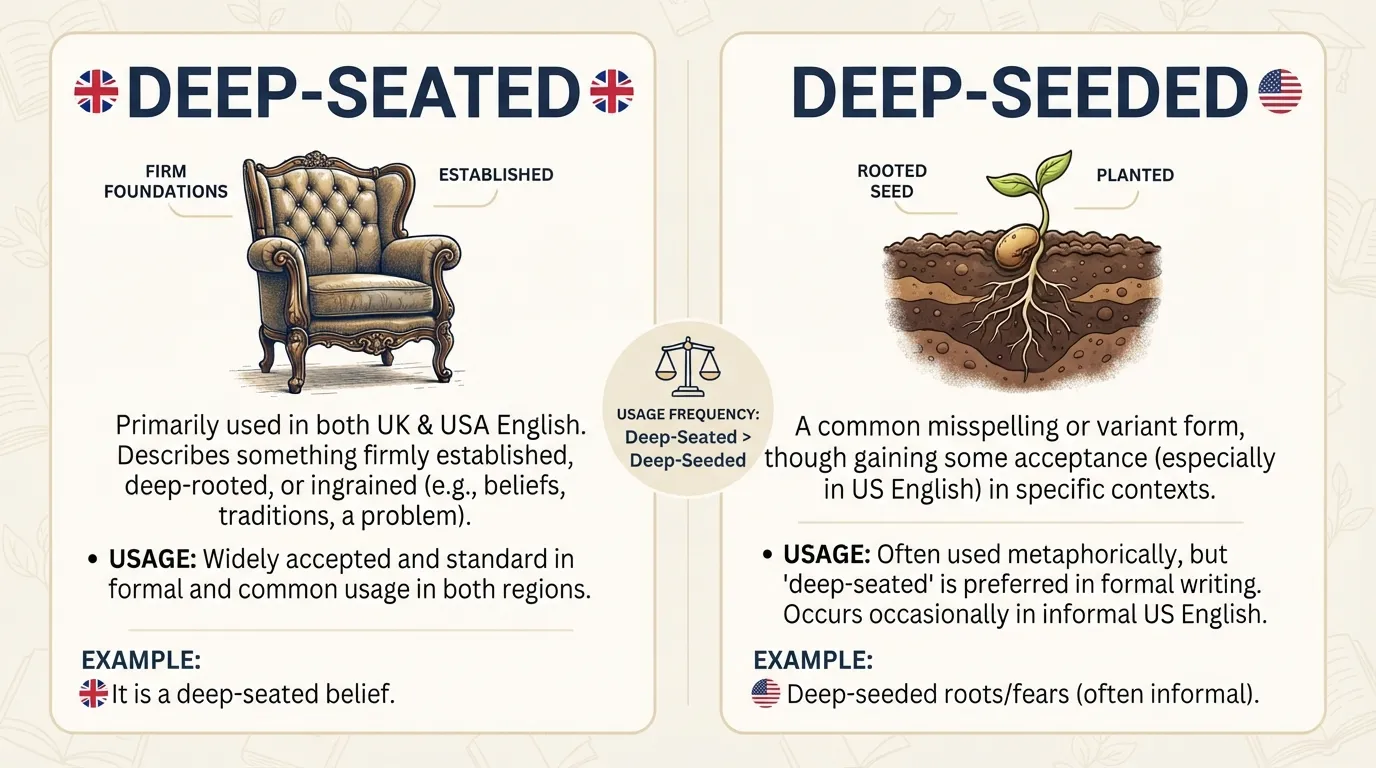
“Deep-seated” means firmly established, deeply rooted, or hard to change. It usually describes beliefs, fears, emotions, or long-standing problems.
“Deep-seeded” isn’t a standard phrase at all. It comes from confusing “seated” with “seeded,” since both suggest something buried or deeply placed.
This kind of mix-up has a name: an eggcorn.
Grammar Rule: What’s an Eggcorn?
An eggcorn happens when someone mishears or misreads a phrase, then replaces it with a similar-sounding alternative that still seems logical.
“Deep-seated” comes from the verb “seat,” meaning to situate or position firmly. The phrase likely traces back to horseback riding, where sitting “deep in the seat” meant a firm, secure position.
“Deep-seeded” swaps that idea for seeds planted deep in soil. It sounds reasonable, since deep roots suggest something lasting. But it’s not the phrase’s actual origin or accepted spelling.
Comparison Table
| Feature | Deep-Seated | Deep-Seeded |
|---|---|---|
| Correctness | Standard, correct phrase | Common error (eggcorn) |
| Origin | From “seat,” meaning firmly positioned | Mistaken association with planted seeds |
| Meaning | Firmly established, deeply ingrained | Not a recognized standard meaning |
| Example | She has a deep-seated fear of failure. | Incorrect: “deep-seeded fear” |
| Acceptable in formal writing | Yes | No |
Memory Trick
Think of someone sitting deep in a saddle, firmly seated and hard to knock loose. That image matches the real meaning: entrenched, hard to remove.
Seeds get planted, not “seated.” If you’re describing something stubborn and hard to shift, you want “seated,” not “seeded.”
Example Sentences
Using “deep-seated” (correct)
- She has a deep-seated fear of public speaking.
- His distrust of authority is deep-seated, going back to childhood.
- The company faces deep-seated problems in its management culture.
- Their rivalry stems from a deep-seated family conflict.
- Doctors traced the pain to a deep-seated infection.
Incorrect uses to avoid
- ❌ She has a deep-seeded fear of public speaking.
- ❌ His distrust of authority is deep-seeded.
- ❌ The company faces deep-seeded problems.
Common Mistakes
❌ Writing “deep-seeded” to describe emotions or beliefs. ✅ Using “deep-seated” for anything firmly established or ingrained.
Assuming the seed imagery is the correct origin. ✅ Remembering the phrase comes from “seat,” not “seed.”
❌ Using “deep-seeded” in formal or academic writing. ✅ Sticking with “deep-seated,” the only widely accepted form.
When to Use Each Form
Use “deep-seated” any time you’re describing something firmly established, whether it’s a fear, belief, tradition, or long-standing issue.
There’s no correct context for “deep-seeded.” If you’re tempted to use it, “deep-seated” is almost certainly the phrase you actually want.
Expert Tip 💡
If your writing tool doesn’t flag “deep-seeded,” double-check it yourself. Many spell checkers miss eggcorns like this one, since both words are spelled correctly on their own.
Quick Quiz
- “He has a ___ distrust of strangers.” (deep-seated / deep-seeded)
- “The infection was ___ and hard to treat.” (deep-seated / deep-seeded)
Answers: 1. deep-seated · 2. deep-seated
FAQs
Is “deep-seeded” ever correct?
No. “Deep-seated” is the standard, accepted phrase. “Deep-seeded” is a common but incorrect variation.
What does “deep-seated” mean?
It means firmly established, deeply ingrained, or hard to change, often describing beliefs, fears, or long-standing problems.
Where does “deep-seated” come from?
It comes from the verb “seat,” meaning to position firmly, possibly tracing back to horseback riding and sitting deep in the saddle.
Why do people write “deep-seeded” instead?
Because it evokes the image of seeds planted deep in soil, which seems logical even though it’s not the phrase’s real origin.
What is an eggcorn?
An eggcorn is a word or phrase that gets replaced with a similar-sounding one that seems to make sense, even though it’s technically incorrect.
Is “deep-seeded” a recent mistake?
It has gained more traction in recent years, but “deep-seated” has always been the historically and grammatically correct form.
Can “deep-seated” describe positive things?
Yes. While it often carries a negative connotation, like fear or suspicion, it can also describe positive things, like deep-seated love or loyalty.
Is “deep-seated” hyphenated?
Yes, when used as a compound adjective before a noun, such as “a deep-seated fear,” it’s typically hyphenated.
Conclusion
“Deep-seated” is the correct phrase, describing something firmly established or hard to change.
“Deep-seeded” is a common mix-up, an eggcorn born from confusing “seated” with “seeded.”
Once you connect the phrase to its real meaning, firmly seated rather than planted, it becomes easy to remember.

Hi, I’m Sophia Bennett. My goal is to make grammar easy, clear, and useful through simple explanations and real-life examples.