Have you ever wondered whether payed or paid is the correct spelling? These two words look similar, but they are not interchangeable in everyday English.
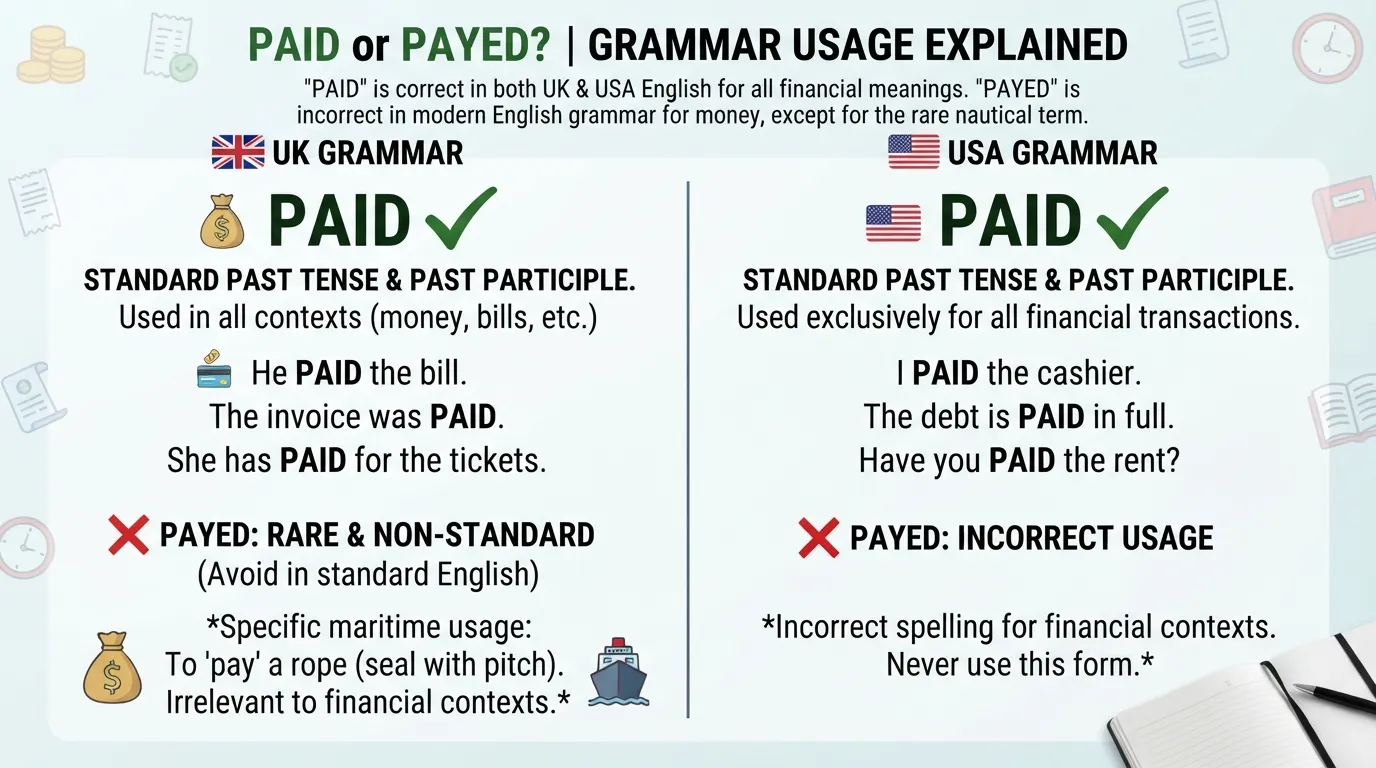
If you mean giving someone money for work, goods, or services, paid is the correct choice. For example, you might say, “I paid the bill yesterday.”
Payed is also a real word, but it has a specific nautical meaning related to sealing a ship’s deck or other surfaces.
In this guide, you’ll learn the difference between paid and payed, see simple examples, and discover which spelling to use in everyday writing.
Table of Contents
- Did You Know?
- Quick Answer Box
- Quick Rule in One Line
- The Difference Explained
- Grammar Rule: A Rare Nautical Exception
- Comparison Table
- Memory Trick
- Example Sentences
- Common Mistakes
- When to Use Each Form
- Expert Tip
- Payed or Paid: Quick Answers
- Payed Meaning and Definition
- Pay, Paid, Paid: Past Tense and Past Participle
- Paid Attention, Paid Bills, and Other Phrases
- Paid Off or Payed Off?
- Why Is It Paid and Not Payed?
- How to Spell Paid and Payed
- More Examples
- Quick Quiz
- FAQs
- Conclusion
- Key Takeaways
Did You Know? 🔍
“Payed” isn’t a typo in every case. Sailors once used it to describe coating a ship’s deck with tar, or letting out a rope, a completely different meaning from money.
Quick Answer Box
“Paid” is the correct past tense of “pay” in almost every situation, including money, attention, respect, and visits.
“Payed” only appears in rare nautical contexts, like coating a ship’s deck or releasing rope.
⚡ Quick Rule in 1 Line
“Paid for everything on land; payed only at sea.”
The Difference Explained
“Pay” is an irregular verb. Its past tense doesn’t follow the standard “-ed” pattern used by regular verbs.
In nearly every situation, “paid” is correct. This covers money, attention, compliments, visits, and respect.
“Payed” survives only in specific nautical usage: coating part of a ship with tar or pitch, or letting out a rope.
Grammar Rule: A Rare Nautical Exception
Most irregular verbs don’t have regional or context-based exceptions like this one. “Pay” is unusual.
For financial and everyday meanings, “pay” becomes “paid,” the same pattern as “say” becoming “said.”
For its rare nautical senses, older usage kept “payed” as the past tense. Even in nautical contexts today, “paid” is often accepted as well, making “payed” increasingly rare overall.
Comparison Table
| Feature | Paid | Payed |
|---|---|---|
| Common usage | Standard for nearly all meanings | Rare, nautical only |
| Context | Money, attention, respect, visits | Coating a ship, releasing rope |
| Frequency | Extremely common | Very rare |
| Example | She paid for the groceries. | Sailors payed out the rope slowly. |
Memory Trick
If you’re not on a boat, use “paid.” That covers money, attention, visits, and virtually everything else.
Save “payed” for sailors and ships; everyone else should stick with “paid.”
Example Sentences
Using “paid” (correct, almost always)
She paid for the groceries in cash.
He paid close attention during the lecture.
They paid their respects at the memorial.
We paid a visit to our grandparents last weekend.
The company paid its employees on time.
Using “payed” (rare, nautical only)
The sailors payed out the rope slowly.
The crew payed the deck with tar before the voyage.
Common Mistakes
❌ Writing “payed attention” instead of “paid attention.” ✅ Using “paid” for any non-nautical meaning.
Assuming “payed” is simply a typo with no real use. ✅ Knowing it has a narrow, correct nautical meaning.
❌ Using “payed” in everyday writing about money or transactions. ✅ Always using “paid” for financial or general contexts.
When to Use Each Form
Use “paid” for essentially everything: money, attention, respect, visits, and general past tense of “pay.”
Use “payed” only if you’re specifically writing about coating a ship or releasing rope in a nautical context, and even then, “paid” is often accepted too.
Expert Tip 💡
Unless you’re writing about sailing or shipbuilding, always default to “paid.” It’s correct in virtually every situation you’ll ever write about.
Payed or Paid: Quick Answers
Here are fast answers to the most common versions of the question.
Payed or Paid?
For money and almost everything else, it’s “paid.”
“Payed” is only for rare nautical uses.
Is Payed a Word?
Yes, “payed” is a real word, but a very narrow one.
It’s mainly used in nautical contexts, such as sealing a ship’s seams or letting out a rope.
Is Payed in the Dictionary?
Yes. Major dictionaries list “payed” as a past tense of “pay” in specific nautical senses.
They don’t list it for money, attention, or visits.
Why Do People Use Payed Instead of Paid?
Most people use “payed” by mistake. Regular verbs add “-ed,” so “pay + ed” looks natural.
But “pay” is irregular, so the spelling changes to “paid.”
Paid or Paid?
If you searched “paid or paid,” “paid vs paid,” or “paid payed,” you probably meant “paid or payed.”
Paid Not Payed Bot
Some online forums have automatic bots that remind people to write “paid,” not “payed.”
That’s because the mistake is so common.
Payed Meaning and Definition
“Payed” has a narrow definition.
It’s the past tense of “pay” in nautical senses.
Define Payed
- To coat the seams of a ship with tar or pitch to make them waterproof.
- To let out a rope or cable gradually: “payed out.”
- To turn a ship’s bow away from the wind: “payed off.”
Payed Meaning in Everyday English
In everyday English, “payed” has no meaning of its own.
When people write it for money, they mean “paid.”
When to Use Payed
Use it only if you’re writing about a ship or a rope in the nautical sense.
Even then, “paid” is often accepted as well.
I Payed: Is It Correct?
“I payed” is incorrect in everyday writing. It should be “I paid.”
For example, “I paid the bill,” not “I payed the bill.”
Payed Bills
“Payed bills” is a mistake. It’s “paid bills.”
Pay, Paid, Paid: Past Tense and Past Participle
“Pay” is an irregular verb. Its past tense and past participle are the same word: “paid.”
| Form | Word | Example |
|---|---|---|
| Base form (V1) | pay | I pay the rent. |
| Past simple (V2) | paid | I paid the rent. |
| Past participle (V3) | paid | I have paid the rent. |
| Third person | pays | She pays the rent. |
| -ing form | paying | He is paying the rent. |
Past Tense of Pay
The past tense of “pay” is “paid.”
That’s the answer to “pay past tense,” “past tense pay,” and “past of pay.”
Pay Past Simple
The past simple of “pay” is “paid.”
For example, “she paid yesterday.”
Past Participle of Paid
The past participle of “pay” is also “paid.”
You use it with “have,” “has,” or “had”: “I have paid,” “he has paid,” “they had paid.”
Pay, Paid, Paid
“Pay, paid, paid” is the full list of forms: V1, V2, and V3.
Have You Paid?
“Have you paid?” is correct. It uses the present perfect.
“Have you payed?” is wrong.
Is “I Already Paid” Correct?
Yes. “I already paid” is correct and common, especially in American English.
“I have already paid” is also correct, and it’s a bit more formal.
Is “Paid in Past Tense” Always the Form?
For money and almost every other meaning, yes.
Only in rare nautical senses does “payed” appear.
Paid Attention, Paid Bills, and Other Phrases
The “Paid” appears in many everyday phrases.
| Phrase | Meaning |
|---|---|
| paid attention | gave attention to something |
| paid bills | settled what was owed |
| paid respects | showed respect |
| paid a visit | visited |
| paid a compliment | gave a compliment |
| paid in full | settled the entire amount |
| paid up | settled everything owed |
Paid Attention or Payed Attention?
It’s “paid attention.” “Payed attention” is always incorrect.
Paid or Payed Attention
The same rule applies: “paid attention.”
Use Paid
When in doubt, use “paid.”
It’s correct for money, attention, respect, visits, and compliments.
Paid Off or Payed Off?
“Paid off” is the standard form.
“Payed off” only appears in a nautical sense.
What Does Paid Off Mean?
“Paid off” can mean:
- Finished paying a debt: “she paid off her loan.”
- Brought a good result: “her hard work paid off.”
- Bribed someone: “he paid off the witness.”
When Is Payed Off Correct?
In sailing, a ship “pays off” when its bow turns away from the wind.
So “the ship payed off” is correct in that nautical sense. Everywhere else, it’s “paid off.”
Why Is It Paid and Not Payed?
Verbs ending in a vowel plus “y” usually just add “-ed,” like “played,” “stayed,” and “prayed.”
But “pay” is an exception. Like “say” (said) and “lay” (laid), it changes to “paid.”
Other Verbs Like Pay
- say → said
- lay → laid
- pay → paid
Three verbs follow that pattern in everyday English.
How to Spell Paid and Payed
Here’s how each word is spelled.
- Paid: P-A-I-D
- Payed: P-A-Y-E-D
How Do You Spell Paid?
P-A-I-D. It’s one syllable, and it rhymes with “made.”
How to Spell Payed
P-A-Y-E-D. It’s only used in nautical senses.
Common Misspellings
- Payd, pade, paide
- Paied, payied, paiid
- Peid, payde
If you ever see “use.paid,” it’s a typo for “use paid.”
More Examples
Here are a few more sentences with “paid.”
- She paid the bill before the deadline.
- They paid for the tickets online.
- He paid a lot of attention in class.
- Have you paid for the order yet?
- All fees were paid in full.
- The staff were paid on Friday.
And two with “payed,” in the nautical sense:
- The crew payed the seams with tar.
- The captain payed out more rope.
Quick Quiz
“She ___ the bill before the due date.” (paid / payed)
“The crew slowly ___ out the anchor rope.” (paid / payed)
Answers: 1. paid · 2. payed (though “paid” is also accepted here)
FAQs
Is “payed” ever a correct word?
Yes, but only in rare nautical contexts, like coating a ship’s deck or releasing rope.
Is “paid attention” or “payed attention” correct?
“Paid attention” is correct. “Payed attention” is always incorrect.
What is the past tense of “pay” for money?
“Paid,” used in essentially every financial or transactional context.
Why does “payed” exist at all?
It comes from older nautical usage, referring to specific tasks like sealing a ship’s deck with tar or letting out rope.
Is “payed” used in modern writing?
Rarely. Even in nautical contexts, “paid” is now often accepted as an alternative.
Is “pay” a regular or irregular verb?
Irregular. Its past tense doesn’t follow the standard “-ed” ending pattern.
What other verbs behave like “pay”?
“Lay” becomes “laid,” and “say” becomes “said,” following a similar irregular pattern.
Should I ever use “payed” in business writing?
No. Business and financial writing should always use “paid.”
People Also Ask
Why do people use payed instead of paid?
Mostly by mistake. Regular verbs add “-ed,” so “payed” looks natural, but “pay” is irregular.
Is payed in the dictionary?
Yes, but only for nautical senses, such as sealing a ship’s seams or letting out a rope.
Is “I already paid” correct?
Yes. “I already paid” is correct, and “I have already paid” is slightly more formal.
Is it paid off or payed off?
“Paid off” is the standard form. “Payed off” is only used in a nautical sense, when a ship turns away from the wind.
People Also Search For
Payed or paid meaning
“Paid” is the past tense of “pay” for money. “Payed” has a rare nautical meaning.
Payed attention
It’s incorrect. It should be “paid attention.”
Payed or paid attention
“Paid attention.”
Payed or paid off
“Paid off,” except in a nautical sense.
Is payed a word
Yes, but only in rare nautical contexts.
Payed or paid examples
“She paid the bill” and “the sailors payed out the rope.” See the examples above.
Payed or paid past tense
The past tense of “pay” is “paid.” “Payed” is the nautical variant.
Payed or paid grammar
“Pay” is irregular, so its past tense is “paid.” The vowel-plus-“y” rule doesn’t apply to it.
More Questions About Paid and Payed
What is the past tense of pay?
Paid.
What is the past participle of pay?
Paid.
What are the three forms of pay?
Pay, paid, paid.
What does payed mean?
It’s a nautical past tense: sealing seams, letting out rope, or turning a ship away from the wind.
Is “I payed” correct?
No. Use “I paid.”
Is “payed bills” correct?
No. Use “paid bills.”
How do you spell paid?
P-A-I-D.
How do you spell payed?
P-A-Y-E-D.
Is “have you paid” correct?
Yes. “Have you payed” is not.
Is it “paid in full” or “payed in full”?
“Paid in full.”
Is it “paid up” or “payed up”?
“Paid up.”
Is it “paid a visit” or “payed a visit”?
“Paid a visit.”
Is it “paid respects” or “payed respects”?
“Paid respects.”
Does “paid” ever mean something other than money?
Yes. It also covers attention, respect, visits, and compliments.
Payed ya paid, kaunsa sahi hai?
Paise ke liye “paid” sahi hai. “Payed” sirf jahazon se juday khaas mauqon par istemal hota hai.
Pay ka past tense kya hai?
Pay ka past tense aur past participle dono “paid” hain.
Conclusion
The difference between payed or paid is easier to remember once you know their meanings. In everyday English, use paid when talking about money, bills, salaries, or completing a payment.
For example, “She paid for her lunch” is correct. Payed is a much less common word used mainly in specific nautical contexts, such as sealing a ship’s seams.
If you are writing an email, school assignment, business message, or social media post about money, paid is almost always the word you need.
Remember this simple rule, and you can avoid this common spelling mistake.

Hi, I’m Ethan Brooks. I create easy-to-follow grammar guides, writing tips, and vocabulary resources to make English learning enjoyable for everyone.