You finish writing a heartfelt thank-you note, hit send, and then wonder if you spelled “grateful” right. That little flicker of doubt is more common than you’d think.
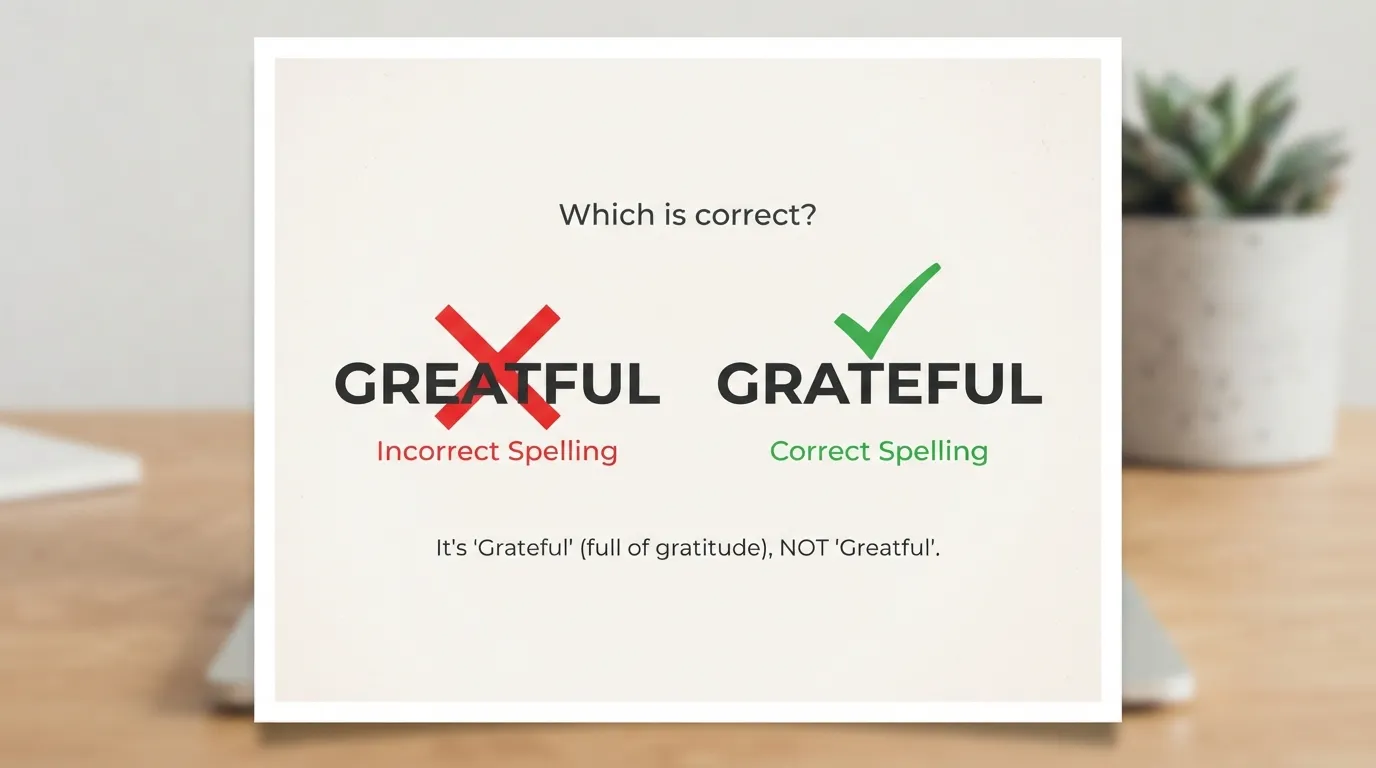
Quick answer: The correct spelling is “grateful.” “Greatful” is not a real word; it’s a common misspelling caused by confusing “grateful” with “great.”
Table of Contents
Quick Answer Box
Quick Rule in One Line
The Difference Explained
Why Is It “Grateful” and Not “Greatful”?
Grammar Rule: Where the Spelling Comes From
Is “Grateful” Spelled Differently in UK English?
Comparison Table
Memory Trick
Example Sentences
Common Mistakes
When to Use Each Form
Grateful vs Gratefulness (and a Word About “Thankful”)
Expert Tip
Common Misconception Callout
FAQs
Conclusion
Key Takeaways
Quick Answer Box
“Grateful” is the only correct spelling of the word meaning thankful or appreciative. “Greatful,” along with variants like “greatfull” and “gratefull,” are all misspellings. The confusion comes from the word “great,” which looks and sounds similar but has no connection to “grateful” at all.
⚡ Quick Rule in 1 Line
“Grateful starts with grate, not great, and ends in just one L.”
The Difference Explained
There is no real choice here the way there is with true US vs UK spelling pairs. “Grateful” is the only correct form, built from “grate” (from the Latin gratus) plus the suffix “-ful.” “Greatful” simply doesn’t exist as a dictionary word; it’s a misspelling that happens because “great” is such a common, familiar word that writers’ brains substitute it in without noticing.
Why Is It “Grateful” and Not “Greatful”?
The short answer is that “grateful” was never built from the word “great” in the first place, so there’s no historical or grammatical reason for the “ea” spelling to appear. “Grateful” descends from the Latin gratus, meaning pleasing or thankful, which entered English through the root “grat-.” “Great,” on the other hand, comes from a completely separate Old English word, great, meaning large or big. The two words simply happen to sound alike in modern English, which is what causes the mix-up, but they don’t share a common ancestor, a meaning, or a correct overlapping spelling.
Grammar Rule: Where the Spelling Comes From
“Grateful” follows the same pattern as many English adjectives ending in “-ful,” such as “careful,” “colorful,” and “hopeful,” all of which use a single L at the end, not a double one. The root “grat-” links “grateful” to “gratitude,” “congratulate,” and “ingrate,” all coming from the Latin gratus. Since none of those related words contain “great,” there’s no grammatical reason for “grateful” to either; the spelling is simply inherited from its Latin ancestor.
Is “Grateful” Spelled Differently in UK English?
No. “Grateful” is spelled exactly the same way in both American and British English, with no regional variation. Unlike genuine US/UK pairs such as “colour” versus “color” or “favourite” versus “favorite,” this isn’t one of them. “Greatful” is simply a misspelling everywhere, not a British alternative, so UK writers should use the same single-L, “grat-” spelling as anywhere else in the English-speaking world.
Comparison Table
FeatureGratefulGreatfulStatusCorrect, standard spellingMisspelling, not a wordWord originLatin gratus (pleasing, thankful)No valid origin; confusion with “great”Related wordsgratitude, congratulateNoneNumber of L’sOneN/A (incorrect spelling)ExampleI am grateful for your help.Not valid in any context
Memory Trick
Think of gratitude: both “grateful” and “gratitude” start with “grat-,” never “great-.” If you can spell “gratitude” correctly, you already know how “grateful” starts. And remember the pattern from “careful” and “hopeful”: these “-ful” endings almost always take just one L, so “grateful” follows suit.
Example Sentences
I am grateful for everyone who helped during the move.
She felt grateful for the extra time to finish her project.
We are deeply grateful for your continued support.
He wrote a note to say how grateful he was for the gift.
The team expressed how grateful they were for the coach’s patience.
I’m grateful to have such supportive friends around me.
She remained grateful even after a difficult year.
He was grateful for the second chance at the interview.
They felt grateful for the warm welcome from their new neighbors.
I am so grateful for this opportunity to learn something new.
Common Mistakes
❌ I am so greatful for your help today. ✅ I am so grateful for your help today.
❌ We’re gratefull for everything you’ve done. ✅ We’re grateful for everything you’ve done.
When to Use Each Form
Always use “grateful.” There is no context, formal or casual, American or British, where “greatful” is the correct choice. If you’re expressing thanks or appreciation in an email, note, essay, or speech, “grateful” is the word you want every time.
Grateful vs Gratefulness (and a Word About “Thankful”)
The noun form of “grateful” is “gratefulness,” not “greatfulness,” following the same “grat-” spelling rule as the adjective. In everyday writing, “gratitude” is used far more often than “gratefulness,” though both are correct; “gratefulness” simply sounds slightly more formal or literary. It’s also worth noting that “thankful” is a separate word entirely, spelled exactly as it looks, with no equivalent spelling confusion, since it comes from “thank” rather than from a Latin root like “grateful” does.
Expert Tip 💡
Before sending anything important, like a thank-you note, cover letter, or client email, run a quick search for “greatful” in your document. Basic spell checkers sometimes miss it if autocorrect has already “fixed” it inconsistently, so a manual check adds an extra layer of confidence.
Common Misconception Callout
Some writers assume “greatful” must be a valid British or informal variant, similar to how “colour” differs from “color.” That’s not the case here. Unlike genuine US/UK spelling differences, “grateful” has only one correct form everywhere in the English-speaking world.
FAQs
Is “greatful” ever correct?
No. It’s a misspelling in every context and every English-speaking region.
Why do people write “greatful” instead of “grateful”?
Because the word “great” is far more common and visually similar, so writers unconsciously substitute it in.
Does “grateful” have one L or two?
One L, following the same pattern as “careful,” “hopeful,” and “colorful.”
What is the difference between “grateful” and “gratitude”?
“Grateful” is an adjective describing a feeling of thankfulness; “gratitude” is the noun for that same feeling.
Where does “grateful” come from?
It comes from the Latin word gratus, meaning pleasing or thankful, and has no connection to the word “great.”
Is it greatful vs grateful?
Grateful is the correct spelling. Greatful is a misspelling.
Is “gratefull” with two L’s ever correct?
No. Like “greatful,” it’s a common misspelling.
What are good synonyms for “grateful”?
Thankful, appreciative, obliged, and indebted all work as close synonyms.
Is this a US vs UK spelling difference?
No. “Grateful” is the only accepted spelling worldwide; there is no regional variant, including in UK English.
How can I quickly check my spelling of “grateful”?
Say “gratitude” first, since they share the same “grat-” beginning, then add “-ful” with a single L.
Can a grammar checker catch “greatful”?
Most modern grammar and spell checkers will flag it, but it’s worth a manual double check in important documents, since autocorrect settings vary.
Is “gratefulness” spelled with “great” or “grat”?
“Grat,” the same as “grateful” itself; the correct spelling is “gratefulness,” never “greatfulness.”
Conclusion
“Grateful” is the only correct spelling, and “greatful” is not a real word at all, just a very common slip caused by the similarity to “great.”
This holds true in both American and British English, so there’s no regional version where the alternate spelling becomes acceptable.
The two words look alike but come from entirely different roots.
Once you remember that “grateful” shares its “grat-” beginning with “gratitude,” the correct spelling becomes easy to lock in for good.
READ MORE:
Etc or Ect: Which Spelling Is Correct?

Hi, I’m Daniel Carter. I’m passionate about helping learners improve their English with practical grammar tips and clear writing advice.