You wrote “everytime I see her, I smile” in a caption, and a comment pointed out the spelling before you could fix it.
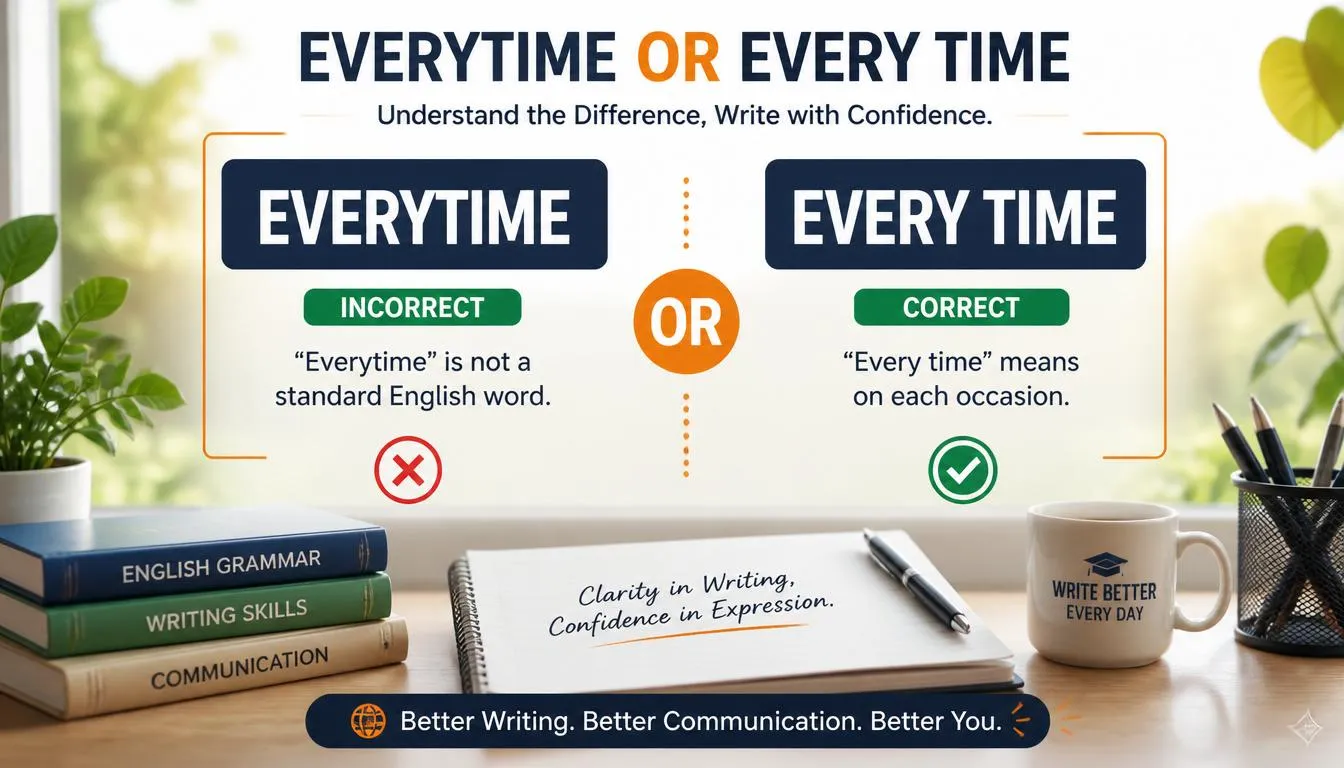
Here’s the quick fix: “every time” is almost always correct, written as two separate words, meaning “on each occasion.”
“Everytime” is a common misspelling, similar to “alot” or “atleast,” though it does appear as a stylized title in some song and brand names.
Once you understand the standard rule and its rare exception, you’ll know exactly which version to use.
Quick Answer
“Every time” (two words) is the correct spelling in standard English, meaning “on each occasion” or “whenever.”
“Everytime” (one word) is a common misspelling in everyday writing, though it appears as a stylized title in some song names.
For all standard writing, always use “every time” as two words.
⚡ Quick Rule
“Every time” is two words in standard writing — “everytime” only appears as a stylized title.
Everytime vs Every Time: The Core Difference
“Every time” combines the adjective “every” with the noun “time,” together meaning “on each occasion” or “each time something happens.”
“Everytime” is not a standard English word, though it occasionally appears as a stylistic choice in song titles, like Britney Spears’ well-known single.
Say “Every time you call, I answer” (correct), not “Everytime you call, I answer” (incorrect in standard writing).
Outside of specific titles or brand names, “every time” should always remain two separate words.
Grammar Rule Explained
“Every” is a determiner, meaning “each” or “all,” and it always modifies a noun that follows it, like “every day” or “every person.”
“Time” is a standalone noun in this phrase, functioning the same way as in “every day” or “every year.”
Since “every day” and “every year” never merge into single words, “every time” logically follows the same consistent pattern.
This comparison to similar phrases helps explain why “everytime” isn’t accepted in standard English grammar.
The One Exception: “Everytime” as a Song or Brand Title
Unlike “alot” or “atleast,” “everytime” does have one legitimate exception: it appears as a single word in certain official titles.
The most famous example is Britney Spears’ 2004 song “Everytime,” which intentionally uses the one-word spelling as a stylistic choice.
Similarly, some brand names or product titles may use “Everytime” as one word for branding purposes.
Outside these specific, official titles, standard English writing should always use “every time” as two separate words.
Everytime vs Every Time Comparison Table
| Feature | Every Time | Everytime |
|---|---|---|
| Correct in standard writing | ✅ Yes | ❌ No |
| Recognized in dictionaries | ✅ Yes | ❌ No (except as a proper title) |
| Meaning | On each occasion, whenever | Not standard, except in titles |
| Formal writing | Always acceptable | Never acceptable |
Memory Trick
Remember: “Every time” follows the same pattern as “every day” and “every year” — none of these phrases merge into one word.
Picture “every” as a word that always needs its own separate partner, whether that’s “day,” “year,” or “time.”
If “everyday” as a single word already has a different meaning (an adjective, as in “an everyday routine”), then “everytime” doesn’t follow that same exception.
Real Example Sentences
Correct (Every Time):
- Every time I visit, she offers me tea.
- He forgets his umbrella every time it rains.
- Every time the phone rings, the dog barks.
- She smiles every time she sees a puppy.
- Every time we meet, we learn something new.
Incorrect (Everytime, in standard writing):
- Everytime I visit, she offers me tea. ❌
- He forgets his umbrella everytime it rains. ❌
Acceptable (Only as an official title):
- Britney Spears’ song “Everytime” was released in 2004. ✅ (proper noun, title)
Common Mistakes
1. Writing “everytime” as one word in regular sentences Incorrect: Everytime I cook, I burn something. Correct: Every time I cook, I burn something.
2. Assuming the song title makes “everytime” acceptable everywhere The one-word spelling is only correct when referring to specific titles, not in everyday writing.
3. Confusing this with “everyday,” which is a legitimate single word “Everyday” is a real adjective (an everyday task), but “everytime” is not a standard equivalent.
4. Trusting autocorrect to always catch it Some autocorrect tools miss this error, especially in casual typing, so manual proofreading still helps.
When to Use “Every Time”
Use Every Time When:
- Describing something that happens on each occasion
- Writing formally, casually, or professionally
- Referring to repeated events or actions
Examples: every time you visit, every time it happens, every time we talk
Use “Everytime” Only When:
- Referring to a specific official title, like a song or product name
- Quoting or citing that exact title directly
FAQs
Is “everytime” ever a correct spelling?
In standard writing, no. The correct spelling is “every time,” as two words. The only exception is specific titles, like song names.
Why is “everytime” sometimes seen online?
Because of its use in titles like Britney Spears’ song “Everytime,” some writers assume it’s an accepted alternative spelling in general writing.
Is “everyday” the same as “everytime”?
No, “everyday” is a legitimate single word functioning as an adjective (an everyday routine), while “everytime” isn’t standard outside titles.
Does “every time” ever function as one grammatical unit?
Yes, it functions together as an adverbial phrase, but it’s still written as two separate words.
Should I use “everytime” in a formal essay?
No, always use “every time” as two words in formal, academic, or professional writing.
Does spell check always catch “everytime”?
Most modern spell checkers do flag it, though it may not always be caught during fast typing or texting.
Is “every time” the same in British and American English?
Yes, “every time” is spelled the same way in both British and American English — this isn’t a regional spelling difference.
Conclusion
Unlike stricter pairs like “alot,” this word does have one narrow exception: official titles like song names.
However, for all standard writing, “every time” should always remain two separate words.
Remember the comparison to “every day” and “every year,” and you’ll always choose the correct spelling in your own writing.

Hi, I’m Olivia Harper. I love turning complex English grammar into simple, practical lessons that help readers write and speak with confidence.