You wrote “noone answered the phone” in a message, and your coworker replied only with a confused question mark.
Here’s the quick fix: “no one” is always correct, written as two separate words, and “noone” is never a recognized word in standard English.
This mistake happens because similar words like “nobody” and “nothing” really do merge into one word, creating a false pattern.
Once you understand why “no one” is the exception, you’ll never doubt this spelling again.
Quick Answer
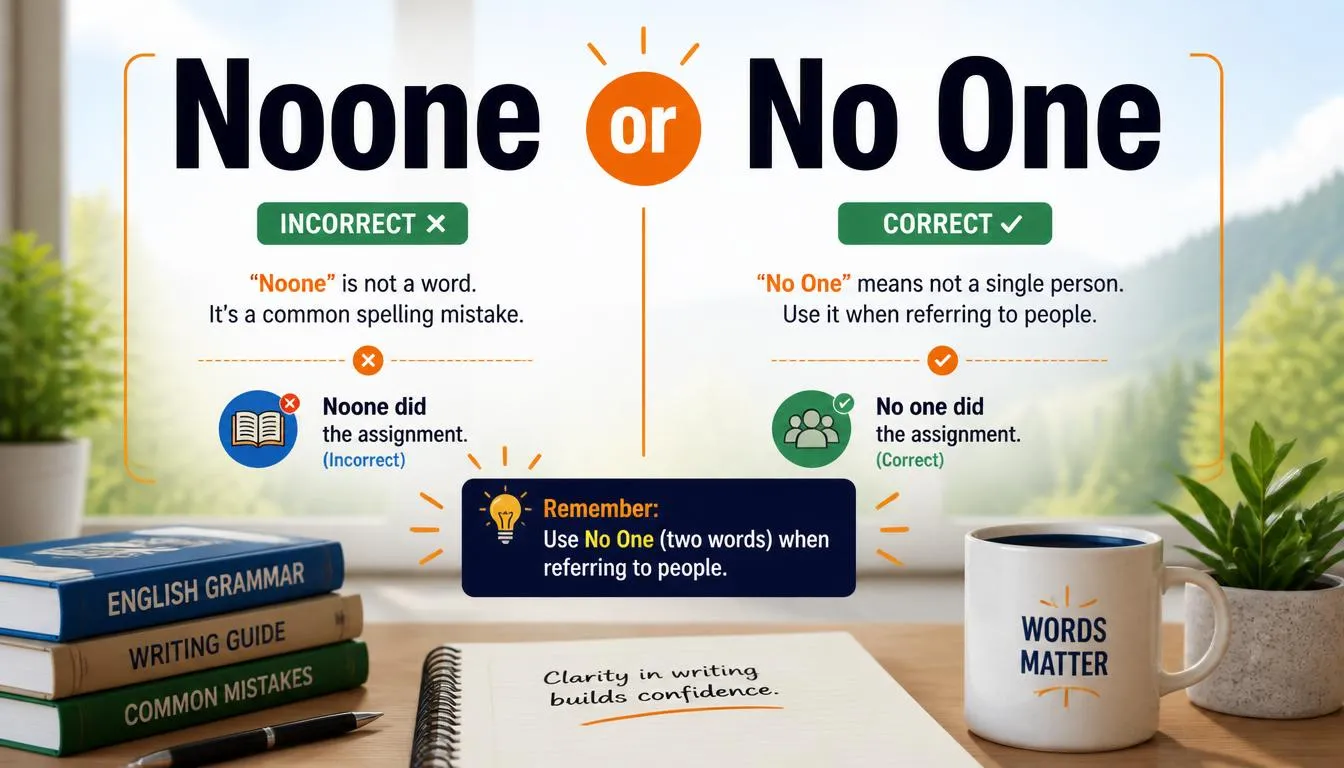
“No one” (two words) is the only correct spelling, meaning “not a single person.”
“Noone” (one word) is a common misspelling and doesn’t appear in standard dictionaries.
Even though it looks similar to “nobody,” “no one” always stays as two separate words.
⚡ Quick Rule
“No one” is always two words — “noone” simply isn’t a standard English word.
Noone vs No One: The Core Difference
“No one” combines “no” and “one” to mean “not a single person,” functioning as a pronoun.
“Noone” is not found in any major English dictionary, despite looking like it should follow the same pattern as “nobody” or “nothing.”
Say “No one came to the meeting” (correct), never “Noone came to the meeting” (incorrect).
Unlike “nobody,” which is a legitimate single word, “no one” resists merging into one word in standard English.
Grammar Rule Explained
Words like “nobody,” “nothing,” and “nowhere” combined into single words over centuries of common use, becoming standard compound words.
“No one,” however, never went through this same transformation, likely because “one” already functions as a standalone pronoun elsewhere in English.
Merging “no” and “one” together would also create potential confusion with the unrelated word “noon,” which is spelled and pronounced similarly.
This distinct pronunciation and spelling risk likely helped keep “no one” as two separate words throughout its history.
Why Do People Write “Noone” as One Word?
Since “nobody,” “nothing,” and “nowhere” are all single words, it’s natural to assume “no one” should follow the same pattern.
This assumption creates one of the most common spelling errors involving negative pronouns in English.
Frequent appearances of “noone” in casual writing and texting have also visually normalized the mistake for many readers.
Despite this, every major dictionary, including Merriam-Webster and Oxford, only recognizes “no one” as the correct spelling.
Noone vs No One Comparison Table
| Feature | No One | Noone |
|---|---|---|
| Correct spelling | ✅ Yes | ❌ No |
| Recognized in dictionaries | ✅ Yes | ❌ No |
| Meaning | Not a single person | Not a real word |
| Formal writing | Always acceptable | Never acceptable |
Memory Trick
Remember: “No one” keeps its space because merging it would look just like “noon,” a completely different word.
Picture the clock striking noon, and remind yourself that “no one” needs its own space to avoid looking like the time of day.
If “nobody” and “nothing” are single words, but “no one” still needs a space, think of it as the one exception in this family of words.
Real Example Sentences
Correct (No One):
- No one answered when I called the office.
- There’s no one else who understands this better.
- No one expected the announcement to happen so soon.
- I looked around, but no one was there.
- No one has solved this problem yet.
Incorrect (Noone):
- Noone answered when I called the office. ❌
- There’s noone else who understands this better. ❌
- Noone expected the announcement to happen so soon. ❌
No One or Nobody? Are They the Same?
“No one” and “nobody” both mean “not a single person” and are generally interchangeable in most sentences.
Example: “No one came to the party” and “Nobody came to the party” mean exactly the same thing.
The main difference is spelling and slight formality — “no one” often feels marginally more formal, while “nobody” feels more casual and conversational.
Either word works correctly, as long as you remember “no one” always stays as two words, while “nobody” stays as one.
Common Mistakes
1. Writing “noone” as a single word Incorrect: Noone was home when I arrived. Correct: No one was home when I arrived.
2. Confusing “no one” with “noon” Incorrect: I’ll see noone at the meeting. Correct: I’ll see no one at the meeting.
3. Assuming all negative pronouns follow the same spelling pattern “Nobody,” “nothing,” and “nowhere” are single words, but “no one” remains the clear exception.
4. Trusting autocorrect to always catch it Some autocorrect tools may not flag “noone” consistently, so manual proofreading still helps.
When to Use “No One”
Use No One When:
- Referring to “not a single person”
- Writing formally, casually, or professionally
- Replacing or pairing with “nobody” in a sentence
Examples: no one knows, no one else, no one’s fault
Never Use “Noone”
There is no correct context for “noone” as a single word in standard English writing.
FAQs
Is “noone” ever a correct spelling?
No, “noone” is never correct in standard English. The only proper spelling is “no one,” as two separate words.
Why is “nobody” one word, but “no one” is two words?
“Nobody” merged into a single word over time, while “no one” never went through the same transformation, partly to avoid confusion with “noon.”
Is “no one” the same as “nobody”?
Yes, both words mean “not a single person” and are generally interchangeable, though “no one” often feels slightly more formal.
Does “no one” ever need an apostrophe?
Only in the possessive form, “no one’s,” as in “It’s no one’s fault,” which uses an apostrophe plus “s.”
Why do people confuse “noone” with “noon”?
Because removing the space from “no one” creates a word that looks almost identical to “noon,” the midday hour.
Does spell check always catch “noone”?
Most modern spell checkers do flag it, though it’s still a frequent typing mistake, especially in casual writing.
Is “no one” the same in British and American English?
Yes, “no one” is spelled identically in both British and American English — this isn’t a regional spelling difference.
Conclusion
Unlike “nobody” and “nothing,” which merged into single words, “no one” remains an exception, always written as two separate words.
The correct spelling is always “no one,” never “noone,” partly to avoid visual confusion with the word “noon.”
Remember this one exception among negative pronouns, and you’ll always spell “no one” correctly.

Hi, I’m Sophia Bennett. My goal is to make grammar easy, clear, and useful through simple explanations and real-life examples.