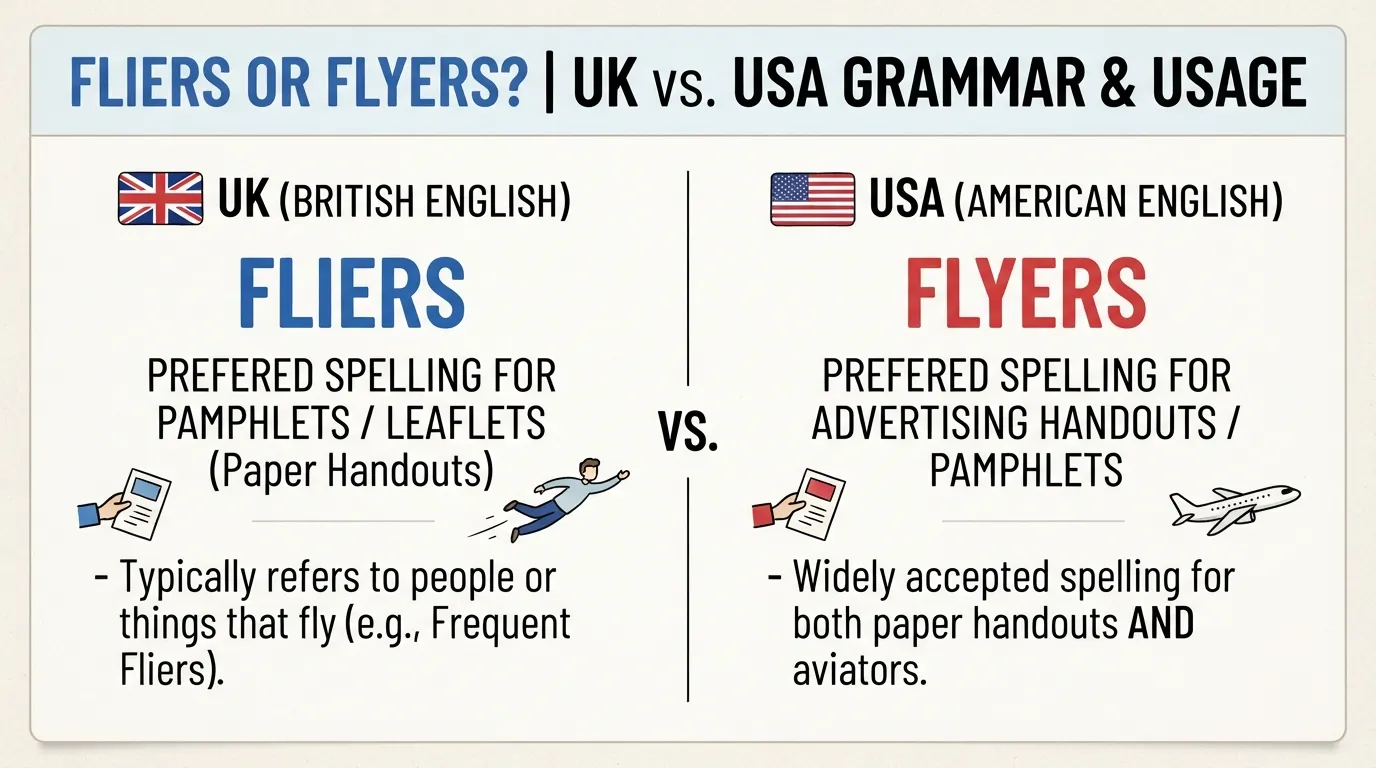
You’re designing a handout for a bake sale. Do you call it a “flyer” or a “flier”?
Quick answer: both spellings are correct. “Flyer” is more common overall, especially for printed handouts. “Flier” shows up more with people or things that fly.
Here’s how to pick the right one.
Table of Contents
- Did You Know?
- Quick Answer Box
- Quick Rule in One Line
- The Difference Explained
- Grammar Rule: Two Coexisting Spellings
- Comparison Table
- Memory Trick
- Example Sentences
- Common Mistakes
- When to Use Each Form
- Expert Tip
- Quick Quiz
- FAQs
- Conclusion
- Key Takeaways
Did You Know? 🔍
“Flyer” started out as slang, long before modern flight existed. It first referred to a single printed sheet, an advertisement passed around and shared quickly.
The name stuck because these papers spread fast, almost like something taking flight.
Quick Answer Box
“Flyer” and “flier” are both correct spellings of the same word.
“Flyer” is more common today for printed handouts and general use.
“Flier” appears more often with people or things that fly, like “frequent flier.”
⚡ Quick Rule in 1 Line
“Flyer for handouts, flier for frequent flier miles — though both work almost anywhere.”
The Difference Explained
“Flyer” and “flier” mean exactly the same thing. There’s no true difference in meaning, only a difference in which spelling shows up more in which context.
Both can describe a printed advertisement, like a paper handed out for an event. Both can also describe someone or something that flies, like a passenger or a pilot.
Style guides don’t fully agree here. AP Style prefers “flyer” across the board. Some airlines and aviation writers still favor “flier” for passengers.
Grammar Rule: Two Coexisting Spellings
Unlike a strict US/UK split, “flyer” and “flier” have coexisted in both American and British English for a long time.
Neither spelling ever became the single, official standard. Instead, usage settled into loose patterns based on context, not fixed rules.
Modern usage data shows “flyer” as more common overall, in both American and British writing, especially for printed materials.
Comparison Table
| Feature | Flyer | Flier |
|---|---|---|
| Overall frequency | More common | Less common |
| Printed handout | Standard choice | Occasionally used |
| Frequent traveler | Used, especially “frequent flyer miles” | Also used, especially in aviation industry writing |
| AP Style preference | Preferred for both meanings | Not preferred |
| Idioms | “High flyer” | “Take a flier” (meaning: take a risk) |
Memory Trick
Think of “flyer” as the flyer you get handed at an event, the more common everyday spelling.
“Flier” often shows up in “frequent flier,” a phrase tied closely to travel and aviation.
Example Sentences
Using “flyer”
- She handed out flyers for the community fundraiser.
- My car was covered in flyers after the game.
- He’s a high flyer at the company, always ahead of schedule.
- We printed 200 flyers for the grand opening.
- The flyer listed the event’s time and location.
Using “flier”
- I’ve joined a frequent flier program for this airline.
- My mom has always been a nervous flier.
- Air traffic increased, with more fliers than usual this summer.
- He decided to take a flier on the new investment.
- The flight attendant welcomed all fliers aboard.
Common Mistakes
❌ Assuming one spelling is simply wrong. ✅ Recognizing both are accepted, just used with different frequency.
Mixing both spellings in the same document without reason. ✅ Picking one spelling and staying consistent throughout.
❌ Following a strict “handout equals flyer, person equals flier” rule as if it’s fixed. ✅ Treating it as a general tendency, not an absolute rule.
When to Use Each Form
Use “flyer” as your safe, general default, especially for printed advertisements and most everyday writing.
Use “flier” if you’re writing about air travel specifically, or if your style guide or publication prefers it, such as some aviation industry writing.
If your organization follows AP Style, use “flyer” for both meanings.
Expert Tip 💡
Check your style guide first. If you don’t have one, default to “flyer,” since it’s the more widely recognized spelling in modern American and global English.
Quick Quiz
- “We’re printing 100 ___ for the school fair.” (flyer / flier)
- “She’s a nervous ___ and prefers window seats.” (flyer / flier)
Answers: 1. flyers · 2. flier
FAQs
Is “flier” or “flyer” more correct?
Neither is more correct. Both are accepted spellings of the same word, though “flyer” is more common overall today.
What’s the plural of “flyer”?
“Flyers,” formed the regular way by adding an S.
What’s the plural of “flier”?
“Fliers,” also formed by adding an S.
Does AP Style prefer “flyer” or “flier”?
AP Style prefers “flyer” for both the printed handout and the person-who-flies meanings.
Is “flier” British and “flyer” American?
Not strictly. Both spellings appear in American and British English, though usage patterns and style guides vary.
What does “take a flier” mean?
It’s an idiom meaning to take a risk, often used in the context of an investment or gamble.
What does “high flyer” mean?
It describes someone who is highly successful or ambitious, often used in a professional context.
Which spelling should I use for frequent traveler programs?
Many airlines use “frequent flyer,” though “frequent flier” also appears, especially in older or aviation-specific writing.
Conclusion
“Flyer” and “flier” are two accepted spellings of the same word, describing either a printed handout or someone who flies.
“Flyer” is the more common, general-purpose choice today. “Flier” shows up more in travel and aviation contexts.
Pick one, stay consistent, and you can’t really go wrong.

Hi, I’m Sophia Bennett. My goal is to make grammar easy, clear, and useful through simple explanations and real-life examples.