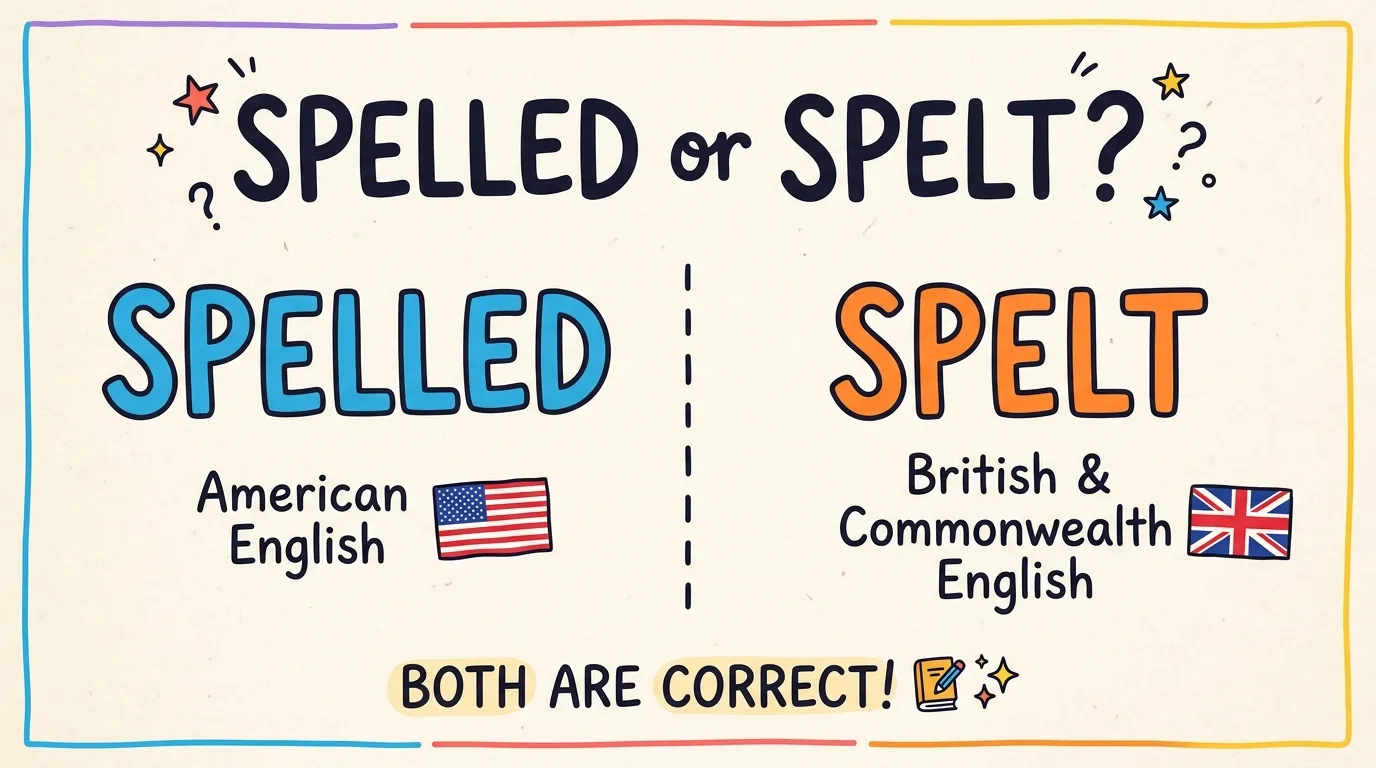
Should you write spelled or spelt? Both forms are correct past tense and past participle forms of the verb spell. The main difference is regional usage.
In American English, spelled is the standard choice. In British English, both spelled and spelt are accepted, although spelt is especially common.
For example, an American writer might say, “She spelled my name correctly,” while a British writer might write, “She spelt my name correctly.” Both sentences are grammatically correct.
In this guide, you will learn when to use spelled or spelt, how American and British English differ, and how to choose the right form for your writing.
Quick Answer: Spelled or Spelt?
Both spelled and spelt are correct. They have the same meaning when used as the past tense or past participle of spell.
| Word | Common Usage | Example |
| Spelled | Standard in American English; also used in British English | She spelled the word correctly. |
| Spelt | Especially common in British English | She spelt the word correctly. |
Quick rule: If you are writing for a US audience, choose spelled. If you are writing for a UK audience, either form is acceptable, but use one consistently.
What Does Spelled Mean?
Spelled is the past tense and past participle of the verb spell. It means to write or say the letters of a word in the correct order.
Use spelled when describing a spelling action that happened in the past or when forming a perfect tense.
Examples:
- The student spelled the word correctly.
- I spelled your name wrong in the email.
- She has spelled every word on the list.
- The teacher asked us how the word was spelled.
- He spelled his surname for the receptionist.
In American English, spelled is the usual form in these sentences. It is also correct in British English.
Spelled as the Past Tense
Use spelled to describe a completed action.
- I spelled the word incorrectly yesterday.
- She spelled my name without an extra letter.
- The child spelled every word in the quiz correctly.
Spelled as a Past Participle
The past participle appears with helping verbs such as has, have, and had.
- I have spelled the name correctly this time.
- She had spelled the word differently in her first draft.
- The name was spelled incorrectly on the form.
These examples are correct in both American and British English.
What Does Spelt Mean?
Spelt is another accepted past tense and past participle form of spell. It has the same meaning as spelled when referring to writing or saying the letters of a word in the correct order.
Examples:
- She spelt my name correctly.
- I spelt the word wrong during the test.
- He has spelt the name the same way every time.
- The word was spelt differently in the old document.
- The teacher asked how the name was spelt.
The form spelt is especially common in British English. It is generally not the preferred form in American English, where spelled is standard.
Important: Spelt can also refer to a type of ancient wheat. That is a separate meaning, not a different spelling of the verb form in these examples.
Spelled vs Spelt: Key Differences
The difference is mainly about regional preference, not meaning.
| Feature | Spelled | Spelt |
| Meaning | Past tense or past participle of spell | Past tense or past participle of spell |
| American English | Standard choice | Generally not preferred |
| British English | Correct | Correct and especially common |
| Grammar | Regular form | Alternative form |
| Example | He spelled the word correctly. | He spelt the word correctly. |
You do not need to memorize two different meanings. In the context of writing words correctly, spelled and spelt mean the same thing.
Spelled or Spelt in American English
In American English, spelled is the standard form. If your audience is in the United States, using spelled is the safest choice for school assignments, business writing, websites, and professional documents.
Examples:
- How is your last name spelled?
- The student spelled the word correctly.
- I spelled the address incorrectly.
- The name has been spelled the same way for years.
- She spelled out the instructions for us.
For a US-focused website such as Grammarlify.com, use spelled in the main examples and explanations unless you are specifically discussing British English.
Spelled or Spelt in British English
In British English, both spelled and spelt are accepted. Many British speakers use spelt naturally, but spelled is also correct.
Examples:
- How is your surname spelt?
- The child spelt the word correctly.
- I have spelt your name wrong.
- The word was spelt differently in the original text.
You can also write:
- How is your surname spelled?
- The child spelled the word correctly.
- I have spelled your name wrong.
Both sets of sentences are acceptable in British English.
If you are writing for a British audience, consider the publication’s style guide and keep your choice consistent throughout the document.
When Should You Use Spelled or Spelt?
Use the following guide to make the right choice.
1. For American Readers
Choose spelled.
Example: “The teacher explained how the word was spelled.”
2. For British Readers
You can use either spelled or spelt.
Example: “The teacher explained how the word was spelt.”
3. For International Writing
If your readers come from different English-speaking countries, spelled is a practical default because it is standard in American English and accepted in British English.
Example: “Please check how the product name is spelled.”
4. When Following a Style Guide
If your school, company, editor, or publisher has a preferred form, follow that preference.
For example, if a British publication consistently uses spelt, keep using it throughout the article. Do not switch between spelt and spelled without a reason.
Common Mistakes to Avoid
Mistake 1: Assuming Spelt Is Always Incorrect
Incorrect claim: “Spelt is not a real word.”
Correct explanation: Spelt is an accepted past tense and past participle of spell, especially in British English.
Example: “She spelt the word correctly.”
Mistake 2: Assuming Spelled Is Only American
Incorrect claim: “British English never uses spelled.”
Correct explanation: Both forms are used in British English. Spelt is a common British alternative, but spelled is also correct.
Mistake 3: Mixing Forms Without a Reason
Using both forms in the same article is not automatically a grammar error. However, switching between them without a clear reason can make your writing look inconsistent.
For example, choose one style for a paragraph or document and follow it throughout.
Mistake 4: Confusing Spelt With Spell
These forms have different grammatical uses.
- Present: I spell my name clearly.
- Past: I spelled my name clearly.
- British alternative: I spelt my name clearly.
- Present participle: I am spelling my name.
- Base form after to: I want to spell my name correctly.
Use spell for the base form and present tense with I, you, we, and they. Use spelling for the continuous form.
Mistake 5: Thinking the Meaning Changes
When referring to writing a word correctly, spelled and spelt do not have different meanings.
- She spelled the word correctly.
- She spelt the word correctly.
Both sentences say that she wrote or said the letters in the correct order.
An Easy Trick to Remember Spelled vs Spelt
Remember this simple rule:
- US English = spelled
- UK English = spelled or spelt
Think of spelled as the all-purpose choice. It works in American English and is also accepted in British English. Choose spelt when it suits your British English audience or your publication’s style.
For example:
- US: “How is this word spelled?”
- UK: “How is this word spelt?”
Both sentences ask for the correct arrangement of letters.
Practice Quiz: Spelled or Spelt?
Choose the best answer for each question.
1. Which form is standard in American English?
a) Spelled
b) Spelt
2. Which two forms are accepted in British English?
a) Spelled only
b) Spelled and spelt
3. Choose the correct sentence for a US audience.
a) She spelt my name correctly.
b) She spelled my name correctly.
4. Choose the correct sentence for a British audience.
a) He spelt the word correctly.
b) He spelled the word correctly.
5. Complete the sentence: “I have ______ your name incorrectly.”
a) spelled
b) Both spelled and spelt, depending on the English variety
6. Which form is the present participle?
a) Spelt
b) Spelling
Answers and Explanations
- a) Spelled — This is the standard American English form.
- b) Spelled and spelt — Both are accepted in British English.
- b) She spelled my name correctly. — Spelled is the standard US choice.
- Both a and b — Both forms are correct in British English.
- b) Both spelled and spelt, depending on the English variety — Both can be used as past participles.
- b) Spelling — The present participle is spelling.
FAQs
1. Is it spelled or spelt?
Both are correct past tense and past participle forms of spell. Spelled is standard in American English, while both forms are accepted in British English.
2. Is spelt British or American?
Spelt is especially common in British English. In American English, spelled is the standard form.
3. Is spelled correct in British English?
Yes. British English accepts both spelled and spelt. The choice often depends on personal preference or a publication’s style.
4. Is spelt grammatically correct?
Yes. Spelt is grammatically correct when used as the past tense or past participle of spell. For example, “I spelt the word correctly.”
5. Should I use spelled or spelt in an essay?
For an essay written in American English, use spelled. For British English, either form is acceptable. Follow your teacher’s or institution’s preferred style.
6. What is the past tense of spell?
The past tense can be spelled or spelt. American English normally uses spelled, while British English commonly uses both.
7. What is the past participle of spell?
The past participle is spelled or spelt. For example, “I have spelled the word correctly” and “I have spelt the word correctly” are both grammatical.
8. Do spelled and spelt mean the same thing?
Yes. When referring to forming a word with the correct letters, they have the same meaning. Their use differs mainly by regional preference.
9. Is spelt a spelling mistake?
No. Spelt is a recognized form of the verb spell. However, spelled is the safer choice for American English.
10. Which form should I use on an international website?
Spelled is a practical default because it is standard in American English and also accepted in British English. Whichever form you choose, use it consistently.
Conclusion
When choosing spelled or spelt, remember that both forms are correct when referring to writing or saying the letters of a word in the correct order.
The difference is mainly regional: spelled is the standard form in American English, while British English accepts both spelled and spelt.
If you are writing for a US audience, choose spelled. If you are writing for a UK audience, either form works. The most important thing is to understand your audience and maintain a consistent style.

Hi, I’m Sophia Bennett. My goal is to make grammar easy, clear, and useful through simple explanations and real-life examples.