You’re writing a grocery list and type “potatos.” Something looks off, but you’re not sure what.
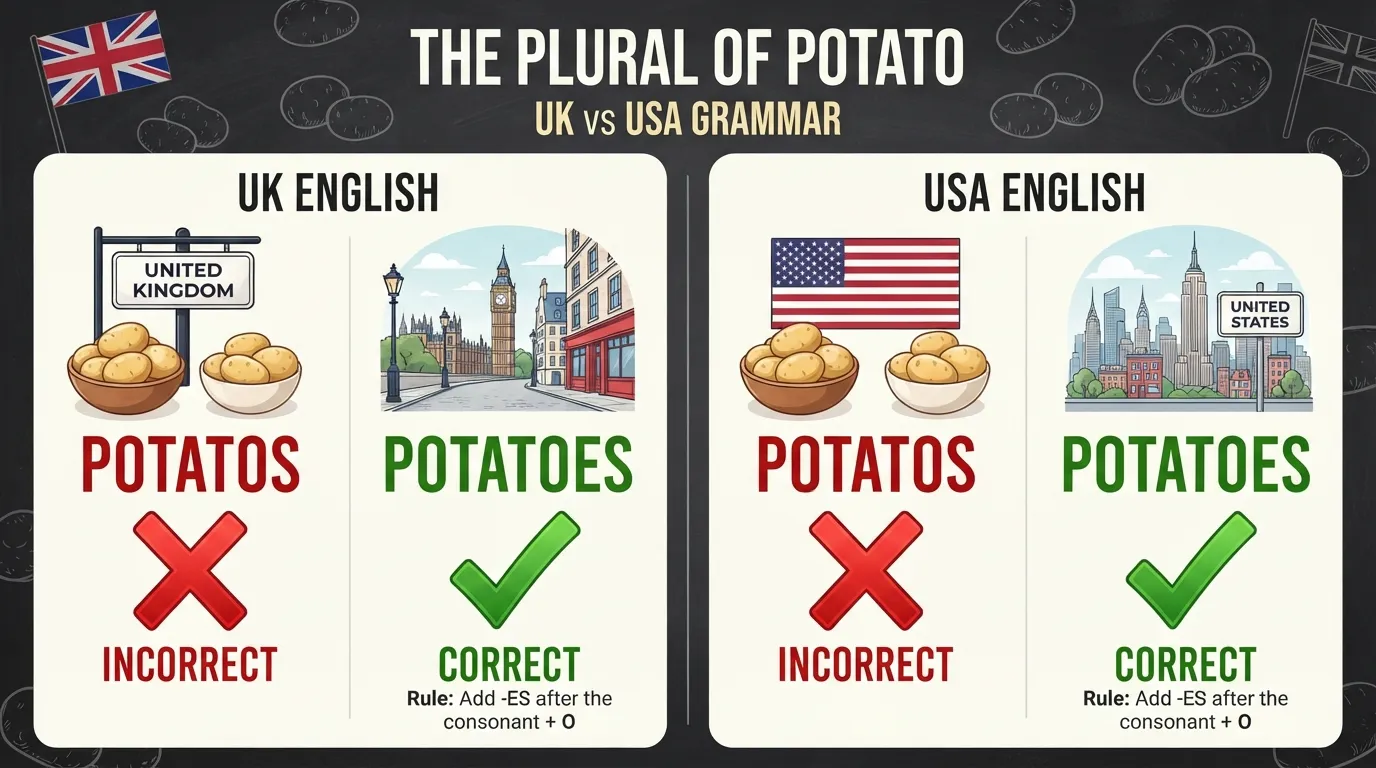
Quick answer: “potatoes” is correct. “Potatos” is always a misspelling.
Here’s why the E matters, and how to remember it for good.
Table of Contents
- Did You Know?
- Quick Answer Box
- Quick Rule in One Line
- The Difference Explained
- Grammar Rule: Nouns Ending in O
- Comparison Table
- Memory Trick
- Example Sentences
- Common Mistakes
- When to Use Each Form
- Expert Tip
- Quick Quiz
- FAQs
- Conclusion
- Key Takeaways
Did You Know? 🔍
This exact mistake once made international news. In 1992, a US vice president famously corrected a student’s correct spelling of “potato” to the incorrect “potato” with an added E, on live television.
The moment became one of the most well-known spelling blunders in American politics.
Quick Answer Box
“Potatoes” is the correct plural spelling of “potato.” “Potatos” is always incorrect, no matter the context.
Most nouns ending in a consonant plus O add “-es” for the plural, and “potato” follows that rule.
⚡ Quick Rule in 1 Line
“Potato plus ES equals potatoes — always, with no exceptions.”
The Difference Explained
“Potato” is a singular noun. Its plural form is “potatoes,” formed by adding “-es” instead of just “-s.”
“Potatos” is simply a misspelling. It’s never correct in any form of English, formal or informal.
This mistake happens because many English plurals just add “-s,” so it’s easy to assume every word follows that pattern.
Grammar Rule: Nouns Ending in O
English has a specific pattern for many nouns ending in a consonant followed by O. These words typically add “-es” in the plural, not just “-s.”
“Potato” becomes “potatoes.” “Tomato” becomes “tomatoes.” “Hero” becomes “heroes.” “Echo” becomes “echoes.”
This rule isn’t universal for every O-ending word. Some, like “photo” and “piano,” simply add “-s”: “photos,” “pianos.” These exceptions often come from words borrowed more recently from other languages, like Italian.
“Potato” firmly follows the “-es” rule, with no accepted exception.
Comparison Table
| Feature | Potatoes | Potatos |
|---|---|---|
| Correctness | Correct plural spelling | Always incorrect |
| Rule followed | Consonant + O takes “-es” | Doesn’t follow standard rule |
| Similar words | Tomatoes, heroes, echoes | — |
| Example | I bought five potatoes at the market. | Never correct in any context |
Memory Trick
Picture the word “potato” needing an extra letter to “grow” into its plural, just like the vegetable grows underground before harvest.
Remember the political spelling mishap: the person who “corrected” a student by adding an E was actually wrong, and the correct spelling really does need that E.
Example Sentences
Using “potatoes” (correct)
- I bought five potatoes at the farmers market.
- Mashed potatoes are a classic side dish.
- The recipe calls for two large potatoes.
- We grew potatoes in the garden this summer.
- She peeled the potatoes before boiling them.
Common Mistakes
❌ Writing “potatos” in any context. ✅ Always using “potatoes” for the plural form.
Assuming all O-ending nouns just add “-s.” ✅ Checking whether the word follows the “-es” pattern, like “potato,” “tomato,” and “hero.”
❌ Second-guessing the correct spelling because of the famous 1992 incident. ✅ Trusting that “potatoes” was correct all along.
When to Use Each Form
Always use “potatoes” when referring to more than one potato. There’s no context, formal or informal, where “potatos” is acceptable.
Expert Tip 💡
If you’re ever unsure about a plural ending in O, check whether it’s a long-established English word (usually “-es,” like “potatoes” and “tomatoes”) or a newer, borrowed word (often just “-s,” like “photos” and “pianos”).
Quick Quiz
- “We need to buy more ___ for dinner.” (potatos / potatoes)
- “The recipe uses three medium-sized ___.” (potatos / potatoes)
Answers: 1. potatoes · 2. potatoes
FAQs
Is “potatos” ever a correct spelling?
No. “Potatoes” is the only correct plural spelling of “potato” in standard English.
Why does “potato” need an E in the plural?
Because it follows the common English rule where nouns ending in a consonant plus O add “-es” in the plural.
Are there other words like “potato”?
Yes, including “tomato” (tomatoes), “hero” (heroes), and “echo” (echoes).
Are there exceptions to this rule?
Yes. Some O-ending nouns, like “photo” and “piano,” only add “-s”: “photos,” “pianos.”
What’s the famous “potato” spelling mistake?
In 1992, a US vice president incorrectly corrected a student’s correct spelling of “potato,” adding an unnecessary E to the singular form during a live event.
Is “potato’s” ever correct?
Only as a possessive, such as “the potato’s skin,” not as a plural. It’s never correct to write “potato’s” to mean more than one potato.
How do you spell the singular form?
The singular is simply “potato,” with no final E.
Does British English spell it differently?
No. “Potato” and “potatoes” are spelled the same way in both American and British English.
Conclusion
“Potatoes” is the only correct plural spelling of “potato.” “Potatos” is never correct, in any context.
The word follows a common English pattern, adding “-es” to nouns ending in a consonant plus O, the same rule that gives us “tomatoes” and “heroes.”
Once you remember the rule, this spelling stops being a guessing game.

Hi, I’m Daniel Carter. I’m passionate about helping learners improve their English with practical grammar tips and clear writing advice.