You’re writing about a surgeon’s schedule.
‘She will preform the operation tomorrow’ or ‘perform’?
One letter changes the entire meaning here.
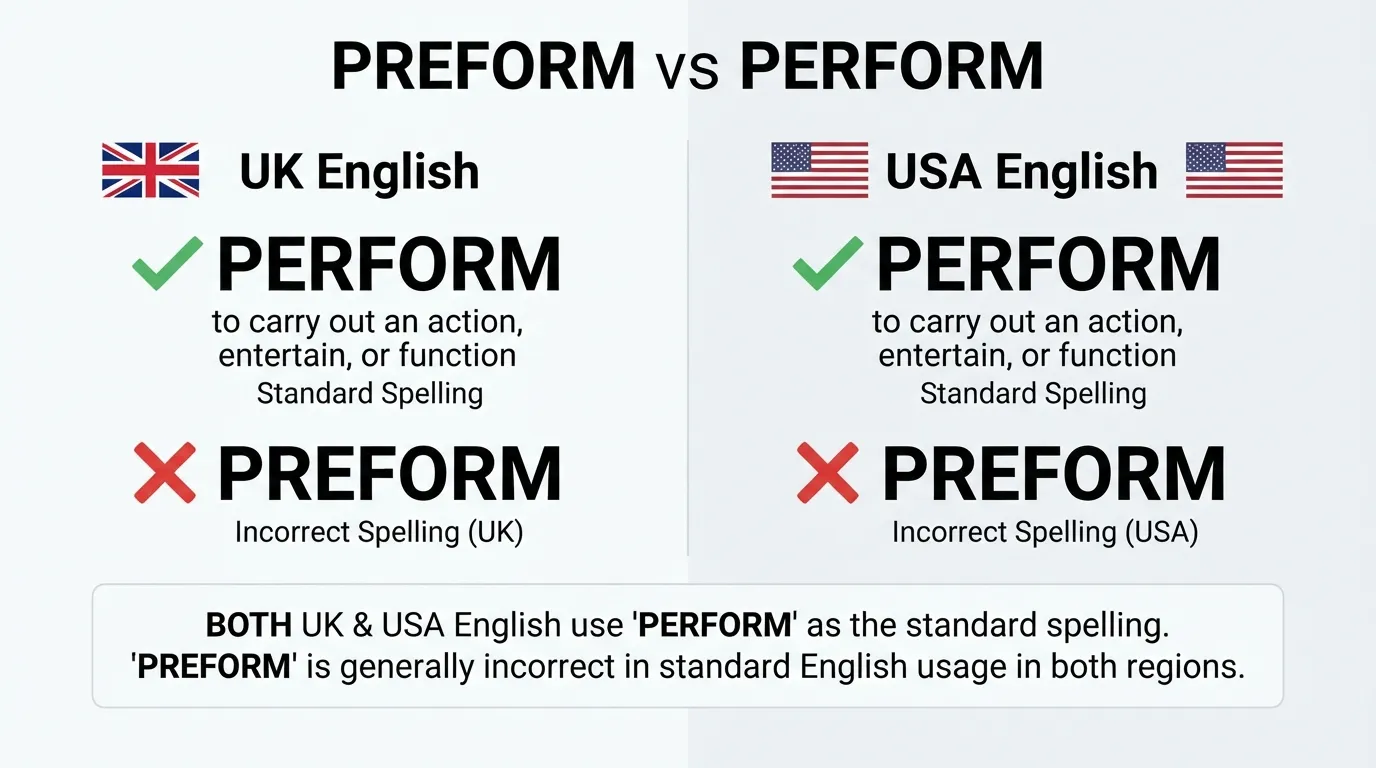
Here’s the quick answer: ‘perform’ means to carry out an action, task, or show.
‘Preform’ means to shape something into a preliminary form before it’s fully finished.
They aren’t interchangeable, even though they look almost identical.
Table of Contents
Did You Know?
Quick Answer Box
Quick Rule in One Line
The Real Difference Explained
Where ‘Preform’ Actually Belongs
Comparison Table
Memory Trick
Example Sentences
Common Mistakes
When to Use Each Form
Expert Tip
FAQs
Conclusion
Key Takeaways
Did You Know? 🔍
‘Perform’ comes from Old French ‘performer,’ combining ‘par-‘ (thoroughly) and ‘fournir’ (to furnish or provide).
‘Preform’ is much newer and more literal, simply combining the prefix ‘pre-‘ (before) with ‘form,’ referring to shaping something ahead of time.
Quick Answer Box
‘Perform’ is the verb you almost always want, meaning to carry out a task, action, or performance.
‘Preform’ is a narrow, mostly technical word meaning to shape or mold something into a preliminary form before final processing.
If you’re describing a person doing a job, a show, or a task, you want ‘perform.’
⚡ Quick Rule in One Line
Perform is doing the task; preform is shaping something in advance, mostly in manufacturing.
The Real Difference Explained
‘Perform’ is a common, everyday verb meaning to carry out, accomplish, or execute an action.
‘The surgeon will perform the operation’ and ‘the band will perform tonight’ both use this everyday sense.
‘Preform,’ by contrast, is a specialized word, mostly used as a noun or verb in manufacturing and technical fields.
A ‘preform’ is the preliminary shape given to a material before it’s fully processed into a finished product.
For example, plastic bottles often start as a small ‘preform’ shape before being blown into their final size.
Where ‘Preform’ Actually Belongs
‘Preform’ shows up almost exclusively in manufacturing, engineering, and some technical or scientific writing.
You’ll see it describing plastic bottle preforms, molded composite preforms, or preliminary shapes in metalworking.
Outside of these specialized contexts, ‘preform’ is essentially never the word you want.
If you catch yourself typing ‘preform’ in a sentence about a person doing a task, a show, or a duty, it should almost always be ‘perform’ instead.
Comparison Table
| Feature | Perform | Preform |
|---|---|---|
| Part of speech | Verb | Noun or verb |
| Meaning | To carry out an action or task | To shape into a preliminary form |
| Common context | Everyday tasks, shows, duties | Manufacturing, technical processes |
| Example | The actor will perform tonight. | The preform is molded before final shaping. |
Memory Trick
Think of the word ‘form’ hiding inside both words, but with different prefixes doing different jobs.
‘Perform’ has ‘per-,’ related to completing something fully, thoroughly carrying it out.
‘Preform’ has ‘pre-,’ meaning before, shaping something ahead of the final step.
If your sentence is about completing a task, think ‘per-‘ for ‘perform.’
Example Sentences
Perform (everyday use):
The surgeon will perform the operation early tomorrow.
The band will perform their new single tonight.
She performs well under pressure.
The lab performs safety checks on every product before shipping.
He was asked to perform his duties as team leader.
Preform (technical use):
The plastic bottle preform is molded before it’s blown into its final shape.
Engineers designed a new composite preform for the aircraft panel.
The preform undergoes additional heating before final processing.
Common Mistakes
❌ ‘She will preform the song at the concert.’
✅ ‘She will perform the song at the concert.’ (an action, not a shaped material)
❌ ‘The team needs to perform the plastic before molding.’
✅ ‘The team needs to preform the plastic before molding.’ (shaping in advance, technical context)
When to Use Each Form
Use ‘perform’ for almost every sentence involving a task, action, duty, or show.
Use ‘preform’ only in manufacturing, engineering, or technical writing, referring to a preliminary shape or the act of creating one.
When in doubt, ‘perform’ is almost certainly the word you need.
Expert Tip 💡
If your sentence has nothing to do with manufacturing, molds, or preliminary shapes, don’t use ‘preform.’ It’s a narrow, specialized word, and ‘perform’ covers the vast majority of everyday writing.
FAQs
Is ‘preform’ a real word?
Yes, but it’s a narrow, technical word used mainly in manufacturing to describe a preliminary shape given to a material before final processing.
What does ‘perform’ mean?
It means to carry out, execute, or accomplish an action, task, or show, such as performing a duty or performing on stage.
Can ‘preform’ ever mean the same as ‘perform’?
No, they have distinct meanings. ‘Perform’ relates to carrying out an action; ‘preform’ relates to shaping something in advance.
Why do people confuse these two words?
Because they look nearly identical and share the root word ‘form,’ making it easy to type one when you mean the other.
Is ‘preform’ used outside of manufacturing?
Rarely. It’s mostly confined to technical and industrial contexts, such as plastic bottle preforms or composite material preforms.
Conclusion
‘Perform’ and ‘preform’ share a root word but serve very different purposes.
‘Perform’ is the everyday verb for carrying out tasks, duties, or performances.
‘Preform’ is a specialized word, mostly limited to manufacturing, describing a preliminary shape before final processing.
For nearly all everyday writing, ‘perform’ is the word you want.
Key Takeaways
‘Perform’ means to carry out an action, task, or show.
‘Preform’ means to shape something into a preliminary form, mostly in manufacturing.
The two words are not interchangeable despite their similar spelling.
Default to ‘perform’ unless you’re specifically discussing a technical, preliminary shape.

Hi, I’m Sophia Bennett. My goal is to make grammar easy, clear, and useful through simple explanations and real-life examples.