You’re writing a grocery list, “buy tomatos for the salad,” and something about that spelling looks off, even though “tomato” alone doesn’t have an E anywhere.
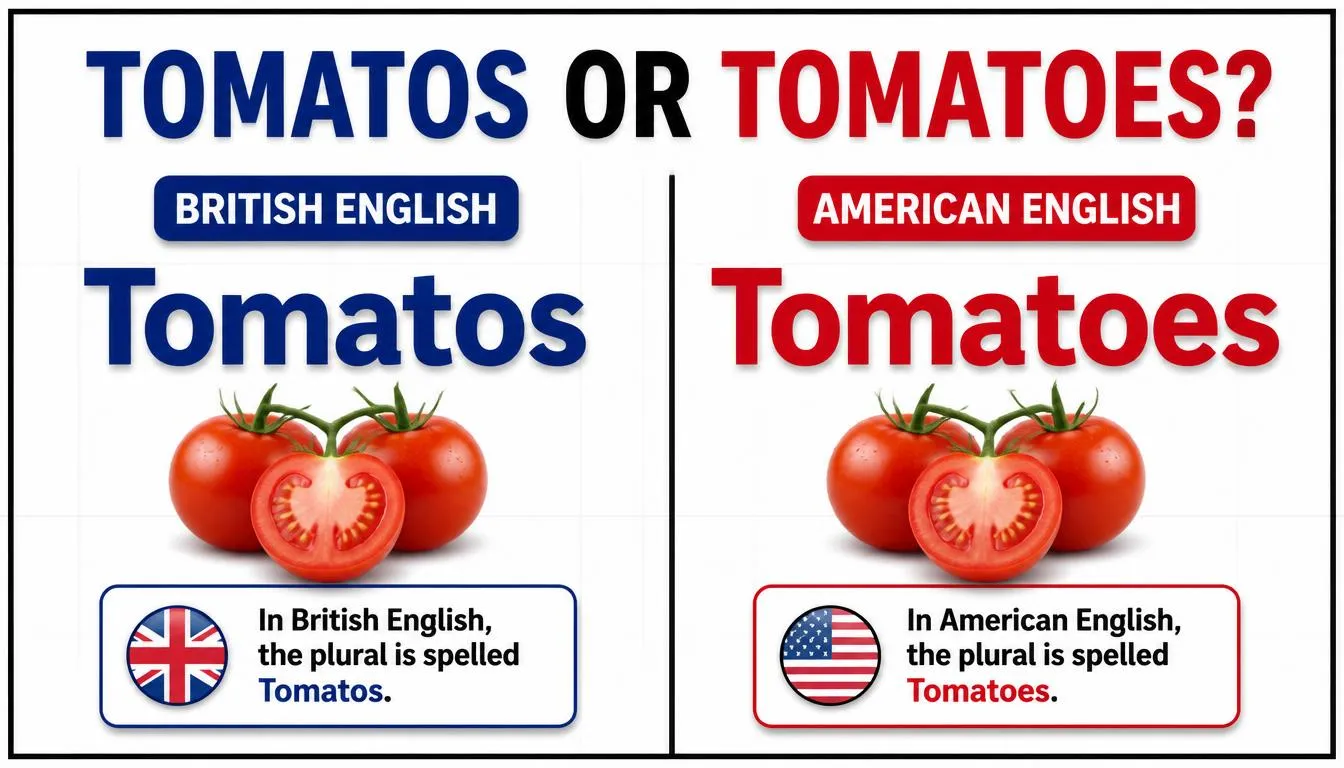
Quick answer: The correct plural is “tomatoes,” with an E before the S. “Tomatos” is a common misspelling, not an accepted alternative.
Table of Contents
- Quick Answer Box
- Quick Rule in One Line
- The Difference Explained
- Grammar Rule: Consonant + O Words
- Comparison Table
- Memory Trick
- Example Sentences
- Common Mistakes
- When to Use Each Form
- Expert Tip
- FAQs
- Conclusion
- Key Takeaways
Quick Answer Box
“Tomatoes” is the only correct plural of “tomato.” It follows a spelling pattern used by many English nouns that end in a consonant plus O, which take “-es” instead of just “-s.”
“Tomatos” is a common mistake, usually from applying the simpler “just add S” rule that works for most other nouns.
⚡ Quick Rule in 1 Line
“Tomato ends in consonant plus O, so the plural always needs -es, not just -s.”
The Difference Explained
Most English nouns form their plural by adding S: cats, books, chairs. That simple pattern doesn’t apply to every word, though.
Nouns ending in a consonant followed by O often take “-es” instead: potato becomes potatoes, hero becomes heroes, echo becomes echoes. “Tomato” follows this same group.
“Tomatos” applies the more common, simpler rule, which is exactly why the mistake happens so often, even to experienced writers.
Grammar Rule: Consonant + O Words
English splits words ending in O into two rough groups.
Words ending in a vowel plus O, like “radio” or “video,” just add S: radios, videos. Words ending in a consonant plus O often need “-es,” including potato, hero, echo, torpedo, and mosquito.
“Tomato” ends in T, a consonant, followed by O. That places it firmly in the “-es” group, alongside its close cousin “potato.”
Comparison Table
| Feature | Tomatoes | Tomatos |
|---|---|---|
| Status | Correct plural | Misspelling |
| Pattern | Consonant + O takes “-es” | Incorrectly applies simple “-s” rule |
| Similar words | potatoes, heroes, echoes | N/A |
| Example | I bought fresh tomatoes. | Not valid in standard English |
| Origin | Nahuatl tomatl, via Spanish tomate | N/A |
Memory Trick
Pair it with its garden neighbor: if potato becomes potatoes, tomato becomes tomatoes the exact same way. The two words are practically twins in the produce aisle and in spelling.
Example Sentences
- She added chopped tomatoes to the sauce.
- We grew tomatoes in the backyard this summer.
- The recipe calls for two cups of diced tomatoes.
- Farmers sold fresh tomatoes at the market.
- I bought a basket of ripe tomatoes yesterday.
- The salad needed more tomatoes and less lettuce.
- Tomatoes are technically a fruit, not a vegetable.
- He sliced the tomatoes thin for the sandwich.
- The soup was made from roasted tomatoes.
- Our garden produced dozens of tomatoes this year.
Common Mistakes
❌ I bought three tomatos at the store. ✅ I bought three tomatoes at the store.
Add sliced tomatos to the salad. ✅ Add sliced tomatoes to the salad.
❌ The farm sells fresh tomatos every Saturday. ✅ The farm sells fresh tomatoes every Saturday.
When to Use Each Form
Always use “tomatoes” for the plural, in recipes, grocery lists, menus, and any other writing. There’s no context, casual or formal, where “tomatos” is considered correct.
Expert Tip 💡
If you write menus, recipes, or food-related content, double-check “tomatoes” before publishing. Misspelled produce names on printed menus are a common, easily avoidable error that can look unprofessional.
FAQs
Is “tomatos” ever an accepted variant?
No. Every major dictionary and style guide treats “tomatoes” as the only correct plural.
Why does “tomato” need an E in the plural if the singular doesn’t have one?
Because it belongs to a group of consonant + O nouns that take “-es” in the plural, even though the singular form doesn’t contain that E.
What other words follow the same pattern as tomatoes?
Potatoes, heroes, echoes, mosquitoes, and torpedoes all follow the same consonant + O, “-es” pattern.
Are there exceptions to this “-es” rule for O words?
Yes. Words ending in a vowel plus O, like “radio” or “piano,” simply add S: radios, pianos.
Is there a difference between American and British English here?
No. Both use “tomatoes” as the standard plural, with no regional variation.
Where does the word “tomato” come from?
It comes from the Nahuatl word “tomatl,” passed into English through the Spanish “tomate” in the 16th century.
How can I remember the correct spelling quickly?
Pair it with “potato”: if you know potatoes has an E, tomatoes follows the identical pattern.
Is “tomatoes” used the same way in singular possessive form?
The singular possessive is “tomato’s” (one tomato’s skin), while the plural possessive is “tomatoes'” (the tomatoes’ color).
Conclusion
“Tomatoes” is the only correct plural spelling, following the same consonant + O pattern as potatoes, heroes, and echoes.
“Tomatos” is a common but avoidable mistake that comes from applying the simpler, more familiar plural rule.
Once you link tomato to potato in your memory, the correct spelling sticks.

Hi, I’m Ethan Brooks. I create easy-to-follow grammar guides, writing tips, and vocabulary resources to make English learning enjoyable for everyone.