Lead is present tense, led is past tense — never spell the past tense as lead.
You proofread your report one more time and stop cold.
“She lead the team to victory.” Something feels off, but you can’t place it.
That sentence needs led, not lead. It’s one of the most common spelling slips in English, and it usually traces back to one sneaky culprit: the metal lead.
Table of Contents
- Quick Answer
- Lead vs Led: The Real Difference
- Past Tense of Lead
- Past Participle of Lead
- Lead-Led-Led: The Irregular Verb Pattern
- Lead’s Three Verb Forms (V1, V2, V3)
- Is Led a Verb? Tenses of Lead Explained
- Led By vs Lead By
- Led By: Synonyms and Alternatives
- To Be Led or To Be Lead
- Led On or Lead On
- Led Astray or Lead Up To: Other Common Phrases
- Feel Led: A Special Idiomatic Use
- Lead or Led in British English (UK)
- How to Spell Lead or Led
- How Do You Pronounce Lead and Led?
- Lead as a Noun (Metal and Guidance)
- Lead as a Noun: Sales Leads, Dog Leads, and Electrical Leads
- Comparison Table
- Memory Trick
- Example Sentences
- Common Mistakes
- When to Use Each Form
- Expert Tip
- Engagement Add-On
- Is Lead Correct or Led?
- Lead and Led Meaning
- Lead vs Lead: Same Spelling, Different Words
- Lead Verb Forms Chart and Conjugation
- Lead or Led After Helping Verbs
- Led To or Lead To?
- Led a Team or Lead a Team?
- Led Me or Lead Me?
- Led By Meaning and Examples
- Led With That, Feel Led, and Easily Led
- Lead, Leads, Leeds, and LEDs
- Verbs That Follow the Same Pattern as Lead
- Led vs Let vs Laid
- Lead and Led Spelling and Common Typos
- Lead or Led in Australia, Canada, and the UK
- Lead Past Tense in Other Languages: Quick Answers
- Led in a Sentence: More Examples
- FAQs
- Conclusion
Quick Answer Box
Led is the correct past tense and past participle of lead.
Present tense: I lead the team. Past tense: I led the team yesterday.
The confusion happens because lead metal is spelled like the present-tense verb but pronounced like led.
Lead vs Led: The Real Difference
Lead, rhyming with seed, is the present tense verb meaning to guide or be in charge.
Led, rhyming with bed, is its past tense and past participle.
This is a classic irregular verb. It doesn’t follow the normal add -ed pattern that turns walk into walked.
The confusion almost always traces back to a different word: the noun lead, the heavy metal.
That noun is spelled exactly like the present-tense verb, but pronounced like led. Writers picture lead in their head, connect it to the bed sound, and mistakenly write lead for the past tense — when led is what they actually mean.
However You Search It, the Answer’s the Same
People type this question in dozens of different ways — lead vs led, led vs lead, lead or led, led or lead, is it led or lead, is it lead or led, lead vs led meaning, lead and led, led and lead, difference between lead and led, led versus lead, led v lead, and every close variation in between (led vd lead, led o lead, lead vs les, leas vs led, and so on).
Whichever way you phrase it, you’re asking the same underlying question, and the answer stays the same: lead is now, led is already happened.
Past Tense of Lead
The past tense of lead is led, never leaded, and never lead spelled the same way twice.
This single answer covers every phrasing of the question, including:
past tense of lead, past of lead, lead past tense, past tense for lead
lead past, lead past form, past form of lead, the past of lead
past tense of lead is led, led is past tense of lead, is led the past tense of lead
to lead past tense, lead in past tense, lead in simple past, lead simple past tense
what is the past tense of lead, define lead past tense
past tense of lead uk, past tense lead uk
the past tense of leads, past tense of leading, and leading past tense.
Past Participle of Lead
The past participle of lead is also led — the same word covers both the simple past tense and the past participle. “I have led this team for five years” uses the past participle form.
This covers past participle of lead, lead past participle, past participle lead, past participle of to lead, past participle of led, led past participle form, and past and past participle of lead.
Lead-Led-Led: The Irregular Verb Pattern
Like many irregular English verbs, lead follows a lead-led-led pattern: base form, past tense, past participle, with the same spelling covering both past forms.
This covers lead led led, lead lead led, led lead led, past tense lead led, to lead led led, lead led, lead led meaning, and lead led past tense.
Lead’s Three Verb Forms (V1, V2, V3)
In grammar terms, lead’s three forms are: V1 (base form) — lead, V2 (past tense) — led, V3 (past participle) — led. Unlike regular verbs, the second and third forms are identical: lead, led, led.
Is Led a Verb? Tenses of Lead Explained
Yes, led is a verb — specifically the past tense and past participle of lead. This answers “is led a verb,” “is led a word,” and “led by” verb meaning.
Present tense: I lead, you lead, they lead. Past tense: I led, you led, they led.
This covers lead present tense, led present tense, present tense of lead, present tense of led, led present form, present form of led, is lead present tense, lead tense, lead tenses, tenses of lead, led in present tense, and led in past tense.
Lead is also classified as an irregular verb, since it doesn’t follow the regular -ed pattern like walk becomes walked. This covers lead irregular verb.
Led By vs Lead By
Use led by for something that already happened, and lead by for an ongoing or present habit. “The team was led by their captain” describes the past; “Great managers lead by example” describes a present, ongoing practice.
This covers led by or lead by, lead by or led by, led by example, lead by example, led by meaning, led by, to be led by, and led from the front, an idiom meaning to lead personally and visibly rather than direct others from a distance.
Led By: Synonyms and Alternatives
If you want to vary your wording instead of repeating ‘led by,’ several alternatives carry a similar meaning, depending on tone.
‘Headed by’ and ‘helmed by’ work well for formal or leadership contexts.
‘Spearheaded by’ suggests a driving force behind an initiative.
‘Overseen by’ emphasizes supervision.
‘Guided by’ or ‘directed by’ work for a softer, less authoritative tone.
Which one fits best depends on whether you want to emphasize authority, initiative, or simple supervision.
To Be Led or To Be Lead
The correct passive form is to be led, not to be lead. This mix-up happens for the same reason as the main verb confusion: lead the metal looks like the present-tense verb but sounds like led.
This covers to be lead or led, to be led or lead, to be led or to be lead, to be led, “I was lead” (should be “I was led”), and “we are being led” meaning.
Led On or Lead On
Led on (past tense) means someone was misled or given false hope, often romantically — “She felt led on by his mixed signals.” Lead on (present tense or imperative) means to go first or take charge of guiding — “Lead on, I’ll follow.”
This covers led on, lead on, led on or lead on, is it lead on or led on, led on meaning, led you on, and lead me on meaning.
Led Astray or Lead Up To: Other Common Phrases
Led astray means someone was guided in the wrong direction, often morally — “He was led astray by bad advice.” Lead up to (or led up to, in the past) means to build toward something over time — “The events that led up to the decision.”
Feel Led: A Special Idiomatic Use
‘I feel led to…’ is a common idiomatic phrase, especially in personal, religious, or reflective writing, meaning someone feels an inner sense of guidance or compulsion to do something, even without a specific external instruction. ‘I felt led to call her that day’ means the speaker sensed an internal pull or prompting, not that anyone literally directed them.
This phrase always uses ‘led,’ never ‘lead,’ since it’s describing something already felt, a completed inner experience, even though the action it prompts may still be in the future.
Lead or Led in British English (UK)
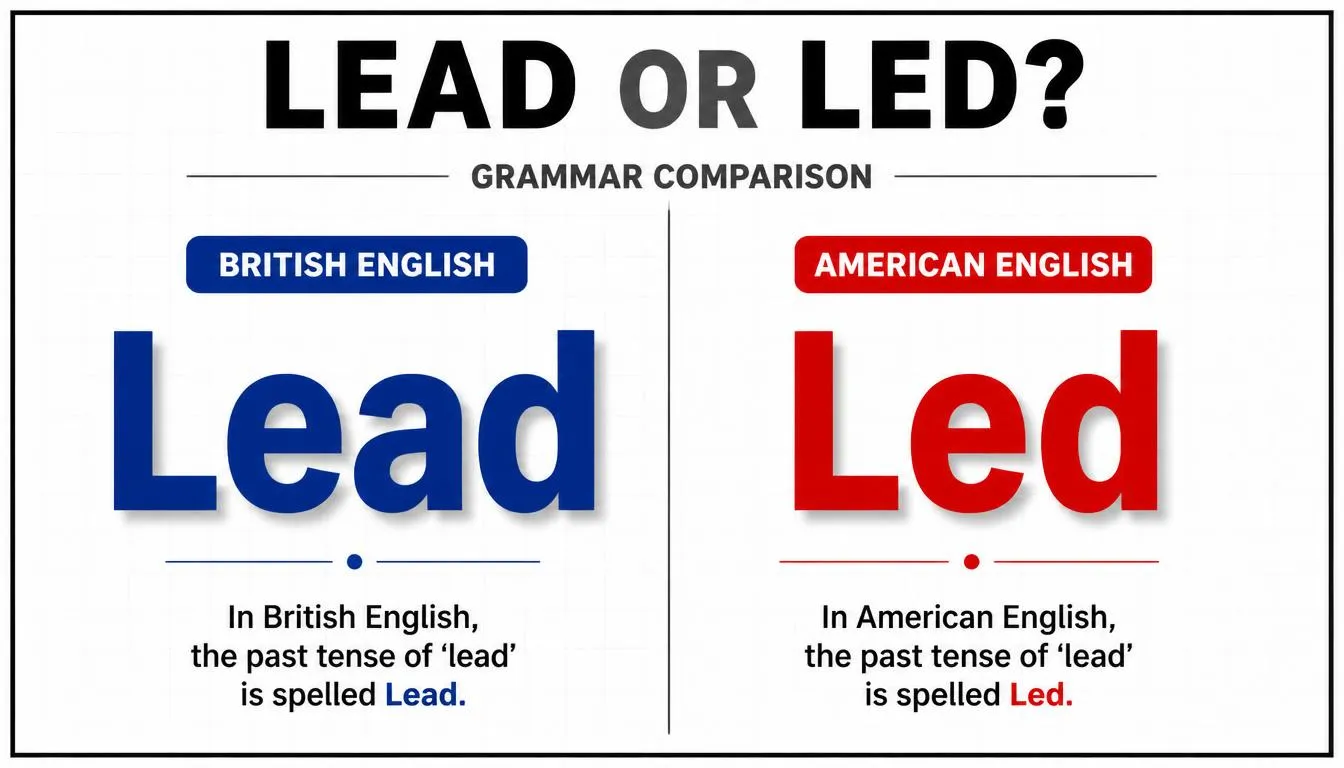
The rule doesn’t change in British English. Led remains the correct past tense of lead in UK English, exactly as in American English, with no regional spelling variation.
This covers led or lead uk, lead or led uk, and led vs lead uk.
How to Spell Lead or Led
Both words are correctly spelled; the challenge isn’t spelling, it’s choosing the right one for the tense you mean. Lead (present tense) is spelled L-E-A-D; led (past tense) is spelled L-E-D, with no extra a.
This covers how to spell lead, how to spell led, how do you spell lead, how do you spell led, how do you spell lead or led, how do you say lead in past tense, how to spell lead past tense, lead spelling, led spelling, spelling of lead, spell lead, spell led, and l-e-d.
Leaded is a real word, but it’s unrelated to the verb’s past tense. It describes something coated or filled with the metal lead, as in leaded gasoline or leaded glass. This covers leaded or led.
How Do You Pronounce Lead and Led?
The verb lead (present tense) is pronounced like “seed.” Led (past tense) is pronounced like “bed.” The noun lead (metal) is also pronounced like “bed,” the same as led.
Lead as a Noun (Metal and Guidance)
Lead also works as a noun in two different ways: as the heavy metal (pronounced like led, as in pencil lead or lead poisoning), and as a word for guidance or a leading position (pronounced like seed, as in “she took the lead”).
This covers pencil lead or led, and clarifies why “lead and lead spelled the same,” “are lead and lead spelled the same,” and “is lead and lead spelled the same” all come up — the noun lead (metal) and the verb lead (to guide) share identical spelling but different pronunciations and completely different meanings.
Lead as a Noun: Sales Leads, Dog Leads, and Electrical Leads
Beyond the metal and the idea of guidance, ‘lead’ has a few more common noun meanings, all pronounced like ‘seed,’ not ‘bed.’ In business, a ‘lead’ is a potential customer or contact, as in ‘the sales team followed up on a new lead.’ In British English, a ‘lead’ is what Americans call a leash, as in ‘keep your dog on a lead.’ In electronics, a ‘lead’ refers to a wire or cable, as in ‘connect the red lead to the battery.’
The plural of all these noun senses is ‘leads,’ not ‘leds.’ This matters because ‘LEDs’ (light-emitting diodes) is a completely different, unrelated word, an acronym for a type of light bulb, and it’s easy to mix the two up in writing since they sound similar.
‘Leads’ (business contacts, leashes, wires) and ‘LEDs’ (light-emitting diodes) have nothing to do with each other.
‘Leads’ can also function as a verb, the third-person singular present tense of ‘lead’: ‘she leads the team,’ ‘he leads by example.’
Comparison Table
| Form | Word | Pronunciation | Example |
|---|---|---|---|
| Present tense | lead | rhymes with seed | I lead the meeting every Monday. |
| Past tense | led | rhymes with bed | I led the meeting yesterday. |
| Past participle | led | rhymes with bed | I have led this team for years. |
| Noun (metal) | lead | rhymes with bed | The pipe was made of lead. |
| Noun (guidance) | lead | rhymes with seed | She took the lead on the project. |
Memory Trick
Say this out loud: “Today I lead, yesterday I led.”
Present tense sounds like reed. Past tense sounds like bed — and it’s spelled without the extra a, just like bed has no extra a either.
Example Sentences
Present tense (lead):
I lead this department.
She always leads by example.
They lead the race right now.
He leads a busy life.
We lead the discussion every week.
Past tense (led):
She led the team to victory last season.
He led the meeting yesterday.
They led the protest in 2023.
I led the project from start to finish.
The coach led the players onto the field.
Scientists led the research for two years.
He had led three companies before this one.
The guide led us through the museum.
I led a group of volunteers last summer, and my co-worker co-led the workshop with me. She led the way through the old city, and he felt led to speak up during the meeting.
The scandal has led to widespread criticism, and this decision has led to real change.
I should have led with the good news first.
Common Mistakes
“She lead the team to victory.” → “She led the team to victory.” This describes something that already happened.
“I have lead this project since January.” → “I should have led this project since January.” Past participles always take led.
Confusing the metal with the past-tense verb. They’re spelled the same but unrelated in origin. Only their sound and spelling overlap.
A separate, unrelated mix-up confuses led with laid, the past tense of the verb lay — a completely different word.
Mixing up ‘leads’ (plural noun, or verb form of lead) with ‘LEDs’ (light-emitting diodes). These are unrelated words that simply sound alike.
When to Use Each Form
Use lead for present tense (I lead), for the noun meaning guidance (take the lead), and for the metal.
Use led only for past tense and past participle forms of the verb (I led, I have led).
Describing something that already happened? It’s almost always led.
Expert Tip 💡
Editing your own writing? Search for every instance of lead and check the surrounding verb tense.
If the sentence describes something that already happened, lead should almost always be led.
Engagement Add-On: Common Misconception
Many writers assume led is a newer, informal shortcut that replaced lead over time.
It’s the opposite. Led has always been the correct historical past tense. Lead is the mistake, one that spreads because the metal shares its spelling.
Is Lead Correct or Led?
Both words are correct. They just belong to different tenses.
Use “led” for the past and “lead” for the present or future.
Should You Use Led or Lead?
Ask yourself whether the action already happened. If it did, use “led.”
If it’s happening now or will happen later, use “lead.”
Lead or Led: A Simple Test
Swap in the word “guide” or “guided.”
If “guided” fits, write “led.” If “guide” fits, write “lead.”
Lead vs Led for Past Tense
For the past tense, only “led” works.
“She led the meeting” is correct. “She lead the meeting” is not.
Lead or Led: Quick Examples
- Today I lead the meeting. Yesterday I led the meeting.
- She leads the team. She led the team last year.
- He will lead the project. He has led the project before.
Lead and Led Meaning
Each word has a clear meaning, and the two are easy to tell apart once you know the tense.
What Does Lead Mean?
As a verb, “lead” means to guide, direct, or be in charge of others.
As a noun, it can mean the heavy metal, a leading position, a sales contact, a dog leash (UK), or a wire.
What Does Led Mean?
“Led” is the past tense and past participle of “lead.”
It means guided, directed, or was in charge of, in the past.
Led Definition and Past Tense Meaning
The definition of “led” is simply “lead” in the past.
So “she led the class” means she guided the class earlier. The same meaning applies to “led” in any past sentence.
Led as in Leading
“Led” is the past of “lead,” as in “leading.”
If you can say “leading” in the present, you’d say “led” in the past.
Is Led a Noun, Preposition, or Abbreviation?
“Led” is a verb, not a noun or a preposition.
“LED,” in capital letters, is an abbreviation for light-emitting diode. Its plural is “LEDs.”
Opposite of Lead
The opposite of “lead” is “follow.”
You can lead a group, or you can follow it.
Lead vs Lead: Same Spelling, Different Words
Some searches ask about “lead vs lead,” and it’s a fair question.
The verb “lead” (to guide) and the noun “lead” (the metal) are spelled the same but are different words.
Why Do They Look the Same?
Words that share spelling but differ in sound and meaning are called heteronyms.
“Lead” is one of them. It has two meanings and two pronunciations.
Lead Pronunciation
- Lead (verb, to guide): LEED, like “seed.”
- Lead (metal): LED, like “bed.”
- Led (past tense): LED, like “bed.”
Lead (the Metal Element)
The Lead is a chemical element with the symbol Pb, from the Latin word “plumbum.”
When you say the element’s name, it sounds exactly like “led.”
Pencil Lead
“Pencil lead” is actually made of graphite, not the metal lead.
It’s still spelled “lead” and pronounced like “led.”
Lead Lead Lead
A sentence can hold all three at once: “She will lead the team, and she took the lead after the lead pipe burst.”
Context tells you which one is which.
Lead Verb Forms Chart and Conjugation
Here are all the forms of the verb “lead” in one place.
| Form | Word | Example |
|---|---|---|
| V1 (base form) | lead | I lead the team. |
| V2 (past tense) | led | I led the team. |
| V3 (past participle) | led | I have led the team. |
| Third-person singular | leads | She leads the team. |
| Present participle | leading | I am leading the team. |
Lead Conjugation by Tense
| Tense | Example |
|---|---|
| Present simple | I lead / she leads |
| Past simple | I led |
| Future simple | I will lead |
| Present perfect | I have led |
| Past perfect | I had led |
| Present continuous | I am leading |
| Past continuous | I was leading |
| Passive future | It will be led |
2nd Form and 3rd Form of Lead
The 2nd form (V2) of “lead” is “led.”
The 3rd form (V3) of “lead” is also “led.”
Is Lead a Regular or Irregular Verb?
Irregular. “Lead” doesn’t take “-ed” in the past, so “leaded” is wrong.
Present Tense of Lead
The present tense is “lead,” or “leads” for he, she, and it.
The present form of “led” is simply “lead.”
Has Led, Have Led, and Had Led
“Have led” and “has led” are the present perfect, like “she has led for years.”
“Had led” is the past perfect, like “he had led two teams before.”
Lead or Led After Helping Verbs
Helping verbs decide which form comes next.
After Do, Did, Will, Can, and To
Use “lead” after these, because they take the base form.
- Do you lead the team?
- Did she lead the meeting?
- He will lead the project.
- They can lead the way.
- I want to lead.
So “do you led” or “did she led” are wrong.
After Have, Has, and Had
Use “led” after these.
“I have led,” “she has led,” and “they had led” are all correct.
“Have lead,” “has lead,” and “could have lead” are mistakes. It’s “could have led” and “would have led.”
After Be (Was, Is, Will Be)
Use “led” for passive sentences.
“I was led,” “the team is led by a captain,” and “it will be led by experts” are all correct.
is He Lead or He Led?
“He led” is correct for the past.
“He leads” is correct for the present.
IS “He lead” is wrong in both cases.
I Lead or I Led?
“I lead” is present.
is “I led” is past.
“Am I lead past tense” is a common search, and the answer is “I led.”
You Can Lead a Horse to Water
In the old saying, “you can lead a horse to water but you can’t make it drink,” “lead” is right because it follows “can.”
In the past, you’d say “he led the horse to water.”
Led To or Lead To?
“Led to” is the past tense. “Lead to” is the present or future.
So you’d say “this led to a problem” yesterday, and “this will lead to a problem” tomorrow.
This Led To or This Lead To?
“This led to” is correct when the result already happened.
“This lead to” is a spelling error in a past sentence.
IS Has Led To or Has Lead To?
“Has led to” is correct. “Has” needs the past participle, “led.”
The same goes for “have led to” and “had led to.”
What Led To and Which Led To
“What led to this?” asks about a cause in the past.
“Which led to” works the same way: “He missed the bus, which led to a late start.”
Led To Meaning
“Led to” means caused or resulted in.
“It led to a promotion” means it caused a promotion.
Led to Believe
“Led to believe” means made to think something.
“I was led to believe the meeting was cancelled” is the correct form.
Led Up To
“Led up to” means built toward something.
“The events that led up to the decision” is correct in the past.
Has the Lead and Has Led
“She has the lead” uses “lead” as a noun, meaning she’s in front.
“She has led” uses the verb, meaning she guided others.
Led a Team or Lead a Team?
Use “led a team” for the past and “lead a team” for the present or future.
“I led a team last year” and “I will lead a team next year” are both correct.
Is a Team Led By or Lead By?
A team is “led by” someone. “Led” is the past participle in a passive sentence.
So “the team is led by a manager” is correct, and “the team is lead by a manager” is not.
Lead by Example
The phrase “lead by example” uses “lead” because it’s a general habit.
In the past tense, it becomes “led by example.”
Led the Meeting and Led the Project
- I led a meeting this morning.
- She led the project from the start.
- He led the class through the exercise.
- They led the effort to raise funds.
- We led the charge on the new plan.
If you “led successfully,” it means you guided something with good results.
Team Lead
“Team lead” is a job title, and “lead” is a noun here.
It’s said like “seed,” not like “bed.”
Student-Led and Instructor-Led
“Student-led” and “instructor-led” are correct adjectives.
“Student lead” and “instructor lead” are common mistakes.
Co-Led or Co-Lead
“Co-led” is the past tense, as in “we co-led the workshop.”
“Co-lead” is the present tense or the noun, as in “she’s a co-lead on the project.”
Led the Way or Lead the Way
“Led the way” is past, and “lead the way” is present or an instruction.
“She led the way” means she went first earlier.
Led Me or Lead Me?
Use “led me” for the past and “lead me” for the present or a request.
“He led me to the door” is past. “Please lead me to the door” is a request.
Led Us, Led You, and Led Them
- She led us to the exit.
- It led you to the answer.
- I led them to the room.
“Lead us” and “lead them” only work in the present or in a command.
Led Me On
“Led me on” means gave me false hope.
The “Led you on” works the same way, and “lead me on” is a present or imperative form.
Led Astray and Lead You Astray
“He led me astray” is the past tense.
“Don’t lead you astray” doesn’t sound right. The usual form is “he might lead you astray.”
Led Back, Led Into, Led Away, and Led Along
- Led back: guided back to a place
- Led into: guided into a room, or caused to do something
- Led away: taken away
- Led along: guided, or deceived over time
Led By Meaning and Examples
The “Led by” means guided or directed by someone.
If a project is “led by” Sara, Sara is in charge.
Led By Examples
- The expedition was led by a local guide.
- The meeting was led by the CEO.
- The study was led by two researchers.
Lead by Example in the Past Tense
The past tense of “lead by example” is “led by example.”
Led By in Tagalog
In Tagalog, “led by” can be translated as “pinamunuan ni” or “pinangunahan ng.”
Led By or Lead By in the UK
British English follows the same rule: “led by” for the past, “lead by” for the present.
Led With That, Feel Led, and Easily Led
A few phrases use “led” in less obvious ways.
Led With That
“Led with that” means started with that.
“You should have led with that” means you should have started with it.
Lead With or Led With
“Lead with” is present or a command, like “lead with your strengths.”
“Led with” is past, like “I led with the good news.”
Feel Led or Feel Lead?
It’s “feel led” and “felt led.”
“I feel led to help” is correct, and “I feel lead to help” is not.
We Are Led and We Are Being Led
Are “We led” means someone guides us.
“We are being led” says the guiding is happening right now.
Easily Led
“Easily led” means easily influenced.
“He is easily led” describes someone who follows others without much thought.
Will Be Led
For the future passive, it’s “will be led.”
So “will be lead” is wrong, and “will be led by” is right.
Lead, Leads, Leeds, and LEDs
These look and sound alike, so they get mixed up.
Leads or Leds?
“Leads” is the verb form for he, she, and it, and the plural noun.
“Leds” isn’t a standard word. For the light bulbs, it’s “LEDs.”
Leeds or Leads?
“Leeds” is a city in England. It’s a proper noun.
“Leads” is the common word. They sound alike but mean different things.
Past Tense of Leads and Leading
The past tense of “leads” is “led,” and the past of “leading” is also “led.”
How Do You Spell Leads?
Leads is spelled L-E-A-D-S.
Fully Leaded
“Leaded” means containing the metal lead.
“Fully leaded” usually describes something that has lead in it, like leaded fuel or leaded glass.
What Are the Three Types of Leads?
Three common types are sales leads (potential customers), leads in the UK sense of dog leashes, and electrical leads (wires).
Verbs That Follow the Same Pattern as Lead
“Lead” isn’t alone. Several verbs shorten the vowel in the past tense.
| Present | Past | Past participle |
|---|---|---|
| lead | led | led |
| bleed | bled | bled |
| feed | fed | fed |
| speed | sped | sped |
| breed | bred | bred |
| mislead | misled | misled |
“Read” is a bit different. It’s spelled the same in the past, but pronounced like “red.”
Led vs Let vs Laid
Three similar words get mixed up.
Led or Let
“Led” is the past of “lead.” “Let” means to allow.
“Let” is spelled the same in all its forms: let, let, let.
Led or Laid
“Led” is the past of “lead.” “Laid” is the past of “lay.”
You led a team, but you laid a book on the table.
Led or Leaf
“Led” is a verb form, and “leaf” is part of a plant. They’re unrelated.
Lead and Led Spelling and Common Typos
Spell them letter by letter to avoid slips.
- Lead: L-E-A-D
- Led: L-E-D
- Leads: L-E-A-D-S
Common Typos
Fast typing creates plenty of misspellings of “lead” and “led.”
- Leed, leas, les, lef, lea
- Kead, elad, ked, ld
- Leaded (when you mean “led”)
- Lead past tens, past tence of lead, past temse of lead, pasttense of lead
If you searched “lead cs led,” “led pr lead,” or “led bs lead,” you probably meant “lead vs led.”
Lead or Led in Australia, Canada, and the UK
The rule is the same everywhere.
In Australia, Canada, the UK, and the US, “led” is the past tense of “lead.”
Lead Past Tense in Other Languages: Quick Answers
Many readers search this in their own language. The answer is the same: the past tense of lead is led.
- Spanish: El pasado de lead es led. En pasado simple y participio: led.
- Portuguese: O passado de lead é led.
- Italian: Il passato di to lead è led.
- German: Die Vergangenheit von lead ist led (Simple Past).
- Polish: Czas przeszły od lead to led.
- Hungarian: A lead múlt ideje led.
- Turkish: Lead’in geçmiş zaman hali led’dir. Lead şimdiki zaman, led geçmiş zamandır.
- Chinese (simplified): lead 的过去式是 led。
- Chinese (traditional): lead 的過去式是 led。
- Korean: lead의 과거형은 led입니다.
- Arabic: ماضي lead هو led.
- Persian: گذشته lead میشود led.
- Indonesian: Bentuk lampau dari lead adalah led. Led adalah verb ke-3 (V3).
- Lithuanian: Lead — esamasis laikas, led — būtasis laikas.
- Roman Urdu / Hindi: Lead ka past tense led hota hai.
Led in a Sentence: More Examples
Here are a few more sentences with “led.”
- She led the class through the exercise.
- He led them to the water.
- The guide led us along the trail.
- I led my team to a win.
- The path led back to the village.
- A series of events led to the change.
- They led the group away.
- He was led into the room.
FAQs
Is it lead or led in the past tense?
Led is always correct for past tense. Lead only works for present tense or as a noun.
Why do people confuse lead and led?
The metal lead is spelled like the present-tense verb but pronounced like led. That creates visual confusion.
How do you pronounce lead the verb vs lead the metal?
The verb rhymes with seed. The metal rhymes with bed — same sound as the past-tense verb led.
Is leaded ever correct?
No. Lead is irregular, so its past tense is led, not leaded. (Leaded only shows up in compound terms like leaded gasoline, referring to the metal.)
What is the past participle of lead?
Led, same as the simple past tense. Example: “I have led this team for five years.”
Is lead a regular or irregular verb?
Irregular. The past tense changes the vowel sound and spelling entirely, unlike regular -ed verbs.
Can lead ever be correct in past tense sentences?
No. A completed past action always calls for led.
What’s a simple way to remember the rule?
“Today I lead, yesterday I led.” Say it aloud and match the spelling to the sound.
Is it led by or lead by example?
Both are correct depending on the tense. Lead by example describes an ongoing habit; led by example describes something already done.
Is led or lead different in British English?
No, the rule is identical in both American and British English. Lead is always the past tense.
Is led on the same as lead on?
No. Led on (past) means someone was misled or given false hope. Lead on (present or imperative) means to go first or guide the way.
What’s the difference between the verb lead and the noun lead (metal)?
They’re spelled identically but pronounced differently. The verb lead rhymes with seed; the noun lead (metal) rhymes with bed, same as led.
Is to be lead or to be led correct?
To be led is correct. To be lead is a common misspelling caused by the metal’s identical spelling to the present-tense verb.
Is led a valid Scrabble word?
Yes — led is an accepted three-letter word in Scrabble and other word games.
What does “I feel led to” mean?
It means someone senses an internal prompting or guidance to do something, often used in personal or reflective writing. It always uses “led,” describing a feeling that’s already occurred.
Is “led” the same as “laid”?
No. “Led” is the past tense of “lead” (to guide). “Laid” is the past tense of “lay” (to place something down). They’re unrelated words that happen to sound similar.
What’s a synonym for “led by”?
Depending on context, alternatives include “headed by,” “helmed by,” “spearheaded by,” “overseen by,” and “directed by.”
Are “leads” and “LEDs” the same word?
No. “Leads” refers to business contacts, leashes (UK), electrical wires, or the verb form of “lead.” “LEDs” is an acronym for light-emitting diodes, an unrelated type of light bulb. They simply sound alike.
People Also Ask
Is lead correct or led?
Both are correct words. Use “led” for the past and “lead” for the present or future.
Is it led or lead a team?
Use “led a team” for the past and “lead a team” for the present or future. For example, “she led a team last year” and “she will lead a team next year.”
Should you use led or lead?
Use “led” when the action already happened and “lead” when it’s happening now or later.
Is a team lead by or led by?
A team is “led by” someone. “Led” is the past participle, and “lead by” only appears in phrases like “lead by example.”
More Questions About Lead and Led
What is the past tense of lead?
The past tense of lead is “led.”
What is the present tense of led?
The present tense is “lead,” or “leads” for he, she, and it.
Is led the past tense of lead?
Yes. “Led” is both the past tense and the past participle of “lead.”
Is lead past or present tense?
“Lead” is present tense. It’s never the past tense of the verb.
What are the three forms of lead?
They are lead (V1), led (V2), and led (V3).
What is the 2nd form of lead?
The 2nd form is “led.”
What is the 3rd form of lead?
The 3rd form is also “led.”
Is led a verb?
Yes. “Led” is the past tense and past participle of the verb “lead.”
Is led a noun?
No. “LED,” in capitals, is a noun meaning light-emitting diode, but “led” is a verb.
Is led a preposition?
No. “Led” is a verb form, not a preposition.
Is led a real word?
Yes. It’s the standard past tense of “lead.”
What does lead mean?
“Lead” means to guide or be in charge. As a noun, it can also mean a metal, a lead position, or a sales contact.
What does led mean?
“Led” means guided or directed in the past.
What does “led by” mean?
“Led by” means guided or directed by someone.
Is it “led to” or “lead to”?
Use “led to” for the past and “lead to” for the present or future.
Is it “has led to” or “has lead to”?
It’s “has led to.”
Is it “led me” or “lead me”?
Use “led me” for the past and “lead me” for the present or a request.
Is it “led on” or “lead on”?
“Led on” is past, and “lead on” is present or a command.
Is it “led with that” or “lead with that”?
“I led with that” is past. “Lead with that” is a present command.
Is it “student-led” or “student lead”?
It’s “student-led.”
Is it “co-led” or “co-lead”?
“Co-led” is past tense, and “co-lead” is present tense or a noun.
Is it “easily led” or “easily lead”?
It’s “easily led.”
Is it “did she lead” or “did she led”?
It’s “did she lead.”
Is it “could have led” or “could have lead”?
It’s “could have led.”
Is it “I feel led” or “I feel lead”?
It’s “I feel led.”
What is the opposite of lead?
The opposite of “lead” is “follow.”
What is the plural of lead?
The plural noun is “leads.”
Is “leads” a verb?
Yes. It’s the form used with he, she, and it, as in “she leads.”
What is the past tense of leads?
The past tense of “leads” is “led.”
What is the past tense of leading?
The past of “leading” is “led.”
What is the past tense of lead in British English?
It’s “led,” exactly as in American English.
Is lead and lead the same word?
No. They’re spelled the same but have different meanings and sounds. They’re called heteronyms.
How do you pronounce lead?
The verb is LEED, like “seed.” The metal is LED, like “bed.”
Is lead (the metal) pronounced like led?
Yes, the metal lead sounds like “led.”
Is pencil lead made of lead?
No. Pencil “lead” is made of graphite, though it’s spelled “lead.”
Led or let?
“Led” is the past tense of “lead.” “Let” means to allow.
Lead ka past tense kya hai?
Lead ka past tense “led” hai.
Led aur lead mein kya farq hai?
“Lead” present tense hai aur “led” past tense hai.
Conclusion
Lead is present tense. Led is past tense.
The metal lead is the real reason so many writers mix them up. Separate the metal from the verb in your head, and the rule becomes automatic: if it already happened, it’s led.

Hi, I’m Olivia Harper. I love turning complex English grammar into simple, practical lessons that help readers write and speak with confidence.