You wrote “the wine really complements the meal,” then a friend asked if you meant to say something nice about the food instead.
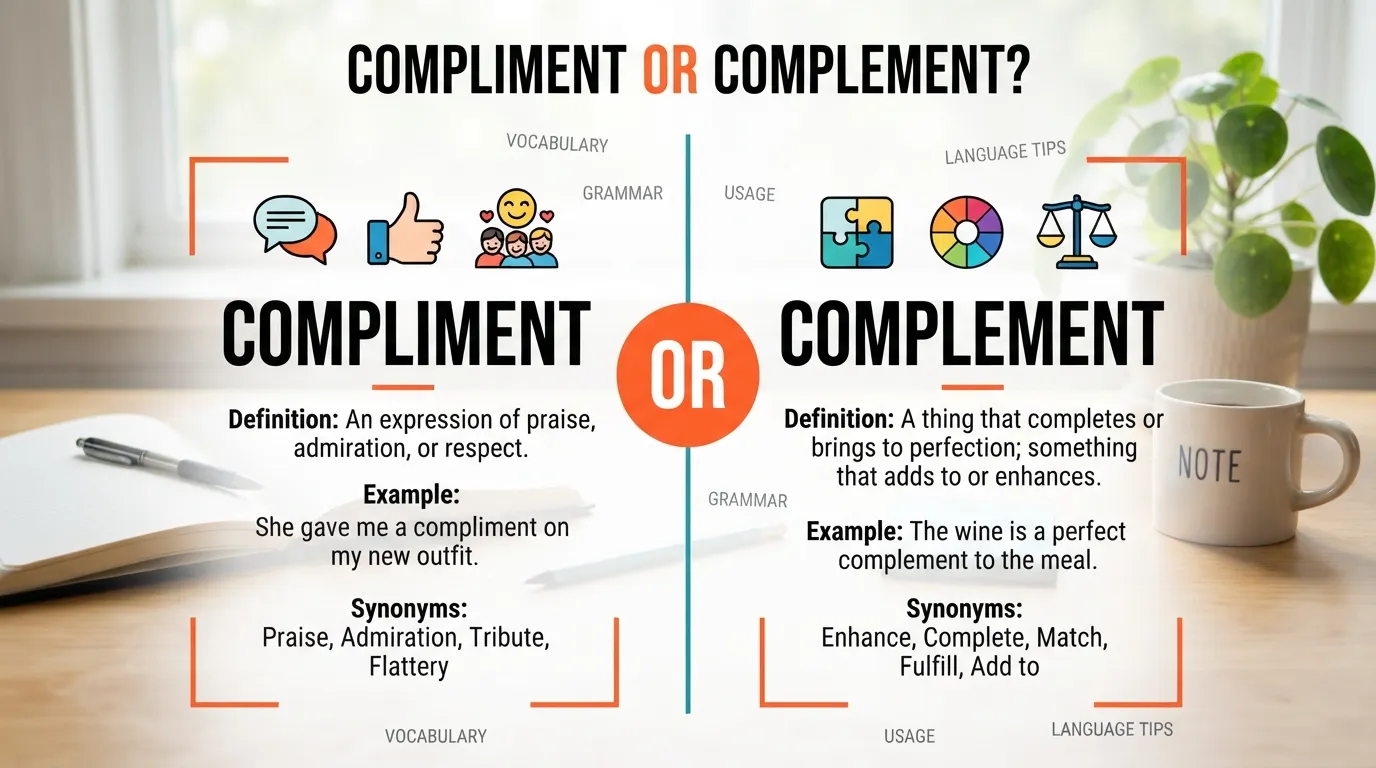
Here’s the quick fix: compliment means to praise someone, while complement means to complete or go well with something.
These words are pronounced exactly the same, which is why they’re constantly swapped in writing.
Once you separate “praise” from “completion,” this word pair becomes easy to use correctly every time.
Quick Answer
Compliment means to say something nice or praise someone (“She gave me a compliment on my work”).
Complement means to complete, enhance, or go well with something (“The scarf complements her outfit”).
They’re pronounced identically but have completely unrelated meanings.
⚡ Quick Rule
Compliment praises a person; complement completes or enhances something — praise versus completion.
Compliment vs Complement: The Core Difference
“Complement” refers to something that completes, enhances, or pairs well with something else.
“Compliment” refers to an expression of praise, admiration, or approval directed at someone.
Say “He gave her a compliment on her speech” (praise), versus “The tie complements his suit” (enhances or completes the look).
This praise-versus-completion distinction is the entire foundation for using these words correctly.
Grammar Rule Explained
Both words can function as either a noun or a verb, but their meanings never overlap.
As a noun: “She received many compliments” (praise) versus “The sauce is a nice complement to the dish” (enhancement).
As a verb: “He complimented her cooking” (praised) versus “The colors complement each other” (go well together).
Neither spelling is grammatically wrong — the correct choice always depends entirely on meaning, not sentence structure.
Compliment vs Complement Comparison Table
| Feature | Compliment | Complement |
|---|---|---|
| Meaning | Praise or admiration | Something that completes or enhances |
| Part of speech | Noun or verb | Noun or verb |
| Example | She paid me a compliment. | The scarf complements her dress. |
| Common context | Kind words, flattery | Design, pairing, completion |
Memory Trick
Remember: “Compliment” has an “I” in it, just like the word “praIse” — think of giving someone a nice “I like you” moment.
“Complement” has an “E,” just like “complEte” — think of something that completes or fills a gap.
If the sentence involves saying something nice, use compliment. If it involves completing or pairing well, use complement.
Real Example Sentences
Using Compliment:
- She gave him a compliment on his presentation.
- Thank you for the kind compliment.
- He complimented her on her new haircut.
- Receiving compliments always makes her smile.
- The chef complimented the waiter’s suggestion.
Using Complement:
- The red wine complements the pasta perfectly.
- Her shoes complement her outfit nicely.
- The two colors complement each other well.
- This course complements the main program of study.
- The new hire’s skills complement the existing team.
Complementary or Complimentary? The Adjective Forms
“Complimentary” means either “given for free” or “expressing praise,” as in “complimentary breakfast” or “complimentary remarks.”
“Complementary” means “completing or enhancing something,” as in “complementary colors” or “complementary skills.”
Notice that “complimentary” has two distinct meanings, while “complementary” sticks to the single idea of completion or enhancement.
Example: “The hotel offered a complimentary breakfast” (free) versus “Blue and orange are complementary colors” (they pair well together).
Common Mistakes
1. Using “complement” instead of “compliment” for praise Incorrect: She gave me a nice complement on my work. Correct: She gave me a nice compliment on my work.
2. Using “compliment” instead of “complement” for completion Incorrect: The wine really compliments the meal. Correct: The wine really complements the meal.
3. Confusing “complimentary” (free) with “complementary” (completing) Incorrect: The hotel offered a complementary breakfast. Correct: The hotel offered a complimentary breakfast.
4. Assuming both words are spelled the same everywhere The only difference is one letter, “i” versus “e,” but it completely changes the meaning.
When to Use Each Word
Use Compliment When:
- Praising or admiring someone
- Giving or receiving kind words
- Describing flattering feedback
Examples: pay a compliment, compliment her dress, backhanded compliment
Use Complement When:
- Describing something that completes or enhances
- Discussing pairing, design, or balance
- Referring to skills or qualities that work well together
Examples: complement each other, complementary skills, perfect complement
FAQs
What’s the difference between compliment and complement?
Compliment means to praise someone. Complement means to complete or enhance something. They’re pronounced the same but mean different things.
How do I remember which spelling to use?
“Compliment” has an “I,” like “I like you.” “Complement” has an “E,” like “complete.”
Is “complimentary” always about being free?
No, “complimentary” can mean either free (complimentary drinks) or expressing praise (complimentary remarks).
What does “complementary colors” mean?
It refers to colors that pair well together or enhance each other visually, like blue and orange.
Can “compliment” be used as a verb?
Yes, “to compliment” means to praise someone, as in “He complimented her presentation.”
Can “complement” be used as a verb?
Yes, “to complement” means to complete or enhance something, as in “The shoes complement the dress.”
Is this a regional spelling difference, like color and colour?
No, this isn’t a US/UK spelling variation — both words exist with distinct meanings in all English-speaking regions.
What’s a simple test to choose the right word?
Ask yourself: am I praising someone, or describing something that completes another thing? That answer decides the correct spelling.
Conclusion
Compliment and complement sound identical, but their meanings couldn’t be more different.
Compliment means to praise; complement means to complete or enhance.
Remember the “I” for praise and the “E” for completion, and you’ll always choose the correct word.

Hi, I’m Olivia Harper. I love turning complex English grammar into simple, practical lessons that help readers write and speak with confidence.