You wrote “either of them are coming,” and your grammar checker flagged it — but you weren’t sure what to fix.
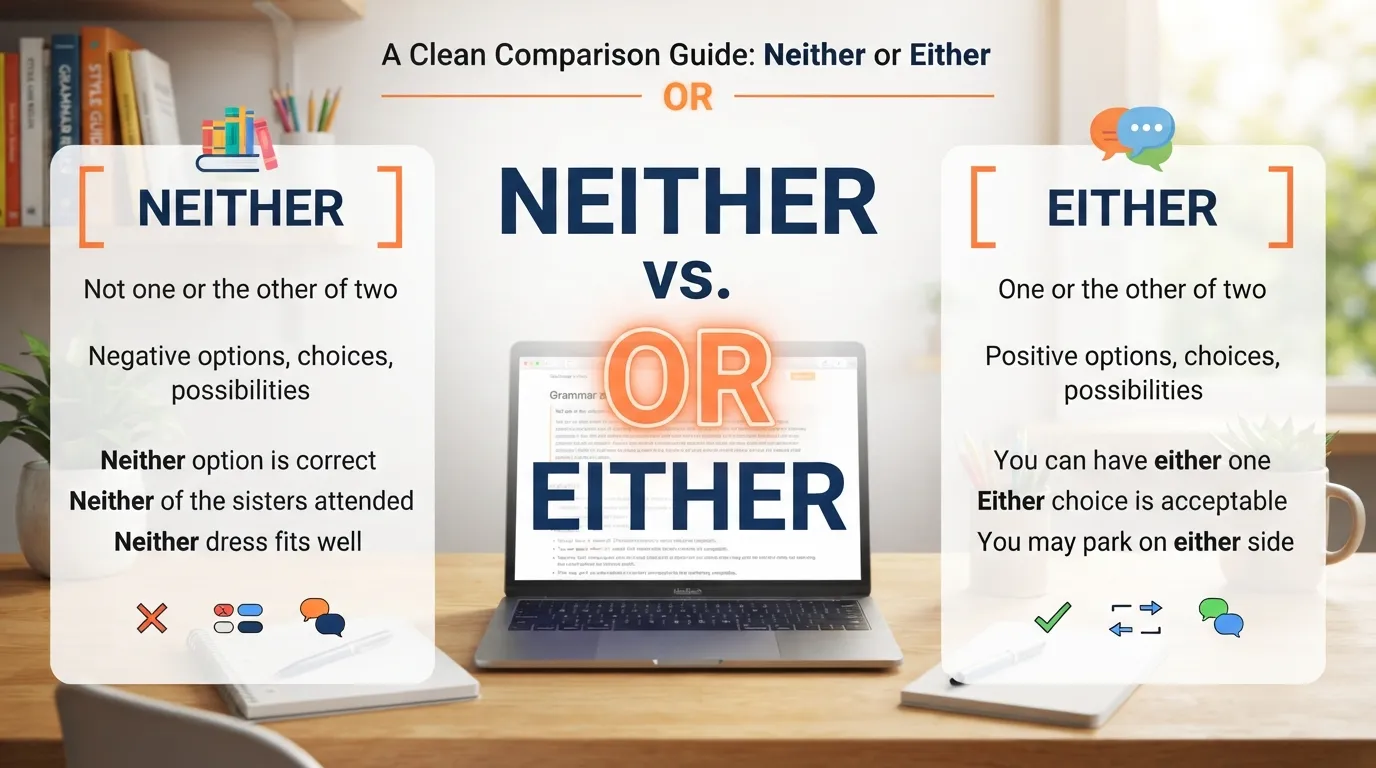
Here’s the quick answer: either means “one or the other” out of two choices, and neither means “not one and not the other.”
Both words deal with two options, but they point in opposite directions — one says yes to a choice, the other says no to both.
Once you see the pattern, verb agreement with these words becomes far less confusing.
Quick Answer
Either means one option or the other, out of exactly two (“Either option works for me”).
Neither means not one and not the other, out of exactly two (“Neither option works for me”).
Both words typically pair with singular verbs, even though they often refer to two things at once.
⚡ Quick Rule
Either picks one of two; neither rejects both — and both usually take a singular verb.
Neither vs Either: The Core Difference
“Neither” is used to reject both options, meaning not one of them applies or is chosen.
Say “Either coffee or tea is fine” (a choice), versus “Neither coffee nor tea is fine” (rejecting both).
This choose-versus-reject distinction is the entire foundation for understanding these two words.
Grammar Rule: Neither…Nor and Either…Or
“Either” pairs with “or” to present two positive options: “Either Monday or Tuesday works.”
“Neither” pairs with “nor” to reject two options together: “Neither Monday nor Tuesday works.”
Never mix these pairings — avoid “either…nor” or “neither…or,” since each word has its own dedicated partner.
Keeping “either/or” and “neither/nor” as fixed pairs prevents one of the most common grammar mistakes with these words.
Verb Agreement with Neither and Either
When “either” or “neither” is the subject of a sentence, the verb is usually singular, even though two things are involved.
Correct: “Neither of the books is available.” Incorrect: “Neither of the books are available.”
Correct: “Either answer is acceptable.” Incorrect: “Either answer are acceptable.”
This singular-verb rule often feels unnatural in speech, but it remains the standard rule in formal writing.
Neither vs Either Comparison Table
| Feature | Either | Neither |
|---|---|---|
| Meaning | One of two options | Not one, not the other |
| Pairs with | or | nor |
| Verb agreement | Usually singular | Usually singular |
| Positive or negative | Positive (choice exists) | Negative (choice rejected) |
| Example | Either day works | Neither day works |
Memory Trick
Remember: “Either” sounds like “I ther,” picture picking one thing — a positive choice.
“Neither” starts with “N,” like “No,” picture rejecting both — a negative answer.
If the sentence feels like “yes, one of these,” use either. If it feels like “no, none of these,” use neither.
Real Example Sentences
Using Either:
- Either color looks great on you.
- You can choose either option for dessert.
- Either way, we’ll figure it out.
- Either of them could win the race.
- I’ll take either seat, it doesn’t matter.
Using Neither:
- Neither answer was correct.
- Neither of us wanted to leave early.
- Neither the manager nor the staff knew the answer.
- Neither option fits our budget.
- Neither of the plans worked out.
Neither of Us or Either of Us? Neither Am I or Neither Do I?
“Neither of us” and “either of us” both refer to two people, and both typically take a singular verb: “Neither of us is ready,” not “are ready.”
“Neither am I” is used to agree with a negative statement, as in “I don’t like coffee.” “Neither am I.”
“Neither do I” works the same way with action verbs: “I don’t drive.” “Neither do I.”
Both phrases show agreement with something negative — never use them to agree with a positive statement.
Common Mistakes
1. Mixing either/or with neither/nor Incorrect: Either the manager nor the staff knew. Correct: Neither the manager nor the staff knew.
2. Using a plural verb with either or neither Incorrect: Neither of the answers are right. Correct: Neither of the answers is right.
3. Using “neither” for more than two options Incorrect: Neither red, blue, or green worked. Correct: None of the colors — red, blue, or green — worked.
4. Confusing “neither am I” with agreeing to a positive statement Incorrect: “I love pizza.” “Neither do I.” Correct: “I love pizza.” “So do I.”
When to Use Each Word
Use Either When:
- Presenting a choice between two options
- Both options are acceptable
- Pairing with “or”
Examples: either way, either option, either day
Use Neither When:
- Rejecting both of two options
- Neither choice applies
- Pairing with “nor”
Examples: neither option, neither answer, neither choice
FAQs
Is it “either is” or “either are”?
“Either is” is correct in formal writing, since “either” typically takes a singular verb.
Is it “neither is” or “neither are”?
“Neither is” is correct in formal writing, following the same singular-verb rule as “either.”
Can I use “neither” for more than two things?
No, “neither” is reserved for exactly two options. Use “none” for three or more.
What’s the difference between “either…or” and “neither…nor”?
“Either…or” presents two positive options. “Neither…nor” rejects both options together.
Is “neither am I” the same as “me neither”?
They mean the same thing, but “neither am I” is more formal, while “me neither” is casual and common in speech.
Can “either” mean “both” in some sentences?
Yes, in phrases like “on either side of the road,” “either” can mean “each” or “both,” rather than “one of two.”
Is it correct to say “neither of them are”?
In casual speech, this is common, but formal grammar prefers “neither of them is.”
Why do “either” and “neither” usually take singular verbs?
Because grammatically, they refer to one item at a time out of the pair, even though two things are being discussed.
Conclusion
Either and neither both deal with choices between two things, but they point in opposite directions.
Either offers a positive choice; neither rejects both options entirely.
Remember to pair “either” with “or,” “neither” with “nor,” and use singular verbs with both for correct formal writing.

Hi, I’m Olivia Harper. I love turning complex English grammar into simple, practical lessons that help readers write and speak with confidence.