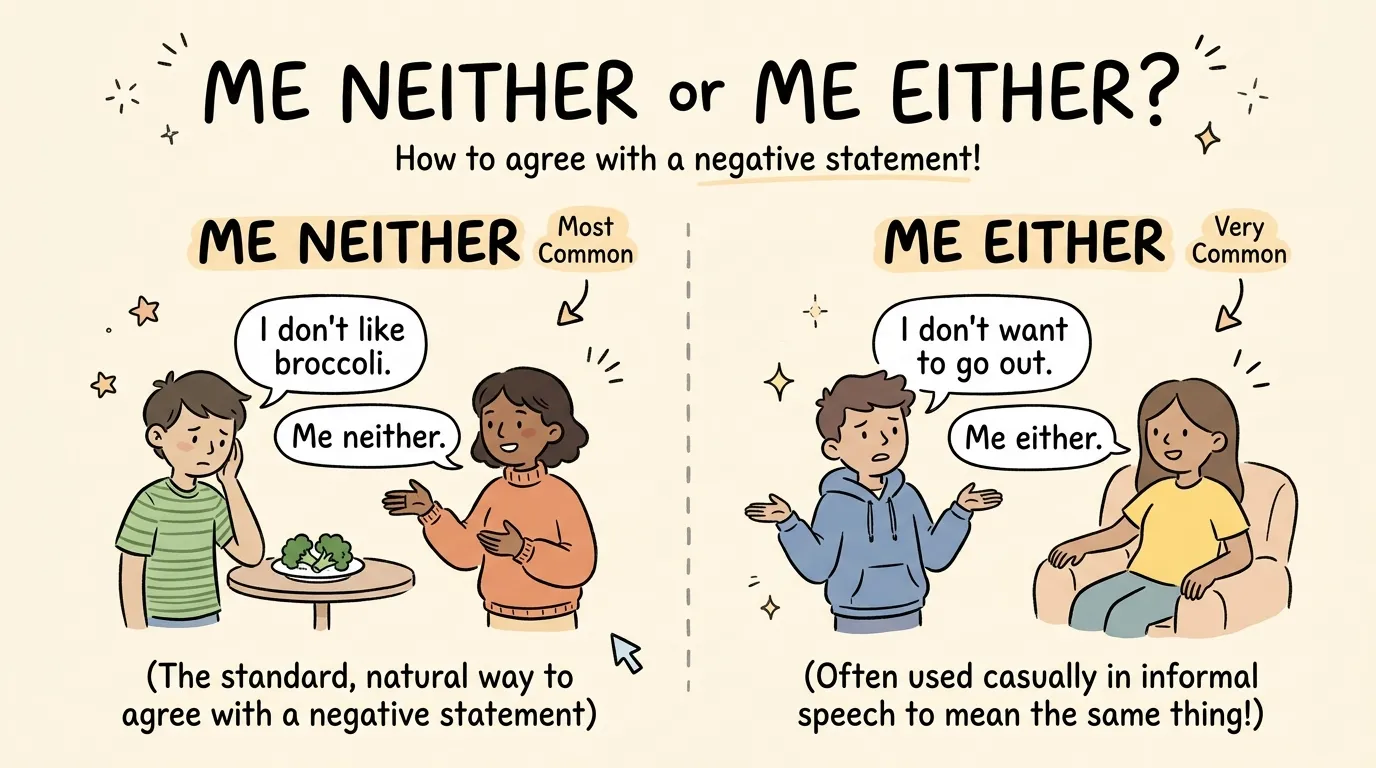
Is it me neither or me either? Both expressions are used in everyday English when someone wants to agree with a negative statement.
However, me neither is the safer and more widely accepted choice, while me either is also heard in some informal conversations.
For example, imagine your friend says, “I don’t like horror movies.” You can reply, “Me neither.” This means you don’t like horror movies either.
You can also say, “Neither do I” or “I don’t either.” These alternatives are useful when you want to express the same idea in a complete sentence.
The right expression depends on the context, your audience, and the style of English you want to use. Let’s look at the meanings, grammar rules, examples, and common mistakes.
Quick Answer: Me Neither or Me Either?
Me neither is the safer, widely accepted informal response to a negative statement. Me either is also used by some speakers in casual conversation, particularly in American English, although some people consider it nonstandard.
| Expression | Usage | Example |
| Me neither | Widely accepted informal reply | “I don’t like coffee.” “Me neither.” |
| Me either | Informal alternative used by some speakers | “I don’t like coffee.” “Me either.” |
| Neither do I | Standard negative agreement | “I don’t like coffee.” “Neither do I.” |
| I don’t either | Complete negative response | “I don’t like coffee.” “I don’t either.” |
Easy rule: Use me neither for a short, informal reply to a negative statement. In formal writing, choose a complete construction such as neither do I or I don’t either.
What Does Me Neither Mean?
Me neither is an informal expression used to show that you share another person’s negative feeling, experience, or situation. Depending on the original statement, it can mean “I don’t either,” “I can’t either,” or “I haven’t either.”
Here are some examples:
- “I don’t like spicy food.” — “Me neither.”
- “I can’t swim.” — “Me neither.”
- “I haven’t seen that movie.” — “Me neither.”
- “I’m not hungry.” — “Me neither.”
- “I don’t understand this question.” — “Me neither.”
In each example, the second speaker agrees with the negative meaning of the first statement.
Although me neither is a short expression rather than a full sentence, it is natural in everyday conversation. In more formal writing, you may prefer a complete response.
What Does Me Either Mean?
Me either is an informal expression that some English speakers use to agree with a negative statement. In this context, it generally communicates the same intended meaning as me neither.
For example:
Person A: I don’t want to go outside.
Person B: Me either.
The Person B means that they don’t want to go outside either.
You may hear this expression in casual conversations and text messages. However, its acceptance varies among speakers, teachers, and editors. If you want a response that is widely accepted across different English-speaking audiences, me neither is the safer choice.
More examples include:
- “I don’t like rainy weather.” — “Me either.”
- “I can’t find my phone.” — “Me either.”
- “I haven’t finished the book.” — “Me either.”
- “I’m not ready yet.” — “Me either.”
These examples show informal usage. For school assignments, professional writing, or situations where standard usage matters, consider using neither do I or a complete sentence with either.
Me Neither vs Me Either: Main Differences
The main difference is how widely each expression is accepted, rather than the intended meaning in a negative reply.
| Feature | Me Neither | Me Either |
| Main purpose | Agree with a negative statement | Informally agree with a negative statement |
| Typical setting | Casual conversation | Casual conversation |
| General acceptance | Widely accepted | Varies by speaker and context |
| Formal writing | A complete construction may be preferable | Usually avoid in formal writing |
| Example | “I don’t drive.” “Me neither.” | “I don’t drive.” “Me either.” |
Both expressions may be understood in casual conversation. However, me neither is the more reliable option when you want your English to sound natural to a broad audience.
When Should You Use Me Neither?
Use me neither when another person makes a negative statement and you want to express the same feeling or situation.
1. When you agree with a dislike
Example:
A: I don’t enjoy horror movies.
B: Me neither.
Both people dislike horror movies.
2. When you share an inability
Example:
A: I can’t ride a bicycle.
B: Me neither.
The second speaker also cannot ride a bicycle.
3. When you share an experience you have not had
Example:
A: I haven’t visited New York.
B: Me neither.
Neither speaker has visited New York.
4. When you share a feeling
Example:
A: I’m not feeling well today.
B: Me neither.
The second speaker also does not feel well.
5. When chatting with friends
Example:
Friend 1: I don’t want to study tonight.
Friend 2: Me neither!
This is a natural, informal way to agree with a friend.
When Should You Use Me Either?
You may encounter me either in informal speech, particularly when speakers use it naturally in their variety of English. However, it is not the best choice when you need a widely accepted standard expression.
For example:
A: I don’t want pizza tonight.
B: Me either.
The intended meaning is clear, but me neither is the safer alternative:
B: Me neither. Let’s order something else.
For essays, business emails, articles, and school assignments, use neither do I or a complete negative sentence with either.
Neither Do I vs I Don’t Either
You do not have to choose between me neither and me either. Two useful alternatives express the same general idea.
Neither do I
Use neither with the appropriate auxiliary verb, followed by the subject.
- “I don’t like coffee.” — “Neither do I.”
- “I can’t swim.” — “Neither can I.”
- “I haven’t finished.” — “Neither have I.”
- “I’m not ready.” — “Neither am I.”
Notice that the auxiliary verb changes to match the original statement.
I Don’t Either
You can also use a complete negative sentence with either.
- “I don’t like coffee.” — “I don’t either.”
- “I can’t swim.” — “I can’t either.”
- “I haven’t finished.” — “I haven’t either.”
- “I’m not ready.” — “I’m not either.”
Both patterns express negative agreement. Choose the correct auxiliary verb for the original sentence.
Me Too vs Me Neither
Do not confuse me too with me neither. The choice depends on whether the original statement is positive or negative.
| Original statement | Suitable response | Meaning |
| I love chocolate. | Me too. | I also love chocolate. |
| I don’t like chocolate. | Me neither. | I also don’t like chocolate. |
| I can swim. | So can I. | I can swim too. |
| I can’t swim. | Neither can I. | I can’t swim either. |
| I’ve visited Paris. | So have I. | I have visited Paris too. |
| I haven’t visited Paris. | Neither have I. | I haven’t visited Paris either. |
Remember: Use me too to agree with a positive statement and me neither to agree with a negative statement.
Common Mistakes to Avoid
1. Using me neither after a positive statement
Incorrect:
A: I love chocolate.
B: Me neither.
Correct:
A: I love chocolate.
B: Me too.
Use me too when you share a positive feeling or experience.
2. Assuming me either is never used
Some speakers use me either in informal conversation. It is too broad to claim that nobody uses it or that every listener considers it incorrect. However, me neither is the safer recommendation for general use.
3. Using the wrong auxiliary verb
Match the auxiliary verb to the original sentence.
- “I can’t drive.” — “Neither can I.”
- “I haven’t eaten.” — “Neither have I.”
- “I’m not tired.” — “Neither am I.”
Do not use neither do I for every negative statement. The correct auxiliary depends on the original sentence.
4. Using an awkward double negative
Avoid nonstandard constructions such as “I don’t like it neither” in standard English.
Better options include:
- “I don’t like it either.”
- “Me neither.”
- “Neither do I.”
5. Using informal replies in formal writing
Me neither is common in everyday conversation, but a complete sentence may suit academic or professional writing better.
Informal:
“I don’t agree with the proposal.” — “Me neither.”
More formal:
“I don’t agree with the proposal either.”
Choose the form that suits your audience and purpose.
How to Remember Me Neither or Me Either
Use this simple memory trick:
Negative statement + me neither.
- “I don’t drink tea.” — “Me neither.”
- “I can’t dance.” — “Me neither.”
- “I haven’t been there.” — “Me neither.”
For complete sentences, remember these patterns:
- Positive statement: Me too or So do I.
- Negative statement: Me neither or Neither do I.
- Complete negative response: I don’t either.
The auxiliary verb in a complete response must match the original statement.
Practice Quiz: Me Neither or Me Either?
Choose the best answer for each question.
1. “I don’t like cold weather.”
A. Me too.
B. Me neither.
2. “I love this song.”
A. Me too.
B. Me neither.
3. Which is the safer short reply for general informal English?
A. Me neither.
B. Me either.
4. “I can’t drive.”
A. Neither can I.
B. Neither do I.
5. “I haven’t finished my homework.”
A. Neither have I.
B. Neither am I.
Answers
- B — Me neither.
- A — Me too.
- A — Me neither.
- A — Neither can I.
- A — Neither have I.
FAQs
Is it me neither or me either?
Me neither is the safer, widely accepted informal reply to a negative statement. Me either is also used by some speakers, but others consider it nonstandard.
Is me either grammatically correct?
Its acceptance varies. Some speakers use it naturally in informal English, while others consider it nonstandard. For general writing, choose me neither or a complete construction such as I don’t either.
Can I say me neither in everyday conversation?
Yes. Me neither is a common informal response when you agree with a negative statement.
Is me neither formal or informal?
It is mainly an informal conversational expression. In formal writing, neither do I or I don’t either may be more appropriate.
Is me neither the same as neither do I?
Both express negative agreement, but their grammatical structures differ. Me neither is a short conversational reply, while neither do I uses an auxiliary verb and subject-auxiliary inversion.
Can I use me either in text messages?
You may encounter me either in casual text messages. However, me neither is the safer option if you want a widely accepted expression.
Should I say me too or me neither?
Use me too to agree with a positive statement and me neither to agree with a negative statement.
Is I don’t either correct?
Yes. I don’t either is a standard way to agree with a negative statement when the original sentence uses don’t.
What is the difference between neither do I and I don’t either?
Both express negative agreement. Neither do I uses subject-auxiliary inversion, while I don’t either follows normal subject-first word order.
Can I use me neither in American English?
Yes. Me neither is used and widely understood in American English. Me either also occurs in some informal conversations, but it is less universally accepted.
Conclusion
Both me neither and me either are heard when people agree with negative statements, but they are not equally accepted in every situation.
Me neither is the safer short reply for everyday English, while me either is an informal alternative that some speakers consider nonstandard.
For formal writing, use neither do I, neither can I, or a complete sentence such as I don’t either. Match the auxiliary verb to the original statement.

Hi, I’m Olivia Harper. I love turning complex English grammar into simple, practical lessons that help readers write and speak with confidence.