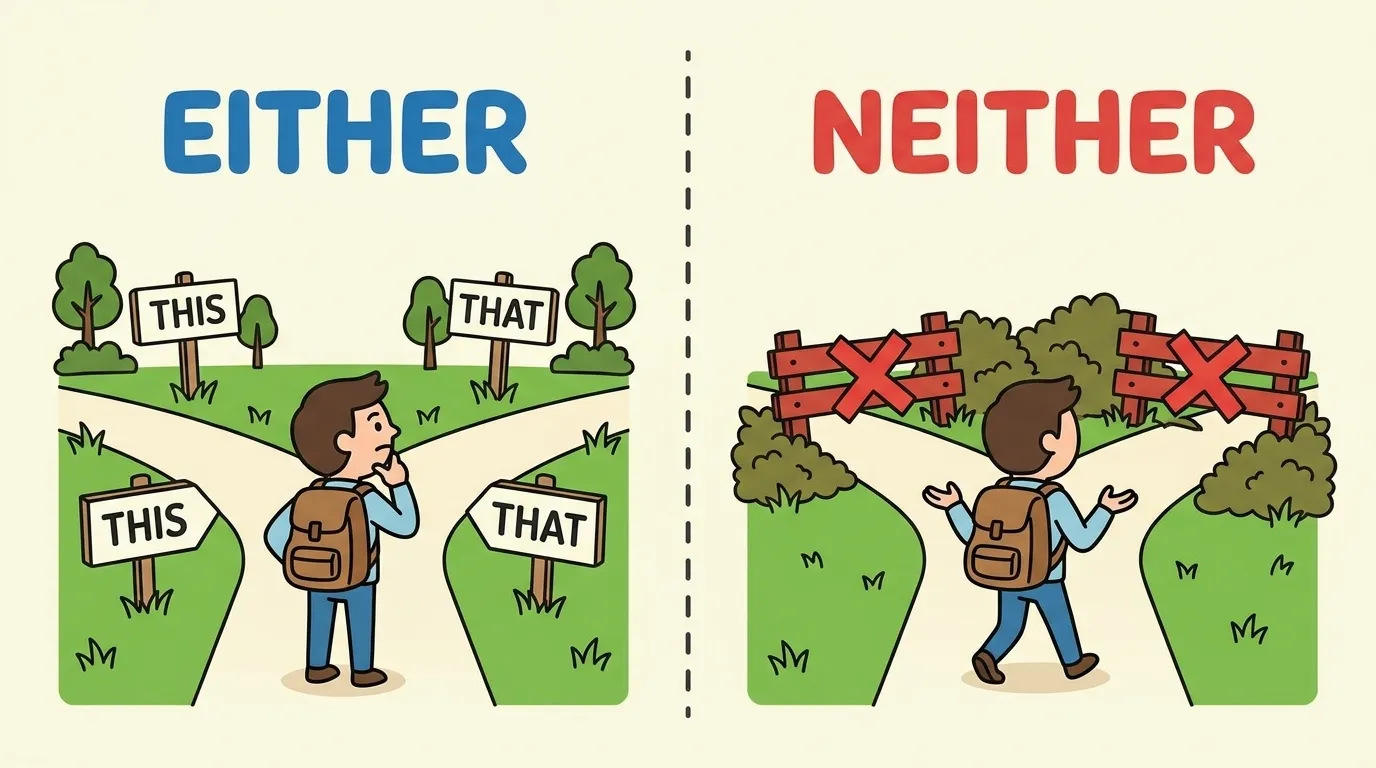
Are you confused about either or neither? These two words look similar, and both often refer to two people, things, or choices. However, they express different ideas.
Use either when you mean one of two options, when either choice is acceptable, or when adding a negative statement with the meaning “also not.” Use neither when you mean not one and not the other.
For example, “Either answer is correct” means both answers are acceptable choices. In contrast, “Neither answer is correct” means both answers are wrong.
Once you understand this difference, choosing the right word becomes much easier. This guide explains the meanings, grammar rules, sentence examples, and common mistakes to help you use either and neither correctly.
Quick Answer: Either or Neither?
Either means one or the other of two options. Neither means not one and not the other.
| Word | Meaning | Example |
| Either | One of two options; either choice is possible | Either dress looks good. |
| Neither | Not one and not the other | Neither dress fits me. |
| Either … or | Presents two alternatives | We can either walk or take a taxi. |
| Neither … nor | Rejects both alternatives | Neither Sam nor Alex called. |
Easy rule: Use either to choose between two possibilities. Use neither to reject both.
What Does Either Mean?
Either is used when referring to two people, things, or possibilities. Depending on the sentence, it can mean one of two options, either choice, or “also” in a negative statement.
1. Either Means One of Two Choices
Use either when both options are possible or acceptable.
Examples:
- Either answer is acceptable.
- You can choose either shirt.
- Either road will take you to the station.
- Either candidate could win the election.
In these examples, you can choose one option from two.
2. Either … Or Presents Two Alternatives
The structure either … or connects two choices or possibilities.
Examples:
- We can either eat at home or go to a restaurant.
- You can either call me or send a message.
- Either Mia or Daniel will lead the meeting.
- You must either finish the work today or ask for more time.
Try to connect items that have the same grammatical structure. For example, “She likes either reading or writing” pairs two activities.
3. Either Can Mean “Also” in a Negative Sentence
You can use either at the end of a negative sentence to mean “also not.”
Examples:
- I don’t like coffee, and my brother doesn’t either.
- She isn’t ready, and I am not either.
- He didn’t call me, and he didn’t text me either.
Notice that the sentence already contains a negative verb. In this pattern, either adds another negative idea.
What Does Neither Mean?
Neither means not one and not the other of two people or things. It is useful when both choices are rejected or when something does not apply to either member of a pair.
1. Neither Means Not One and Not the Other
Examples:
- Neither answer is correct.
- Neither restaurant is open.
- Neither student knew the answer.
- Neither option works for me.
In each sentence, both possibilities are ruled out.
2. Neither … Nor Connects Two Negative Alternatives
Use neither … nor to say that two people or things are both excluded.
Examples:
- Neither John nor Mark attended the meeting.
- Neither the manager nor the employees knew about the change.
- She likes neither coffee nor tea.
- Neither my phone nor my laptop is working.
This structure is often more concise than writing two separate negative statements.
Remember: The standard pairings are either … or and neither … nor.
3. Neither Can Agree With a Negative Statement
When someone says something negative, you can use neither to say that the same is true for you.
Examples:
- Person A: “I don’t like spicy food.”
- Person B: “Neither do I.”
Another example:
- Person A: “I’m not tired.”
- Person B: “Neither am I.”
The auxiliary verb changes according to the original sentence. Use do with many present-tense action verbs, did for past actions, and am/is/are with the verb be.
In casual conversation, “Me neither” is also a common response.
Either vs Neither: Key Differences
| Feature | Either | Neither |
| Main meaning | One or the other | Not one and not the other |
| Typical use | Choices and alternatives | Rejecting both alternatives |
| Common pairing | Either … or | Neither … nor |
| Negative agreement | I don’t either. | Neither do I. |
| Example | Either option is fine. | Neither option is suitable. |
The biggest difference is the meaning you want to express. Either allows a choice; neither rules out both choices.
Either of Us or Neither of Us?
Both expressions are correct, but they mean different things.
Either of us refers to one person or the other from a group of two.
Examples:
- Either of us can drive.
- Either of us could answer the question.
- You can ask either of us for help.
Neither of us means that the statement applies to neither person.
Examples:
- Neither of us is ready.
- Neither of us knows the answer.
- Neither of us wants to leave early.
In formal writing, either of us and neither of us normally take a singular verb. In informal speech, you may hear plural agreement with neither of, but singular agreement is a safe choice for formal writing.
Either Is or Either Are? Neither Is or Neither Are?
When either or neither is the subject of a sentence, a singular verb is generally preferred in standard formal English.
Correct examples:
- Either answer is acceptable.
- Neither answer is correct.
- Either of the options is suitable.
- Neither of the options is available.
Avoid using a plural verb simply because the sentence refers to two things.
When either … or or neither … nor connects two subjects, verb agreement can depend on the subjects and their relationship to the verb. If the subjects differ in number, many formal grammar guides recommend matching the verb to the nearer subject. For clearer writing, you can often rewrite the sentence to avoid awkward agreement.
Common Mistakes to Avoid
Mistake 1: Mixing Either … Nor and Neither … Or
Incorrect: Either Monday nor Tuesday works for me.
Correct: Either Monday or Tuesday works for me.
Also correct: Neither Monday nor Tuesday works for me.
Use either with or and neither with nor.
Mistake 2: Using Neither to Accept a Choice
Incorrect: “Which dessert would you like?” “Neither, please,” when you actually want one of the desserts.
Correct: “Either is fine.”
Use either when you are willing to accept one of the two options. Use neither when you want none of them.
Mistake 3: Using Neither to Agree With a Positive Statement
Incorrect:
- Person A: “I love reading.”
- Person B: “Neither do I.”
Correct:
- Person A: “I love reading.”
- Person B: “So do I.”
Use neither do I to agree with a negative statement, not a positive one.
Mistake 4: Adding an Unnecessary Negative
Incorrect: I don’t like neither option.
Correct: I like neither option.
Also correct: I don’t like either option.
In standard English, avoid combining not and neither to express the same negative idea. Choose one of the two correct patterns.
Mistake 5: Using Neither for Three or More Options
When discussing two options, neither is appropriate. When discussing three or more, none is usually the better choice.
- Two choices: Neither answer is correct.
- Three choices: None of the answers is correct.
An Easy Trick to Remember Either vs Neither
Use this simple memory trick:
- Either = one of two.
- Neither = not either one.
Imagine that you have two cups of tea.
If both cups are acceptable and you are willing to drink either one, say, “Either cup is fine.”
If you do not want tea from either cup, say, “Neither cup is fine for me.”
You can also remember the common pairs:
- Either … or = a choice.
- Neither … nor = neither option is included.
These patterns will help you choose the right word in most everyday sentences.
Practice Quiz: Either or Neither?
Choose the correct answer for each sentence.
1. ______ option is acceptable, so choose the one you prefer.
a) Either
b) Neither
2. ______ of the two keys opens the door.
a) Either
b) Neither
3. You can ______ stay here or come with us.
a) either
b) neither
4. ______ Emma nor Jack attended the meeting.
a) Either
b) Neither
5. “I don’t enjoy horror movies.” “______ do I.”
a) Either
b) Neither
6. I don’t want ______ of those two shirts.
a) either
b) neither
7. ______ of the two answers is correct.
a) Either
b) Neither
8. I haven’t finished the book, and my sister hasn’t ______.
a) neither
b) either
Answers and Explanations
- a) Either — Both options are acceptable.
- b) Neither — Neither key opens the door.
- a) either — The sentence presents two alternatives with or.
- b) Neither — Neither … nor excludes both people.
- b) Neither — Neither do I agrees with the negative statement.
- a) either — After don’t want, either refers to both options being unwanted.
- b) Neither — Both answers are incorrect.
- b) either — Either is used after the negative verb hasn’t.
FAQs
1. What is the main difference between either and neither?
Either refers to one of two options, while neither means not one and not the other. For example, “Either choice works” accepts both possibilities, but “Neither choice works” rejects both.
2. Is it either or or neither nor?
Both pairings are correct. Use either … or to present alternatives and neither … nor to exclude both alternatives.
3. Is it neither of us is or are?
In formal writing, neither of us is is the safest choice. Plural agreement appears in informal speech, but singular agreement is generally preferred in formal contexts.
4. Can I say “Me neither”?
Yes. “Me neither” is a common informal response to a negative statement. For example, “I don’t like cold weather.” “Me neither.”
5. Can either mean both?
In some contexts, yes. For example, “There were trees on either side of the road” means there were trees on both sides. The exact meaning depends on the sentence.
6. Should I use either or neither in a negative sentence?
Use either after a negative verb to mean “also not,” as in “I don’t like it either.” Use neither to mean that neither of two options applies, as in “Neither option is suitable.”
7. Is “I don’t like neither” correct?
In standard English, avoid this double-negative construction. Say “I like neither option” or “I don’t like either option.”
8. Do either and neither take singular verbs?
When either or neither is the subject, singular verbs are generally preferred in formal English. For example, “Either answer is correct” and “Neither answer is correct.”
9. Is neither used for two or more things?
Neither normally refers to two people or things. For three or more options, use none when you mean that not one option applies.
10. How do I remember either or neither?
Remember that either offers a choice between two possibilities, while neither rejects both. Pair either with or and neither with nor.
Conclusion
Choosing between either or neither becomes easier when you focus on the meaning. Use either when one of two options is possible or acceptable.
Use neither when both options are rejected. Remember the pairings either … or and neither … nor, and use singular verbs with either and neither in formal writing when they are the subject.
With these simple rules and examples, you can use both words more confidently in school assignments, professional emails, and everyday conversations.
Key Takeaways
- Either means one or the other of two choices.
- Neither means not one and not the other.
- Use either … or to present alternatives.
- Use neither … nor to exclude both alternatives.
- Use either after a negative verb to mean “also not.”
- Prefer singular verbs with either and neither in formal writing.

Hi, I’m Olivia Harper. I love turning complex English grammar into simple, practical lessons that help readers write and speak with confidence.