You type “we support eachother” and it looks fine.
After all, “everyone” and “anyone” are single words, so why not this one?
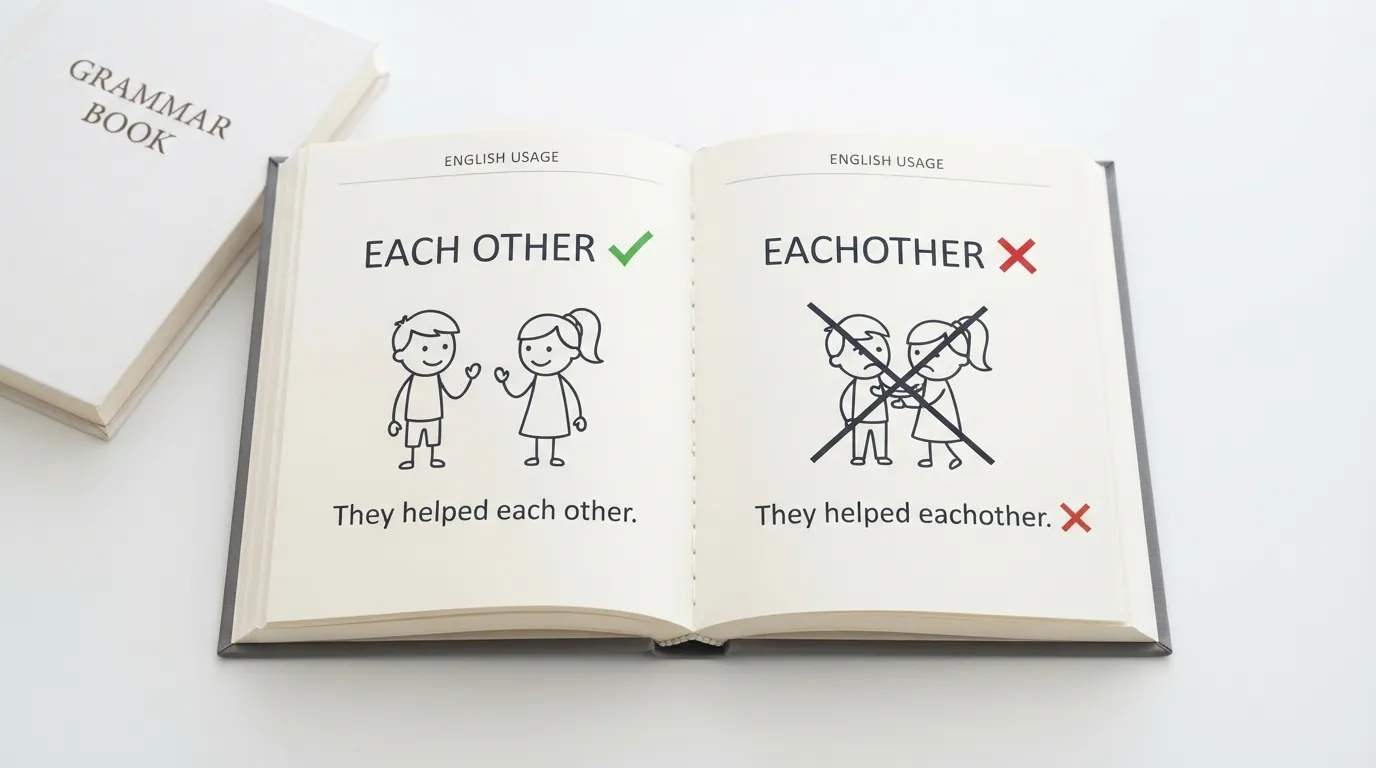
Here’s the quick answer: each other is always two separate words.
“Eachother” is a common misspelling, not an accepted form in any style guide.
Did You Know? 🔍
“Each other” has stayed two separate words since Middle English.
Other similar phrases like “everyone” and “anyone” merged into single words over time.
Despite that, it’s never made the same shift, according to grammar references like GrammarBook.com.
Quick Answer Box
Each other is always spelled as two words.
Eachother, written as one word, is incorrect in standard English.
It isn’t accepted by any major dictionary or style guide, in either American or British English.
⚡ Quick Rule in 1 Line
“Each other” stays two words always — no dictionary or style guide accepts “eachother” as one.
Why People Confuse Each Other and Eachother
The mix-up happens because English has plenty of compound words that merged over time, like “everyone,” “anyone,” and “together.”
It’s natural to assume “each other” followed the same pattern.
It hasn’t — dictionaries and grammar guides have never accepted “eachother” as a standard spelling.
Is “Each Other” a Compound Word?
No. A compound word joins two words into one, like “someone” or “notebook.” “Each other” is a reciprocal pronoun, and it is written as two separate words in standard English.
Why It Looks Like It Could Be One Word
Because “each” and “other” almost always appear together, the pair can feel like a single unit. That is true in meaning, but spelling hasn’t followed. Dictionaries list the two words separately.
What Each Other Actually Means
“Each other” is a reciprocal pronoun, used to show a mutual action or relationship between two or more people or things.
For example, in “The dogs played with each other,” the phrase shows that the dogs interacted mutually, not independently.
Is “Each Other” a Noun or a Pronoun?
It is a pronoun, specifically a reciprocal pronoun. It stands in for the people or things involved in a two-way action, so it usually works as the object of a verb or preposition.
- “They hugged each other.” (object of the verb)
- “They argued with each other.” (object of the preposition)
Can “Each Other” Be the Subject?
Not normally. A sentence like “Each other helped” doesn’t work. The people doing the action are the subject (“They helped each other”), and “each other” receives it.
Each Other’s or Each Others’? The Apostrophe Placement
The correct possessive form is always ‘each other’s,’ with the apostrophe placed before the ‘s,’ never after it.
‘Each others,” with the apostrophe after the ‘s,’ is incorrect and shows up as a common mistake.
Writers sometimes assume ‘other’ is being pluralized the way a regular noun would be.
The reason it’s never ‘each others” is that ‘other’ in this phrase isn’t a plural noun being made possessive, the way ‘the dogs’ toys’ works for multiple dogs.
‘Each other’ functions together as a single reciprocal pronoun.
So the possessive ‘s’ always attaches directly to ‘other,’ with the apostrophe coming right before it, regardless of how many people or things are involved.
❌ ‘They respected each others’ opinions.’
✅ ‘They respected each other’s opinions.’
Does “Each Other” Have a Plural Form?
No. “Each other” already refers to two or more people or things, so it never takes a plural ending.
Why “Each Others” Is Wrong
Adding an “s” to “other” turns the phrase into something that doesn’t exist in standard grammar. If you want to show possession, use “each other’s,” with the apostrophe before the “s.”
- ❌ They borrowed each others books.
- ✅ They borrowed each other’s books.
Each Other’s vs Others’
These two are different things. “Each other’s” shows mutual possession between the people involved: “They respect each other’s opinions.” “Others'” refers to people in general who aren’t part of the action: “She respects others’ opinions.”
Comparison Table
| Form | Correct? | Notes |
|---|---|---|
| Each other | ✅ Correct | Standard reciprocal pronoun, always two words |
| Eachother | ❌ Incorrect | Common misspelling, not in any dictionary |
| Each other’s | ✅ Correct | Possessive form, apostrophe before the “s” |
| Each others | ❌ Incorrect | Missing apostrophe, incorrect possessive form |
| Each others’ | ❌ Incorrect | Apostrophe in the wrong place, after the “s” |
| Eachothers / Eachother’s | ❌ Incorrect | One-word spelling is never accepted, even with an apostrophe |
Example Sentences
The couple sang to each other at the karaoke bar.
We will see each other as soon as I’m back from my trip.
The cats chased each other around the yard.
You and your coworker should respect each other.
The birds were singing to each other at dawn.
The siblings support each other through difficult times.
They listened to each other’s opinions before deciding.
The two countries depend on each other for trade.
The teams shook hands and thanked each other after the game.
Good friends check in on each other regularly.
❌ Incorrect: “The dogs played with eachother in the yard.”
✅ Correct: “The dogs played with each other in the yard.”
❌ Incorrect: “They held each others hands.”
✅ Correct: “They held each other’s hands.”
Common Mistakes
Writing “eachother” as one word, which is never correct in standard English.
Dropping the apostrophe in the possessive form, writing “each others” instead of “each other’s.”
Placing the apostrophe after the “s,” writing “each others'” instead of “each other’s.”
Writing “each others'” or “each other’s'” when the correct possessive is simply “each other’s.”
Assuming autocorrect or spellcheck will catch the mistake — many tools do flag it, but not all.
Each Other vs One Another
“Each other” and “one another” are both reciprocal pronouns and are often used interchangeably.
Some traditional style guides suggest using “each other” for two people or things and “one another” for three or more.
This distinction isn’t strictly enforced in modern English.
Synonyms for “Each Other”
Several phrases can replace “each other,” depending on tone and context.
| Synonym | When to use it | Example |
|---|---|---|
| One another | The closest match. Works in nearly every sentence where “each other” does, and takes the same possessive pattern: “one another’s.” | They trust one another. |
| Mutually / reciprocally | Adverbs, so the sentence structure changes. | They mutually respect one another. |
| Between themselves / among themselves | Stresses a private or internal exchange. | The team settled it among themselves. |
Expert Tip 💡
If you’re ever unsure, remember that “each” and “other” each carry their own grammatical role in the sentence.
That separation is exactly why the phrase has never merged into one word, unlike “everyone” or “anyone.”
Practice Quiz: Test Yourself
Choose the correct option in each sentence.
- The two friends always support (each other / eachother).
- They read (each others / each other’s) messages.
- The neighbors waved at (each other / each-other).
- The players praised (each other’s / each others’) efforts.
Answers
- each other
- each other’s
- each other
- each other’s
FAQs
Is “eachother” ever correct?
No, it’s always considered a spelling mistake.
Standard English uses “each other” as two separate words in every context.
Is “eachother” a word?
No. It has no meaning of its own.
It’s just a misspelling of “each other.”
How do you spell “each other”?
E-A-C-H, then a space, then O-T-H-E-R.
Two words, no hyphen.
Is it “each-other” with a hyphen?
No. It’s always two separate words with a space.
It’s never hyphenated and never joined.
What is the possessive form of each other?
The possessive form is “each other’s,” with the apostrophe placed before the “s.”
Is each other one word in British English?
No, both British and American English use “each other” as two words.
There’s no regional difference for this phrase.
What does “each other” mean grammatically?
It’s a reciprocal pronoun that shows a mutual action or relationship between two or more people or things.
Is “each other” the same as “one another”?
They’re very similar and often interchangeable.
Some traditional guides reserve “one another” for three or more participants.
Why do people think eachother might be one word?
Because similar words like “everyone” and “anyone” did merge into single words over time.
So it’s an easy, if incorrect, assumption.
Does spellcheck always catch “eachother”?
Most modern spellcheck and grammar tools do flag it, but not all.
It’s still worth knowing the rule instead of relying only on software.
Can “each other” be used in formal writing?
Yes, “each other” is standard in all registers of writing, from casual texting to academic and professional writing.
Does “each other’s” ever take the apostrophe after the “s”?
No. The correct form is always “each other’s,” apostrophe before the “s.”
“Each others’,” with the apostrophe after, is incorrect, since “other” isn’t a plural noun being made possessive.
Is it “each others” or “each other’s”?
“Each other’s” is correct when showing possession, as in “each other’s opinions.”
“Each others,” with no apostrophe at all, is incorrect in every context.
Does “each other” have a plural?
No. It already refers to two or more people or things, so adding an “s” is incorrect. Use “each other’s” for the possessive.
Is “each other” a noun?
No. It is a reciprocal pronoun, not a noun.
Is “each other” a compound word?
No. It stays as two separate words, unlike compounds such as “someone” or “anybody.”
Is it “each other’s” or “others'”?
They mean different things. “Each other’s” shows mutual possession between the people involved, as in “They respect each other’s opinions.” “Others'” refers to people in general, as in “She respects others’ opinions.”
What is a synonym for “each other”?
The most common synonym is “one another.” Other options include “mutually,” “reciprocally,” and “among themselves,” though these may need the sentence to be reworded.
Can “each other” be the subject of a sentence?
Usually not. It normally acts as an object, as in “They trust each other.”
Is “as well” also written as two words?
Yes. Like “each other,” it is written as two words in standard English, and “aswell” is a common misspelling.
Is it acceptable to write “eachother” in a text message or social media post?
It is very common in informal typing, but it is still a misspelling. In any writing where spelling matters, use “each other.”
Conclusion
“Each other” is always two separate words, no matter how casually or formally you’re writing.
“Eachother” has never been accepted by any dictionary or style guide.
Remember the apostrophe goes before the “s” in “each other’s,” and you’ll always get this reciprocal pronoun right.

Hi, I’m Sophia Bennett. My goal is to make grammar easy, clear, and useful through simple explanations and real-life examples.